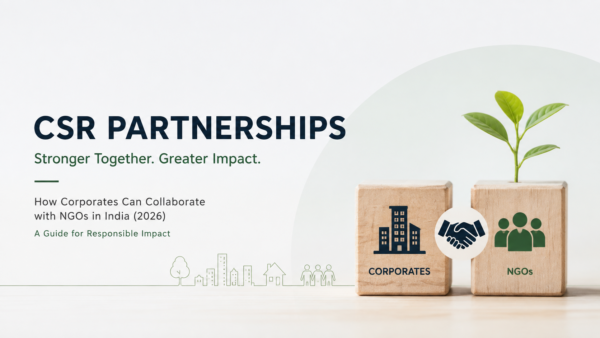
Every year, Indian companies collectively deploy over ₹25,000 crore in mandated CSR spending. Yet a significant share of that budget goes underutilized, misdirected, or trapped in compliance friction — not because companies lack intent, but because most CSR teams are navigating NGO partnerships without a clear playbook.
If you’re a CSR manager, sustainability lead, or trustee of a corporate foundation, this guide walks through exactly how to identify, vet, structure, and manage a CSR-NGO partnership in India — from the legal groundwork under the Companies Act to writing an MOU that protects both sides, to reporting impact your board will actually trust.
CSR in India has moved past its early “check-writing” phase. The Ministry of Corporate Affairs (MCA) has tightened disclosure norms, unspent-fund rules, and impact-reporting expectations year over year. At the same time, companies are under growing pressure — from investors, regulators, and employees — to show CSR spending translates into measurable, credible outcomes.
That shift changes what a “good” NGO partner looks like. It’s no longer enough for an NGO to be registered and willing. Corporates now need partners who are compliant, transparent, capable of absorbing funds at scale, and able to report back in a form the CSR committee can defend to the board.
Any conversation about CSR partnerships in India starts with Section 135 of the Companies Act, 2013, and the Companies (Corporate Social Responsibility Policy) Rules, 2014 (amended multiple times since, most notably in 2021).
A company is required to constitute a CSR Committee and spend on CSR if, in the immediately preceding financial year, it meets any one of these thresholds:
At least 2% of the average net profit of the company made during the three immediately preceding financial years (or since incorporation, for newer companies).
Spending must fall within the activities listed in Schedule VII of the Act — this includes eradicating hunger and poverty, promoting education, gender equality, environmental sustainability, healthcare, rural development, and several other categories. Spending outside Schedule VII, or spending that primarily benefits the company’s own employees or their families, does not qualify.
Since the 2021 amendment, unspent CSR amounts for ongoing projects must be transferred to a separate “Unspent CSR Account” within 30 days of the financial year-end and utilized within three financial years, or transferred to a fund specified in Schedule VII (such as the PM CARES Fund). Amounts not linked to an ongoing project must be transferred to a Schedule VII fund within six months. This makes NGO partner selection time-sensitive — funds sitting idle due to a slow or unprepared NGO partner directly creates compliance risk for the company.
Companies must file Form CSR-2 as an addendum to their annual financial statement, and the CSR Committee’s report must be part of the Board’s Report, detailing amount spent, unspent amount, project-wise breakup, and the implementing agency used.
For a deeper compliance walkthrough on the NGO side of this relationship, see our NGO Compliance Checklist on weforworld.org.
Companies can technically implement CSR directly, but most choose to route funds through NGOs or foundations. Here’s why:
This is the step most CSR teams either skip or rush — and it’s the single biggest source of compliance risk. Before any partnership discussion goes further, verify the NGO holds:
| Requirement | What It Confirms |
| CSR-1 Registration (Form CSR-1 with MCA) | Mandatory since April 2021 — an NGO cannot legally receive CSR funds from a company unless it has filed Form CSR-1 and holds a valid CSR Registration Number. This is the single non-negotiable checkpoint. |
| 12A Registration | Confirms the NGO’s income is exempt from income tax, and that it is recognized as a genuine charitable entity. |
| 80G Certification | Confirms the corporate can claim tax benefits on the contribution — always confirm whether it is 80G(5) valid and its expiry/renewal status, since 80G is no longer a one-time lifetime registration. |
| Registration under Trust / Society / Section 8 | Confirms the NGO’s legal structure and that its governing documents permit the activities you’re funding. |
| NGO Darpan ID (NITI Aayog) | Increasingly used by government and larger corporates as a baseline credibility and transparency check, especially for government-linked CSR routing. |
| FCRA Registration (only if relevant) | Required only if the NGO also receives foreign contributions — not directly relevant to domestic CSR funding, but a useful signal of overall compliance maturity. |
Practical tip: Ask the NGO to share their CSR-1 acknowledgment number and 12A/80G certificates upfront, before any project discussion. A credible NGO will have these ready instantly — hesitation or delay here is itself a red flag.
Beyond legal eligibility, evaluate prospective NGO partners against these dimensions:
How long has the NGO been operational? Request past project reports, not just testimonials. An NGO operating since 2003, for instance, carries a different risk profile than one registered eighteen months ago — longevity is a reasonable (though not sole) proxy for institutional stability.
Ask for the last 2–3 years of audited financial statements and annual reports. Look at the ratio of program spending to administrative/overhead spending — most credible NGOs will be transparent about this without prompting.
Does the NGO’s existing work align with your company’s CSR policy focus areas (education, healthcare, environment, livelihoods, women’s empowerment, etc.) and your operational geography? Partnering with an NGO active in your plant locations or markets often strengthens the CSR narrative for stakeholders.
Does the NGO have a documented M&E framework, or does impact reporting consist of photos and anecdotes? For larger CSR allocations, MCA rules require impact assessment by an independent agency for projects with an outlay of ₹1 crore or more (for companies meeting certain thresholds) — your NGO partner should already be structured to support this kind of assessment.
Review the NGO’s board composition, conflict-of-interest policies, and whether statutory filings (Form 10B, ITR, annual returns) are current and on time.
Speak to at least one existing corporate partner of the NGO, if possible. Ask specifically about fund utilization timelines, reporting consistency, and responsiveness — not just “impact.”
Not every partnership needs to look the same. Depending on your company’s CSR policy, budget, and internal bandwidth, consider:
A well-drafted MOU protects both the company and the NGO, and gives your CSR Committee a defensible compliance trail. At minimum, include:
Our NGO Legal Guide on Contracts, MOUs & Agreements covers this from the NGO’s side of the table, which is useful reading for CSR teams too — it shows you what a well-prepared partner organization should already have in place.
Boards and regulators increasingly expect outcome data, not just output data. The distinction matters:
Ask your NGO partner to report on both, and to define success metrics before the project begins, not retrospectively. For larger allocations, factor in the mandatory independent impact assessment requirement under the CSR Rules, and budget for it as part of the overall project cost (assessment costs can be included within the CSR spend, up to prescribed limits).
We For World Foundation has been operating since 2003, is NITI Aayog registered and 80G certified, and runs active, on-ground programs across education, healthcare, women’s empowerment, environmental sustainability, and community development — including tree plantation drives, beach clean-ups, food distribution programs, and MSME upliftment initiatives across Mumbai and beyond.
For CSR teams evaluating a partner, WFWF offers exactly the profile this guide describes: verified compliance documentation, a multi-year operational track record, structured reporting, and program areas that map directly onto Schedule VII categories.
If your company is exploring a CSR partnership for 2026, get in touch with our team — we’re happy to walk through fit, past project reports, and how a partnership could be structured around your CSR policy and budget cycle.
Is CSR spending mandatory for all companies in India?
No — only companies meeting the net worth, turnover, or net profit thresholds under Section 135 of the Companies Act, 2013 are required to spend on CSR.
Can a company implement CSR directly without an NGO?
Yes, companies may implement CSR directly, through their own foundation, or through a registered implementing agency (including NGOs). Most companies use NGOs for execution capability and domain expertise.
What happens if a company doesn’t spend its full CSR obligation?
Unspent amounts for ongoing projects must be transferred to a designated Unspent CSR Account and utilized within three financial years. Amounts not linked to an ongoing project must be transferred to a Schedule VII fund within six months of the financial year-end. Non-compliance can attract penalties under the Companies Act.
Can CSR funds be used to cover an NGO’s administrative costs?
CSR Rules allow a limited portion of project costs to go toward administrative overheads of the implementing agency, subject to prescribed limits — this should be clearly itemized in the project budget and MOU rather than left implicit.
Is impact assessment mandatory for every CSR project?
Independent impact assessment is mandatory for CSR projects with an outlay of ₹1 crore or more, undertaken in the preceding three financial years, for companies meeting specified turnover/CSR spend thresholds. Companies below the threshold can still choose to commission assessments voluntarily.
How do I verify an NGO’s CSR-1 status before partnering?
Ask the NGO for their CSR Registration Number and Form CSR-1 acknowledgment, issued by the Ministry of Corporate Affairs. This registration is a legal prerequisite for the NGO to receive CSR funds from any company.
Looking to structure a CSR partnership for your company in 2026?
Contact We For World Foundation — weforworld.org/contact-us