They study for years, prepare for competitive examinations, learn new skills, migrate to cities, start small businesses, take internships and increasingly look toward technology to improve their prospects.
Yet for millions of young Indians, the idea of a secure government job continues to represent something larger than employment: stability, dignity, social status and a predictable future.
That aspiration should not be dismissed.
But it raises a bigger question for India in 2026:
Can the country create enough good-quality opportunities that young people do not feel their only path to a secure future is a government job?
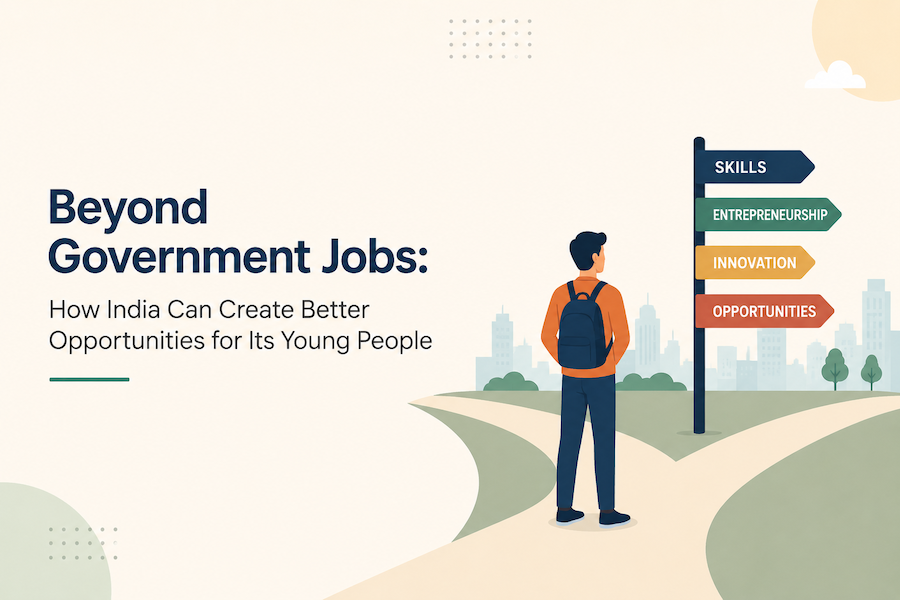
The answer will depend on much more than the number of vacancies announced each year. It will depend on whether India can create an economy in which young people can build careers through private employment, entrepreneurship, skilled trades, social enterprises, technology, agriculture, creative industries and other forms of productive work.
This is not an argument against government employment.
It is an argument for creating more choices.
For many Indian families, a government job carries an unusual level of importance.
It can mean:
Therefore, simply telling young people to “look elsewhere” misses the point.
The real issue is whether alternatives provide comparable dignity, stability and opportunity.
If a young graduate chooses between a highly competitive government examination and a private-sector job with uncertain employment, limited growth and poor working conditions, the choice is understandable.
India therefore needs to improve the quality of the alternatives—not merely tell young people to accept them.
India’s employment picture is not simply a story of “no jobs.”
Recent government and international assessments point to a more complicated picture involving participation in the labour market, skills, productivity, job quality and the transition from education to employment.
The World Bank noted in June 2026 that around 11 million young people are expected to enter India’s labour market every year over the next two decades, highlighting the scale of the opportunity—and the challenge—of creating productive employment.
The International Labour Organization’s India Employment Report 2024 similarly examined youth employment through the interconnected issues of education and skills.
This means India’s challenge is not simply:
How do we give young people jobs?
It is:
How do we create enough productive, dignified and sustainable opportunities for young people to build independent lives?
That is a much bigger question.
India needs millions of young people to see private employment not as something they accept after failing to obtain a government job, but as a legitimate and rewarding career path.
That requires employers to compete for talent through:
A young graduate should be able to look at a private-sector career and see a future, not simply a first salary.
The government’s own employment and skilling agenda increasingly recognizes the importance of industry-relevant skills and private-sector opportunities.
One of India’s biggest social challenges is the hierarchy we have created around education.
A university degree is often treated as superior to practical skills.
But a country needs far more than graduates.
It needs:
A skilled worker should not be considered unsuccessful simply because they did not pursue a traditional degree.
Skill must become a source of dignity.
India’s demographic advantage becomes meaningful only when young people can convert their abilities into productive livelihoods.
One of the biggest gaps facing young people is the distance between what they learn and what employers need.
A degree can demonstrate that someone completed an educational programme.
It does not automatically demonstrate that they can:
Education and employment therefore need to become more closely connected.
Colleges, employers, training institutions, NGOs and governments can work together to provide:
learning → practical experience → mentorship → portfolio → employment
rather than:
education → graduation → job search
Not every young person will follow the same path.
Some will become engineers.
Some will work in manufacturing.
Some will build businesses.
Some will work in healthcare.
Some will become teachers.
Some will enter the creative economy.
Some will work in agriculture.
Some will become social entrepreneurs.
Others will develop careers that barely exist today.
The role of India’s development system should therefore be to create multiple pathways to a dignified livelihood.
That includes apprenticeships, internships, entrepreneurship, vocational education, community-based enterprises and flexible skill-development programmes.
Entrepreneurship is often presented through the image of a technology startup founder.
But entrepreneurship can be much smaller—and much more important to communities.
A young person opening:
is also creating economic value.
India’s millions of small businesses and MSMEs can become an important part of the youth employment story.
The challenge is ensuring young entrepreneurs can access:
Artificial intelligence is rapidly changing the skills young people need.
On India’s Independence Day in 2026, the government announced a plan for AI training for one crore young Indians, alongside other youth-focused initiatives.
But AI training alone will not solve the employment challenge.
A young person also needs:
education + digital access + practical skills + human skills + opportunity.
AI should help a student learn faster, help a small business compete, help a teacher create better learning material and help an NGO reach communities more effectively.
But access to AI cannot become another divide between young people who have resources and those who do not.
The objective should be inclusive digital opportunity.
Mumbai is one of India’s most important economic centres.
It offers opportunities across:
But the city also demonstrates the challenges young people face.
High living costs, competition, unequal access to education and differences in digital and professional networks can determine who benefits from economic growth.
The lesson for Mumbai is relevant to India as a whole:
Creating jobs is not enough if young people cannot realistically access them.
Opportunity must also be accessible.
India cannot fully benefit from its young population if large numbers of young women remain outside meaningful economic opportunity.
This requires more than skill programmes.
Women also need:
For many young women, the barrier is not ability.
It is the structure surrounding employment.
A stronger youth employment strategy must therefore be a women’s empowerment strategy too.
Government and business cannot solve India’s youth opportunity challenge alone.
Civil society organisations have an important role.
NGOs can work at the community level to identify young people who may otherwise remain disconnected from opportunity.
They can help with:
For organisations such as We For World Foundation, this creates an important area of social impact:
helping young people move from potential to opportunity.
The objective is not simply to provide temporary assistance.
It is to help build the skills, confidence and connections that allow people to become economically independent.
The success of India’s youth employment strategy should not be measured only by:
How many jobs were announced?
We should ask better questions.
These measures tell us much more about whether India’s demographic dividend is actually being converted into human development.
India does not need to convince its young people to stop dreaming about government jobs.
It needs to make the world beyond government employment worth dreaming about too.
That means creating an economy where a young person can say:
“I can build a good life here.”
Whether that life comes through a government department, a factory, a technology company, a hospital, a school, a small business, a farm enterprise, a social organisation or a business of their own should matter less than whether the opportunity is productive, dignified and sustainable.
India’s demographic advantage is often described in terms of numbers.
But numbers alone do not create development.
People do.
Young Indians need more than employment.
They need pathways to independence, skills, dignity and purpose.
The task before India is therefore not simply to create more government jobs.
It is to create more futures.
At We For World Foundation, we believe development should expand people’s ability to build independent and meaningful lives.
For India’s young people, that means looking beyond employment numbers and investing in education, skills, opportunity, inclusion and dignity.
The future of India’s youth should not depend on one examination, one vacancy list or one career path.
India’s young people deserve a choice of futures.
No. Government employment remains an important career path, but opportunities also exist across private-sector employment, skilled professions, entrepreneurship, MSMEs, social enterprises and emerging industries.
India can expand employment through private-sector growth, MSMEs, manufacturing, services, entrepreneurship, infrastructure, green industries, technology and better connections between education and industry.
Alongside technical and vocational skills, young people increasingly need digital literacy, communication, problem-solving, adaptability, critical thinking and the ability to work with emerging technologies such as AI.
NGOs can support career awareness, digital literacy, vocational training, mentoring, entrepreneurship, women’s economic participation and connections between underserved communities and existing opportunities.
Government jobs are often associated with stability, predictable income, benefits and social status. Expanding the quality and security of alternative employment can give young people more meaningful choices.