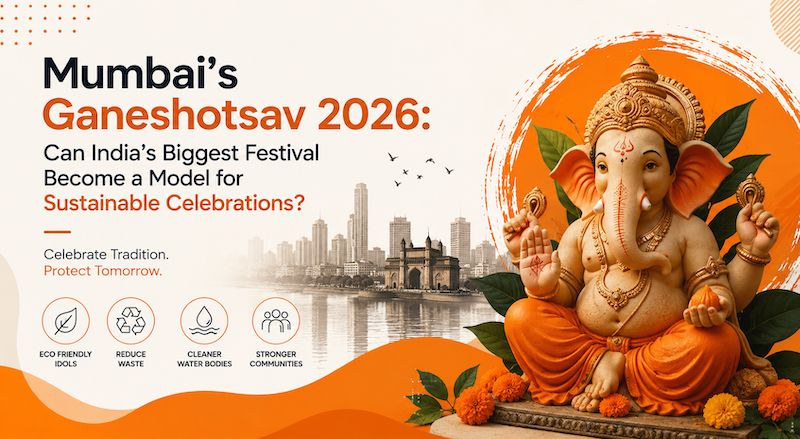
The streets change. Communities come together. Homes and neighbourhoods become places of celebration. For millions of people, Ganeshotsav is not simply a religious festival. It is a tradition of community, creativity, generosity and belonging.
But as Mumbai prepares for Ganesh Chaturthi on 14 September 2026, another question deserves equal attention:
Can one of India’s biggest celebrations become a model for how cities can celebrate tradition without placing unnecessary pressure on the environment?
The question is particularly relevant this year. Mumbai’s civic authorities and environmental agencies have been preparing for the festival, while the debate over eco-friendly clay idols, Plaster of Paris (PoP), immersion and pollution is again gaining attention.
The answer should not be to reduce the celebration.
It should be to make the celebration smarter.
There is sometimes an assumption that environmental responsibility means giving up tradition.
That is the wrong way to look at the challenge.
Mumbai’s Ganeshotsav has changed many times over the decades. The scale of celebrations, the size of public installations, transportation, lighting, decoration and technology have all evolved.
The festival has adapted before.
It can adapt again.
The real opportunity is to preserve what matters most — faith, community participation, creativity and togetherness — while reducing avoidable environmental damage.
That could mean choosing more sustainable materials, improving waste collection, using natural colours, reducing single-use plastic and making immersion more environmentally responsible.
The Maharashtra Pollution Control Board has long highlighted concerns associated with idol immersion, including water pollution and the effects of materials and colours entering water bodies.
One of the most visible environmental questions surrounding Ganeshotsav is the material used to make idols.
Traditional natural clay, including shadu mati, can offer a more environmentally responsible alternative to materials that are difficult to manage after immersion.
But simply telling consumers to “choose clay” does not solve the entire problem.
Mumbai’s current experience shows why.
Recent reporting has highlighted practical obstacles including the higher cost, additional time and space required for clay idols compared with PoP idols.
That matters.
If sustainable choices are significantly more expensive or difficult to access, adoption will remain uneven.
Therefore, the transition needs more than awareness campaigns.
It needs an ecosystem.
Artisans need affordable raw materials.
Consumers need accessible choices.
Public authorities need practical infrastructure.
And communities need information they can trust.
Mumbai has already experimented with this approach. BMC’s climate reporting notes initiatives such as distributing shadu soil and eco-friendly colours to sculptors and promoting artificial ponds for immersion.
These efforts should not remain isolated initiatives.
They should become part of a larger model for sustainable festivals.
The idol itself is only one part of the story.
A major urban festival generates a much wider environmental footprint.
Consider everything surrounding a typical celebration:
This is where the idea of a sustainable Ganeshotsav becomes much more powerful.
The objective should not simply be:
“Use an eco-friendly idol.”
It should be:
“Make the entire celebration more environmentally responsible.”
That means thinking about the festival from the moment preparations begin until the last piece of waste has been properly collected and processed.
Perhaps the greatest strength of Ganeshotsav is also its greatest opportunity.
The festival is community-driven.
Thousands of families, housing societies, mandals, volunteers, artisans, businesses and local organisations participate.
That creates something that government programmes often struggle to achieve: mass participation at neighbourhood level.
Imagine if every housing society celebrating Ganeshotsav adopted a simple sustainability pledge.
For example:
One festival, five commitments:
Individually, these actions may appear small.
Across thousands of communities, they become significant.
One of the practical challenges of environmentally responsible celebrations is immersion.
Mumbai cannot expect citizens to make environmentally conscious choices if convenient alternatives are unavailable.
Artificial ponds and designated immersion facilities can therefore play an important role.
BMC’s climate documentation says the city created 298 artificial ponds in 2025 and promoted eco-friendly immersion as part of its festival sustainability measures.
The lesson is straightforward:
Environmental responsibility becomes easier when sustainable infrastructure is convenient.
People should not have to choose between tradition and practicality.
The city should make the sustainable choice easier.
There is another group that deserves more attention in this conversation: young people.
Mumbai’s young residents are already comfortable with ideas such as recycling, climate action, sustainable consumption and community volunteering.
Ganeshotsav could become a platform for turning that awareness into action.
Schools and colleges could organise:
The festival could become more than a celebration.
It could become an annual civic-learning experience.
That would connect culture with citizenship.
Sustainability cannot be placed entirely on citizens.
Businesses that supply decorations, food, packaging, lighting, flowers and festival materials can influence what consumers are able to buy.
Local manufacturers and artisans can also benefit from the transition.
This is where sustainable festivals can create an unexpected economic opportunity.
A growing demand for:
could support small businesses and local artisans.
In other words, sustainability does not necessarily mean economic sacrifice.
Done properly, it can create a new local economy around responsible celebration.
There is a danger in environmental campaigns: making ordinary people feel guilty rather than empowered.
That approach rarely works.
A family that cannot afford an expensive eco-friendly idol should not feel that it is failing.
A small community that cannot immediately eliminate every plastic item should not be discouraged from making improvements.
Progress should be measured by participation and practical change.
If 10,000 communities each make three meaningful improvements, that may matter more than a small number of perfect celebrations.
The goal should be better, not perfect.
What happens in Mumbai rarely stays only in Mumbai.
Ganesh Chaturthi is celebrated across Maharashtra and in many other parts of India. Similar environmental questions arise around Durga Puja, Navratri, Dussehra, Diwali and other large public celebrations.
That makes Mumbai an interesting laboratory.
If one of India’s most densely populated and environmentally stressed cities can demonstrate that a major cultural festival can coexist with responsible waste management and cleaner practices, other cities can learn from it.
The model could eventually be adapted elsewhere.
Ganeshotsav has always been about bringing people together.
Perhaps the next evolution of the festival is not about making it smaller.
It is about making it more conscious.
Mumbai has the opportunity to demonstrate that faith and environmental responsibility can strengthen each other rather than compete.
The choice is not between tradition and sustainability.
The better choice is tradition with responsibility.
As Ganpati Bappa arrives in Mumbai this September, the city can celebrate with all its colour, music, creativity and emotion.
But it can also leave behind something else:
a cleaner city, healthier water bodies and a stronger culture of civic responsibility.
That would be a celebration worth carrying forward.
For families, housing societies and Ganesh mandals, a practical approach is simple:
Choose responsibly. Celebrate generously. Waste less. Immerse carefully. Clean up completely.
No single action will solve the environmental challenges associated with large festivals.
But millions of small actions can change the outcome.
And perhaps that is the most important lesson Ganeshotsav can offer Mumbai in 2026.