Starting an NGO is a meaningful step towards creating social change. Many people begin their journey with a strong mission—to support education, healthcare, rural development, environment protection, women empowerment, or other social causes.
However, registering an NGO is only the beginning.
A registered NGO must continue following various legal, financial, and administrative responsibilities to operate smoothly and maintain public trust.
This ongoing responsibility is known as NGO Compliance.
Many NGOs focus only on their projects and activities but ignore compliance until a problem occurs. This can create challenges such as:
A well-managed NGO understands that compliance is not just a legal obligation—it is a foundation for transparency, credibility, and long-term growth.
This complete NGO Compliance Checklist in India explains the important requirements every Trust, Society, and Section 8 Company should understand.
NGO Compliance means following all legal, financial, tax, and reporting requirements applicable to a non-profit organization.
In simple words:
NGO compliance is the process of ensuring that an NGO follows government rules, maintains proper records, completes required filings, and uses funds responsibly.
Compliance requirements may depend on:
For example:
A Trust, Society, and Section 8 Company may all work for charitable purposes, but their compliance responsibilities can differ.
Compliance is not only about avoiding penalties. It helps an NGO build a strong foundation.
Donors want confidence that their contributions are being used properly.
Proper compliance shows:
Many funding organizations check whether an NGO maintains proper compliance before providing support.
This may include:
Ignoring important filings and requirements can create unnecessary risks for an organization.
Regular compliance helps maintain smooth operations.
A compliant NGO usually has better systems for:
Before understanding compliance requirements, it is important to know your NGO structure.
In India, NGOs are mainly registered as:
| NGO Type | Registered Under | Common Compliance Areas |
|---|---|---|
| Trust | Trust laws and applicable state regulations | Accounts, tax compliance, records |
| Society | Societies Registration Act and state rules | Meetings, records, annual requirements |
| Section 8 Company | Companies Act, 2013 | ROC filings, accounts, corporate compliance |
Each structure has different responsibilities.
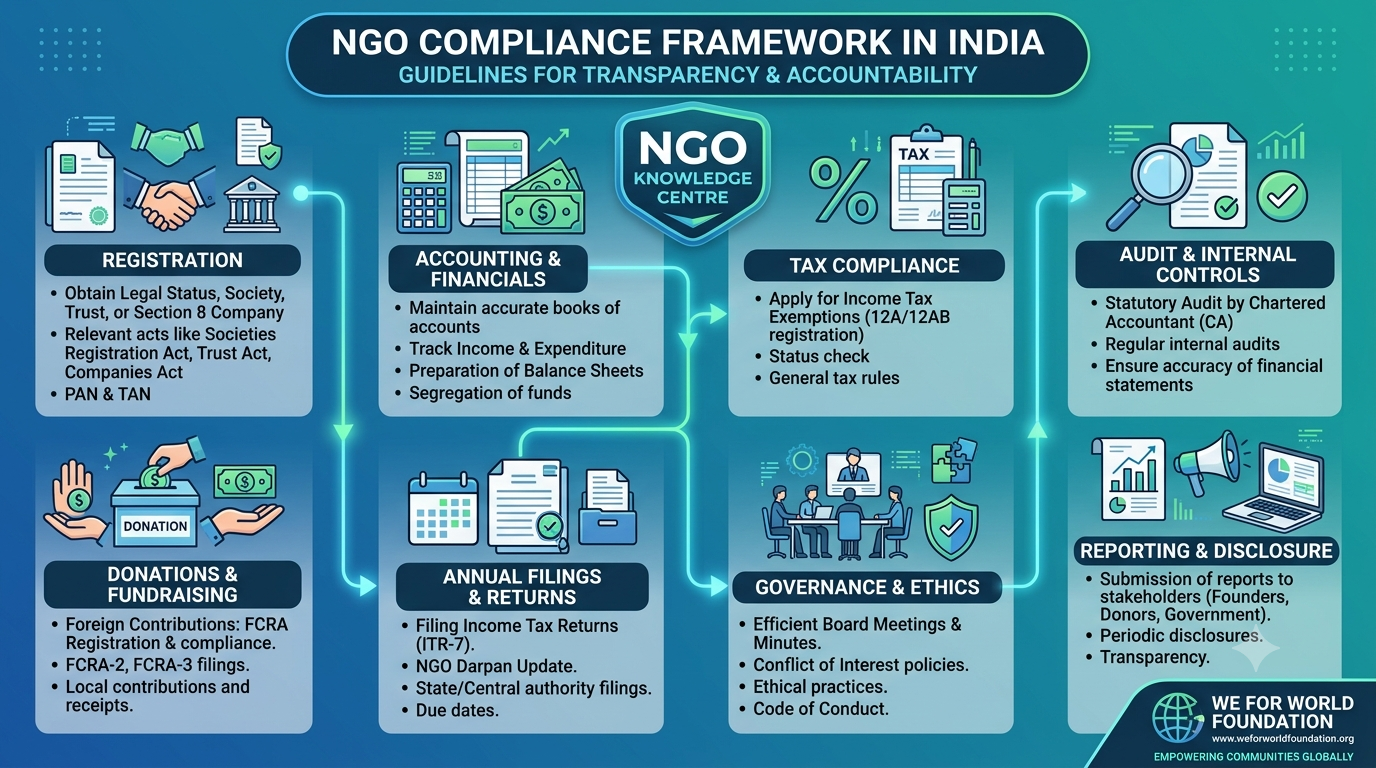
Every NGO should maintain a compliance calendar covering:
✅ Registration documents
✅ Financial records
✅ Income tax requirements
✅ Annual filings
✅ Audit requirements
✅ Donor records
✅ Tax registrations
✅ Funding compliance
✅ Governance records
Let us understand each area.
Good documentation is the backbone of NGO compliance.
Every NGO should maintain updated records of:
Keep safe copies of:
Maintain:
Proper governance records demonstrate accountability.
Financial transparency is one of the most important parts of NGO compliance.
An NGO should maintain proper records of:
Good accounting helps NGOs:
A common mistake among small NGOs is treating financial records casually.
Even a small NGO should maintain organized accounts from the beginning.
An NGO should maintain separate bank accounts for organizational activities.
Important practices:
✅ Avoid mixing personal and NGO funds
✅ Record every transaction properly
✅ Maintain payment proofs
✅ Keep bank statements safely
Financial discipline creates trust among donors and stakeholders.
Many NGOs believe that registration automatically provides tax exemption.
This is not always true.
Eligible NGOs generally need appropriate tax registrations and must follow applicable income tax requirements.
Important areas include:
12AB registration is related to income tax exemption benefits available to eligible charitable organizations.
It helps eligible NGOs claim tax benefits on their income, subject to applicable conditions.
NGOs should maintain:
80G registration allows eligible donors to claim tax benefits for donations made to approved NGOs.
For NGOs, it can help:
However, NGOs must maintain proper records and follow applicable requirements.
NGO compliance is not a one-time activity. Every NGO must regularly review and complete its yearly responsibilities.
A good NGO maintains a compliance calendar to avoid missing important deadlines.
Annual compliance generally includes:
The exact requirements depend on the type of NGO and registrations held.
An audit helps verify that an NGO’s financial records are accurate and properly maintained.
It provides confidence to:
An NGO audit generally reviews:
A proper audit helps:
✅ Improve financial transparency
✅ Identify accounting mistakes
✅ Maintain donor confidence
✅ Support funding applications
✅ Prepare accurate reports
A professional NGO should treat audits as a tool for improvement, not just a legal requirement.
Trusts are one of the most common structures used for charitable activities in India.
A Trust should maintain:
Important compliance areas may include:
| Compliance Area | Status |
|---|---|
| Trust Deed maintained | ✅ |
| Trustee details updated | ✅ |
| Bank records maintained | ✅ |
| Accounts prepared | ✅ |
| Tax compliance completed | ✅ |
A Society is generally managed by a group of members through a governing body.
Societies should maintain:
Good governance is especially important for societies because decision-making involves multiple members.
| Compliance Area | Status |
|---|---|
| Member records updated | ✅ |
| General meetings conducted | ✅ |
| Minutes maintained | ✅ |
| Financial records maintained | ✅ |
| Annual requirements completed | ✅ |
A Section 8 Company operates under the Companies Act, 2013 and follows company-related compliance requirements.
Compared to Trusts and Societies, Section 8 Companies generally have a more structured compliance system.
Important areas include:
| Compliance Area | Requirement |
|---|---|
| Board records | Maintain regularly |
| Financial statements | Prepare annually |
| ROC filings | Complete applicable filings |
| Company records | Keep updated |
NGOs receiving foreign contributions must follow FCRA-related compliance requirements.
FCRA compliance includes:
Foreign funding requires a higher level of transparency because it involves international sources.
✅ Maintain separate records
✅ Track foreign contributions
✅ Maintain proper utilisation records
✅ Complete required filings
✅ Keep documents updated
CSR funding has become an important source of support for many NGOs.
Eligible NGOs seeking CSR funding from companies generally need to complete CSR-1 registration as applicable.
CSR compliance helps create a connection between:
CSR-1 helps companies identify eligible implementing agencies for CSR activities.
Before approaching companies for CSR partnerships, NGOs should ensure:
A compliance calendar helps NGOs stay organised.