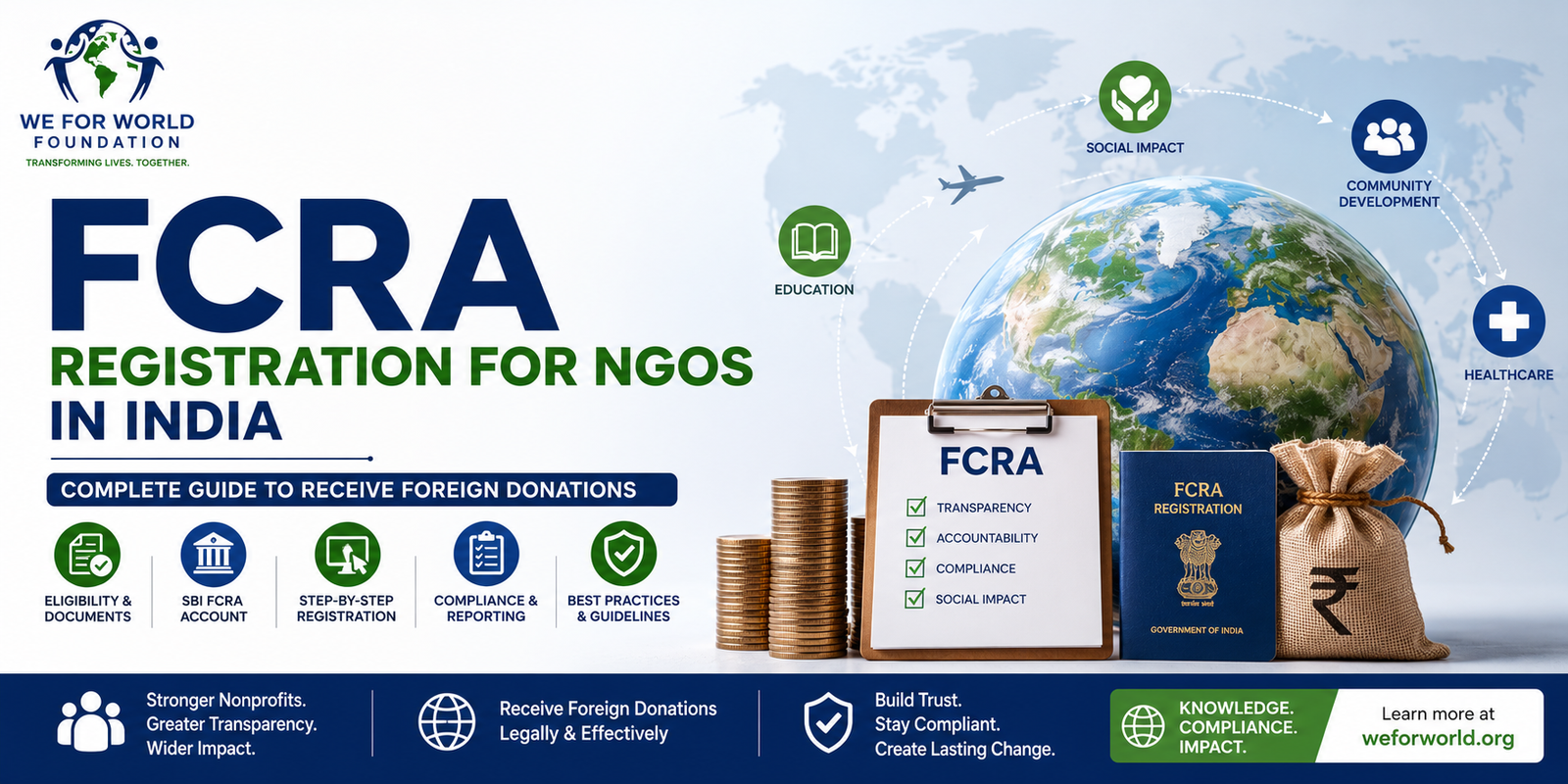
Foreign donations can significantly strengthen an NGO’s ability to create social impact. However, before any Indian nonprofit organization can legally receive contributions from outside India, it must comply with the Foreign Contribution (Regulation) Act (FCRA), 2010, along with the applicable rules.
Whether your organization plans to receive grants from international foundations, overseas philanthropists, CSR arms of multinational companies, or members of the Indian diaspora, understanding FCRA is essential.
This guide explains the eligibility criteria, registration process, required documents, designated bank account requirements, compliance obligations, and common mistakes to avoid.
The Foreign Contribution (Regulation) Act, 2010 (FCRA) regulates the acceptance and utilization of foreign contributions by certain individuals, associations, and nonprofit organizations in India.
Its primary objective is to ensure that foreign contributions are received and utilized only for legitimate charitable purposes while maintaining transparency and accountability.
A foreign contribution generally includes donations, grants, gifts, or transfers received from a foreign source in the form of:
Whether a contribution qualifies as a foreign contribution depends on the provisions of the FCRA and the nature of the donor.
FCRA registration enables eligible NGOs to legally receive foreign contributions for charitable purposes such as:
Receiving foreign contributions without complying with FCRA requirements can lead to legal consequences.
Organizations commonly eligible to apply include:
The organization should be engaged in genuine charitable activities and meet the eligibility requirements prescribed under the Act.
Generally, an organization should:
Applicants should refer to the latest government notifications and seek professional advice where necessary.
Suitable for organizations with an established track record that satisfy the prescribed eligibility requirements.
Organizations that do not yet qualify for full registration may, in certain cases, apply for prior permission to receive a specific foreign contribution from a specific donor for a defined purpose, subject to applicable rules.
The exact documentation requirements may change over time.
As per current regulations, organizations receiving foreign contributions are generally required to have the designated FCRA account at:
State Bank of India, New Delhi Main Branch (NDMB)
Foreign contributions are first received in this designated account and may then be transferred to utilization accounts as permitted under the applicable rules.
Organizations with FCRA registration should:
Failure to comply may result in penalties or regulatory action.
1. Is FCRA registration mandatory to receive foreign donations?
Yes, unless the organization is eligible to receive a contribution under prior permission or another applicable provision of law.
2. Can a newly registered NGO apply for FCRA?
It depends on whether the organization satisfies the applicable eligibility conditions. Some organizations may instead apply for prior permission.
3. Can individuals receive foreign contributions?
The applicability depends on the provisions of the Act and the nature of the recipient.
4. Is the SBI New Delhi Main Branch account mandatory?
Organizations should follow the latest legal requirements regarding designated FCRA accounts.
5. Can FCRA funds be used for administrative expenses?
Administrative expenses are subject to the limits and conditions prescribed under the FCRA and related rules.
6. Can an NGO transfer FCRA funds to another NGO?
Transfers are governed by the applicable provisions of the Act and Rules.
7. Is annual filing compulsory?
Yes, organizations should comply with annual reporting requirements as prescribed.
8. Can FCRA registration be cancelled?
Yes, registration may be suspended or cancelled for non-compliance or other reasons specified under the law.
9. Can one bank account be used for both domestic and foreign donations?
Organizations should follow the separate account requirements prescribed under FCRA.
10. How long does the process take?
Processing timelines may vary depending on the application and regulatory review.
At We For World Foundation (WFWF), our mission is to simplify complex NGO laws, compliance requirements, CSR regulations, fundraising strategies, governance practices, and nonprofit management through practical, research-driven educational resources.
Explore our Knowledge Centre for more expert guides on NGO registration, FCRA, CSR, 12AB, 80G, fundraising, and nonprofit governance to build a stronger, more compliant, and impactful organization.