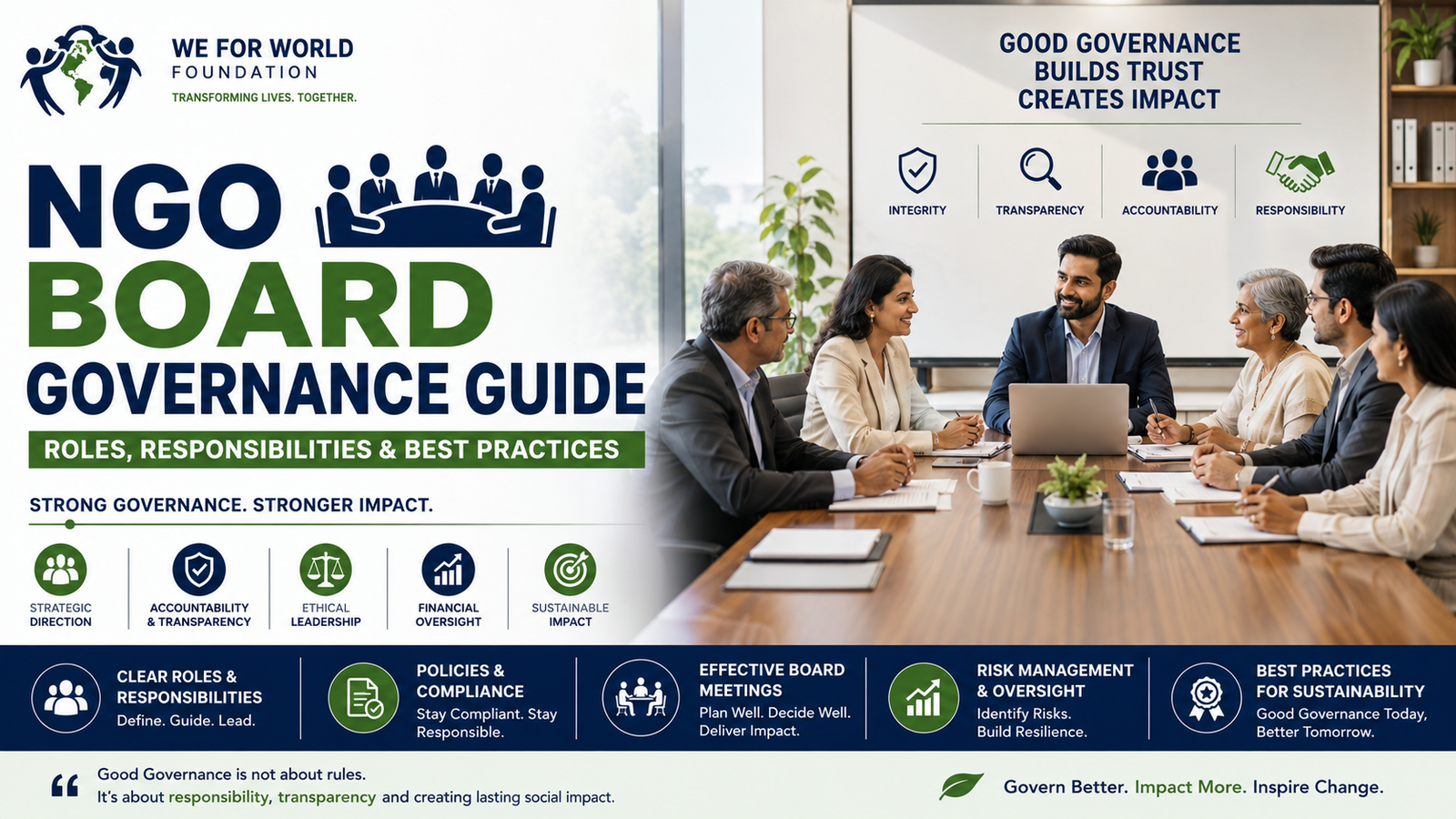
Strong governance is the foundation of every successful nonprofit organization. Whether your organization is a Public Charitable Trust, Society, or Section 8 Company, an effective governing board plays a crucial role in ensuring accountability, transparency, legal compliance, ethical leadership, and long-term sustainability.
An NGO’s mission may focus on education, healthcare, women empowerment, environmental conservation, child welfare, disaster relief, or community development, but without good governance, even the most impactful initiatives can struggle to achieve lasting success.
This NGO Board Governance Guide explains the essential roles and responsibilities of board members, governance structures, fiduciary duties, board committees, compliance requirements, meeting practices, and governance best practices. Whether you are forming a new nonprofit or strengthening an existing one, this guide will help you build a responsible and effective governing board.
NGO Board Governance refers to the system through which the governing body directs, supervises, and oversees the organization’s mission, strategy, finances, legal compliance, and ethical conduct.
The governing board acts as the highest decision-making authority of the organization. It ensures that the NGO operates in accordance with its founding documents, applicable laws, donor expectations, and public trust.
Good governance is not about managing daily operations. Instead, the board provides strategic direction while management and staff handle day-to-day implementation.
A well-governed NGO is more likely to attract donors, secure CSR partnerships, maintain regulatory compliance, and deliver meaningful social impact.
Effective governance benefits every stakeholder connected with an NGO.
Donors increasingly evaluate governance before providing financial support. Organizations with active boards, documented policies, audited financial statements, and transparent decision-making processes are generally viewed as more credible.
Strong governance ensures that resources are utilized responsibly and that programs remain focused on achieving meaningful social outcomes.
The governance structure depends on the legal form of the organization.
| Organization Type | Governing Body |
|---|---|
| Public Charitable Trust | Board of Trustees |
| Society | Governing Body / Managing Committee |
| Section 8 Company | Board of Directors |
Although the terminology differs, the responsibilities of these governing bodies are broadly similar: providing strategic oversight, ensuring accountability, and safeguarding the organization’s mission.
An effective board includes individuals with diverse skills and experience.
Provides overall leadership to the board, presides over meetings, and facilitates effective governance.
Supports the Chairperson and assumes leadership responsibilities when required.
Responsible for maintaining governance records, meeting minutes, statutory documentation, and communication with board members.
Oversees financial management, budgeting, financial reporting, internal controls, and audit coordination.
Offer objective perspectives, professional expertise, and help strengthen governance.
Many NGOs benefit from including professionals with expertise in law, finance, healthcare, education, CSR, technology, communications, or fundraising.
Every board member shares collective responsibility for the organization’s success.
The board ensures that all activities align with the organization’s charitable objectives and long-term vision.
The board approves strategic plans, annual priorities, and major organizational initiatives.
Board members should ensure compliance with applicable laws, regulations, and reporting requirements relevant to the organization’s legal structure and operations.
Financial oversight is one of the board’s most important responsibilities.
Key responsibilities include:
The board typically appoints and evaluates the Chief Executive Officer, Executive Director, or equivalent senior leadership.
Responsibilities include:
Board members serve as ambassadors for the organization.
They should uphold high ethical standards, promote transparency, and maintain public confidence.
Board members have fiduciary duties that require them to act in the best interests of the organization.
Exercise reasonable care, remain informed, participate actively in meetings, and make decisions based on adequate information.
Avoid conflicts of interest and place the organization’s interests above personal or professional gain.
Ensure that the organization complies with its governing documents, charitable objectives, and applicable legal obligations.
Successful nonprofit organizations are guided by key governance principles:
These principles strengthen public trust and support long-term organizational effectiveness.
As an NGO grows, the governing board may establish committees to improve oversight and ensure that important areas receive focused attention. While smaller organizations may operate effectively without multiple committees, medium and large NGOs often benefit from a structured committee system.
Committees should operate under clear terms of reference approved by the board and report regularly on their activities.
The Finance & Audit Committee oversees the organization’s financial health and accountability.
Primary Responsibilities:
This committee focuses on board effectiveness and leadership development.
Responsibilities:
This committee ensures that organizational programs remain aligned with the NGO’s mission.
Responsibilities:
Fundraising is a shared responsibility of the governing board.
This committee supports the organization in developing sustainable funding strategies.
Responsibilities:
As NGOs expand, dedicated oversight of people management becomes increasingly important.
Responsibilities:
Regular board meetings are essential for informed decision-making and organizational oversight.
| Meeting Type | Suggested Frequency |
|---|---|
| Full Board Meeting | Quarterly (minimum) |
| Executive Committee | Monthly or Bi-monthly |
| Finance Committee | Quarterly |
| Audit Committee | Before and after annual audit |
| Annual General Meeting (where applicable) | Once a year |
| Strategic Planning Session | Annually |
Organizations should follow the requirements set out in their governing documents and applicable laws.
A well-structured agenda improves efficiency and accountability.
A typical meeting may include:
Meeting minutes should accurately record discussions, resolutions, and assigned responsibilities.
To maximize effectiveness:
Every NGO should adopt a written Conflict of Interest Policy to protect the integrity of decision-making.
A conflict of interest arises when a board member’s personal, financial, or professional interests could improperly influence decisions made on behalf of the organization.
A transparent approach protects both the individual board member and the organization.
High-performing boards regularly assess their own effectiveness.
Annual evaluations help identify strengths, address gaps, and improve governance.
Evaluation criteria may include:
The results should be used to create an action plan for continuous improvement.
Every NGO should maintain a documented governance framework supported by written policies.
Key policies include:
These policies promote consistency, transparency, and accountability across the organization.
Boards are responsible for overseeing organizational risks and ensuring appropriate mitigation measures are in place.
| Risk Area | Examples |
|---|---|
| Financial | Fraud, budget overruns, cash flow issues |
| Legal | Non-compliance, regulatory penalties |
| Operational | Project delays, process failures |
| Reputational | Negative publicity, donor concerns |
| Human Resources | Staff turnover, workplace disputes |
| Cybersecurity | Data breaches, phishing attacks |
| Fundraising | Donor dependency, declining contributions |
| Strategic | Mission drift, ineffective planning |
A formal risk register should be reviewed periodically by the board.
Strong internal controls reduce the risk of fraud, misuse of funds, and operational errors.
Recommended controls include:
Effective internal controls demonstrate accountability to donors, regulators, and beneficiaries.
Before concluding each financial year, the board should verify that the organization has:
✅ Conducted regular board meetings
✅ Maintained approved meeting minutes
✅ Reviewed financial statements
✅ Completed statutory audits
✅ Updated governance policies
✅ Reviewed organizational risks
✅ Monitored strategic objectives
✅ Evaluated senior leadership
✅ Managed conflicts of interest
✅ Maintained statutory records
✅ Complied with applicable legal and regulatory requirements
✅ Developed an annual action plan for governance improvements
Even well-intentioned nonprofit organizations can face governance challenges if board responsibilities are not clearly defined or consistently implemented. Recognizing these common pitfalls can help organizations strengthen governance and reduce operational risks.
Board members sometimes become involved in day-to-day operations, while management may make strategic decisions that should be reserved for the board.
Best Practice: Clearly distinguish governance responsibilities from operational management.
Boards that meet irregularly often struggle to provide timely oversight and strategic guidance.
Best Practice: Schedule board meetings in advance and ensure active participation by all members.
Failure to regularly review financial reports, budgets, and audit findings can expose the organization to financial risks.
Best Practice: Require quarterly financial reporting and annual independent audits.
Undisclosed personal interests can undermine public trust and organizational credibility.
Best Practice: Adopt a written Conflict of Interest Policy and obtain annual declarations from all board members.
Organizations without a strategic roadmap often lose focus and struggle to measure progress.
Best Practice: Develop a three-to-five-year strategic plan aligned with the NGO’s mission and review it annually.
Missing meeting minutes, resolutions, and governance records can create compliance and accountability issues.
Best Practice: Maintain complete and organized governance records with secure backups.
A board lacking diversity in skills and experience may overlook important opportunities or risks.
Best Practice: Recruit members with expertise in finance, law, CSR, fundraising, technology, communications, and program management.
Without periodic assessments, governance weaknesses may persist unnoticed.
Best Practice: Conduct annual board and committee performance evaluations and implement improvement plans.
Organizations recognized for strong governance often follow these principles:
Strong governance is not simply about compliance—it is about creating a resilient organization capable of delivering lasting social impact.
Use this checklist annually to assess the effectiveness of your governing board.
| Governance Area | Status |
|---|---|
| Clear organizational mission and vision | ☐ |
| Defined board roles and responsibilities | ☐ |
| Board charter approved | ☐ |
| Governance policies documented | ☐ |
| Conflict of Interest Policy implemented | ☐ |
| Regular board meetings conducted | ☐ |
| Meeting minutes maintained | ☐ |
| Annual budget approved | ☐ |
| Financial statements reviewed | ☐ |
| Statutory audit completed | ☐ |
| Risk register reviewed | ☐ |
| Strategic plan monitored | ☐ |
| CEO/Executive Director evaluated | ☐ |
| Board performance evaluated | ☐ |
| Succession planning documented | ☐ |
| Compliance calendar maintained | ☐ |
| Donor reporting completed | ☐ |
| Internal controls reviewed | ☐ |
| Board training conducted | ☐ |
| Annual governance review completed | ☐ |
If several items remain unchecked, consider prioritizing governance improvements during the next board cycle.
NGO Board Governance is the framework through which the governing body provides strategic leadership, oversight, accountability, and compliance for a nonprofit organization.
The governing body depends on the legal structure:
The board’s primary responsibility is to ensure that the organization fulfills its mission while maintaining sound governance, financial accountability, and legal compliance.
Generally, no. The board provides strategic oversight, while management is responsible for day-to-day operations.
The frequency depends on the organization’s governing documents and applicable legal requirements. Many organizations hold at least four board meetings annually to maintain effective oversight.
A fiduciary duty requires board members to act with care, loyalty, and obedience in the best interests of the organization.
It promotes transparency, protects decision-making integrity, and helps maintain stakeholder trust.
This depends on the organization’s legal structure, governing documents, applicable laws, and the nature of the role performed. Professional advice should be obtained before making such arrangements.
Common governance records include:
An effective board demonstrates integrity, strategic thinking, financial oversight, legal compliance, active participation, diversity of expertise, and commitment to the organization’s mission.
A diverse board brings varied perspectives, strengthens decision-making, improves innovation, and enhances stakeholder representation.
Organizations should review governance policies at least once a year or whenever significant legal or operational changes occur.
Yes. Good governance principles benefit organizations of every size and can be adapted to available resources.
Donors, CSR partners, and grant-making organizations often evaluate governance standards before providing financial support. Transparent governance enhances credibility and trust.
Begin by defining board roles, adopting essential governance policies, conducting regular board meetings, and establishing effective financial oversight mechanisms.
Effective NGO board governance goes beyond statutory compliance—it creates the foundation for sustainable social impact. A proactive, informed, and accountable governing board enables an organization to navigate challenges, build stakeholder confidence, and pursue its mission with integrity.
Whether your organization is newly established or well established, investing in governance today will strengthen leadership, improve transparency, and enhance long-term resilience.
The We For World Foundation (WFWF) Knowledge Centre is committed to empowering NGOs, Trusts, Societies, Section 8 Companies, CSR professionals, and social entrepreneurs through practical, research-driven educational resources.
Explore our comprehensive guides on NGO registration, FCRA, CSR compliance, 12AB and 80G registrations, fundraising, financial management, governance, policy development, and nonprofit leadership to build a stronger, more transparent, and more impactful organization.