Every successful NGO is known not just for its mission, but for the impact of its projects. Whether the goal is improving education, protecting the environment, empowering women, providing healthcare, or supporting rural livelihoods, a well-planned project transforms ideas into measurable social change.
Unfortunately, many NGO projects struggle because of unclear objectives, poor planning, unrealistic budgets, weak monitoring, or inadequate stakeholder engagement. Effective project management helps organizations use resources efficiently, achieve intended outcomes, and demonstrate accountability to communities, donors, CSR partners, and grantmakers.
This comprehensive guide walks you through the complete NGO project lifecycle—from identifying community needs to designing projects, implementing activities, measuring impact, and ensuring long-term sustainability.
Table of Contents
What is NGO Project Planning?
NGO project planning is the structured process of identifying a social problem, developing practical solutions, allocating resources, implementing activities, monitoring progress, and evaluating results.
Project planning ensures that every activity contributes toward a clearly defined purpose and measurable impact.
A strong project plan answers questions such as:
Why Project Planning Matters
Well-planned projects help NGOs:
Planning reduces uncertainty and improves the likelihood of success.
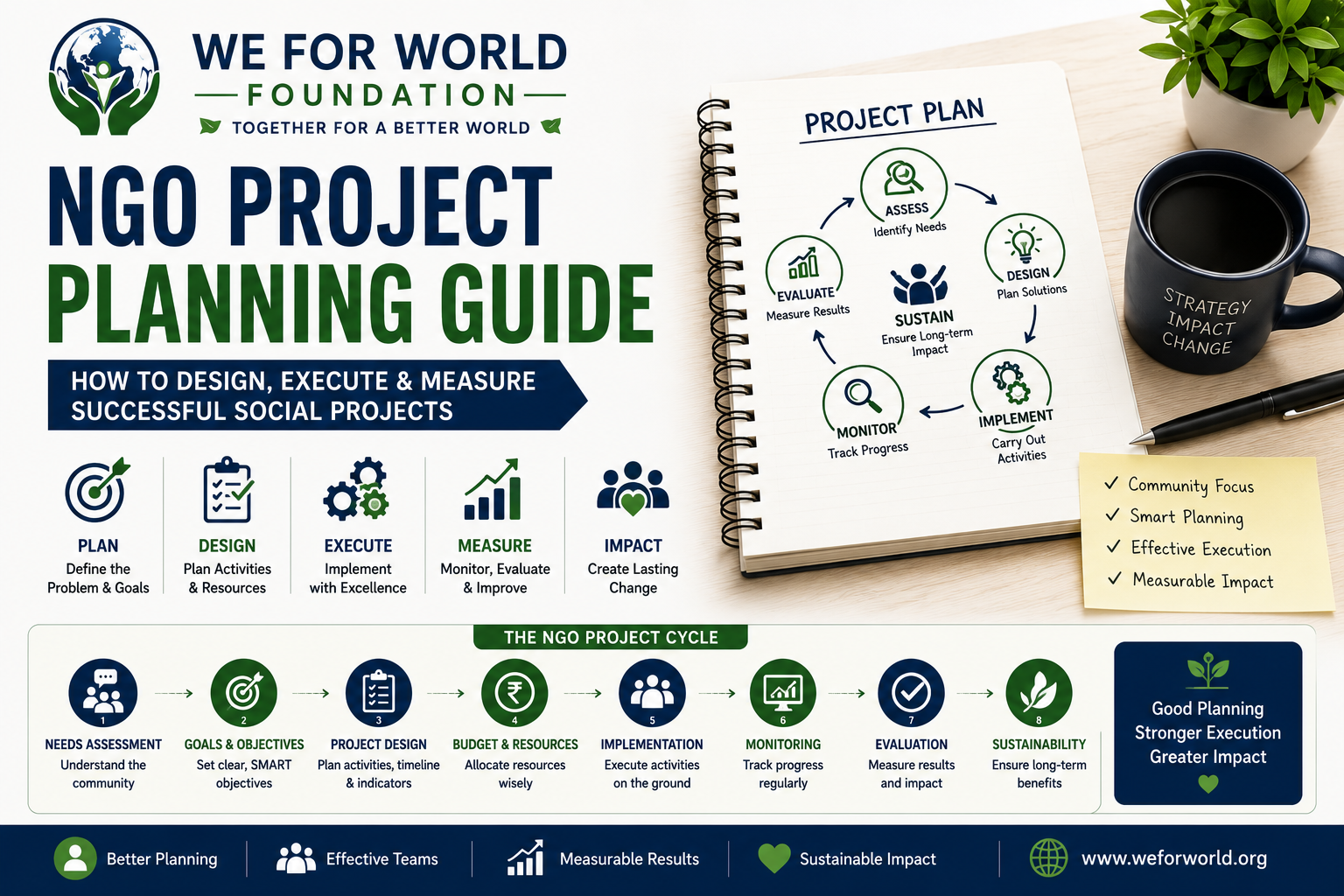
The NGO Project Life Cycle
Every successful NGO project typically follows these stages:
| Stage | Purpose |
| Needs Assessment | Identify community problems |
| Project Design | Develop solutions |
| Planning | Define activities, budget, timeline |
| Implementation | Execute project activities |
| Monitoring | Track progress |
| Evaluation | Measure results |
| Reporting | Communicate outcomes |
| Sustainability | Continue impact beyond funding |
Viewing projects as a continuous cycle encourages learning and improvement.
Step 1: Conduct a Community Needs Assessment
Projects should respond to genuine community needs rather than assumptions.
Methods include:
Ask questions such as:
Engaging beneficiaries early increases relevance and ownership.
Step 2: Define Clear Goals and Objectives
A goal describes the overall change you want to achieve.
Objectives describe the specific results required to reach that goal.
Use the SMART framework:
Example Goal:
Improve access to quality education in underserved rural communities.
Example Objective:
Provide digital learning support to 1,000 students across 20 villages within 12 months.
Step 3: Design the Project
Project design connects community needs with practical solutions.
Define:
Every activity should directly support the project’s objectives.
Step 4: Develop a Realistic Budget
An accurate budget increases credibility with donors and funding agencies.
Include:
| Budget Category | Examples |
| Personnel | Salaries, consultants |
| Training | Workshops, facilitators |
| Equipment | Computers, tools, supplies |
| Travel | Field visits |
| Communications | Internet, printing |
| Monitoring & Evaluation | Surveys, assessments |
| Administration | Office expenses |
| Contingency | Unexpected costs |
Ensure that the budget aligns with project activities and includes appropriate justifications.
Step 5: Build the Right Project Team
Clearly assign responsibilities.
Typical project roles include:
Define reporting relationships and decision-making authority to avoid confusion.
Step 6: Create a Project Timeline
Break the project into manageable phases.
Example:
A realistic timeline helps monitor progress and manage expectations.
Step 7: Identify and Manage Risks
Every project involves risks.
Common NGO project risks include:
Prepare mitigation strategies for significant risks and review them regularly.
Step 8: Implement the Project
Successful implementation depends on:
Regular field visits help ensure activities remain aligned with project objectives.
Step 9: Monitor Progress Continuously
Monitoring tracks whether activities are being implemented as planned.
Useful monitoring tools include:
Regular monitoring allows issues to be addressed before they become major problems.
Step 10: Measure Outcomes and Impact
Outputs measure what the project delivered.
Outcomes measure the changes created.
Impact reflects the long-term difference in people’s lives.
Examples:
| Level | Example |
| Output | 500 farmers trained |
| Outcome | Farmers adopt improved agricultural practices |
| Impact | Increased household income and food security |
Measuring all three provides a comprehensive understanding of project success.
Step 11: Prepare Quality Reports
Project reports demonstrate accountability and support future fundraising.
Include:
Clear reporting builds confidence among donors, CSR partners, and government agencies.
Step 12: Plan for Sustainability
A successful project should continue creating value after initial funding ends.
Consider:
Sustainability planning should begin during project design—not at project completion.
Monitoring & Evaluation (M&E) Checklist
✅ Baseline data collected
✅ SMART indicators defined
✅ Monitoring schedule established
✅ Beneficiary database maintained
✅ Field reports completed
✅ Financial tracking updated
✅ Mid-term review conducted
✅ Final evaluation completed
✅ Lessons learned documented
Common NGO Project Management Mistakes
Avoid these common pitfalls:
Strong planning reduces these risks significantly.
NGO Project Planning Checklist
✅ Community needs assessment
✅ Problem statement
✅ SMART objectives
✅ Project activities
✅ Work plan
✅ Budget
✅ Risk assessment
✅ Team structure
✅ Monitoring framework
✅ Evaluation plan
✅ Reporting template
✅ Sustainability strategy
Frequently Asked Questions
It is the structured process of designing, implementing, monitoring, and evaluating social projects to achieve defined objectives and measurable impact.
It ensures projects respond to genuine community priorities rather than assumptions.
Outputs are the immediate products or services delivered, while outcomes are the changes resulting from those activities.
Monitoring helps track progress, identify challenges early, and improve project performance.
Through indicators, surveys, evaluations, beneficiary feedback, case studies, and analysis of long-term changes.
Yes. Community participation improves relevance, ownership, and sustainability.
Strong community involvement, local capacity, partnerships, and planning for long-term continuation beyond initial funding.
Budgets should clearly reflect project activities, include realistic costs, and provide appropriate justification for each expense.
Documentation supports accountability, reporting, learning, compliance, and future funding applications.
Beginning implementation without clearly defining objectives, measurable outcomes, stakeholder roles, and a monitoring framework.
Final Key Takeaways
Conclusion
Successful NGO projects are built on careful planning, strong community engagement, disciplined implementation, and continuous learning. While passion drives social change, structured project management ensures that resources are used effectively and intended outcomes are achieved.
By adopting a systematic approach to project planning, execution, monitoring, evaluation, and sustainability, NGOs can increase their effectiveness, strengthen accountability, and create lasting positive change for the communities they serve.
Continue Your Learning with WFWF
The We For World Foundation (WFWF) Knowledge Centre is committed to empowering NGOs, trusts, Section 8 companies, CSR professionals, donors, volunteers, and social entrepreneurs with practical, expert-led educational resources. Explore our comprehensive guides on NGO governance, project management, fundraising, compliance, CSR partnerships, digital transformation, financial management, leadership, and organizational development to build stronger organizations and maximize social impact.