Running an NGO is about creating social impact—but maintaining financial integrity is equally important. Every registered nonprofit organization in India must understand its legal responsibilities relating to taxation, accounting, statutory filings, audits, and financial compliance.
Many people mistakenly believe that NGOs are completely exempt from taxes. In reality, registered trusts, societies, and Section 8 companies may qualify for certain tax benefits under Indian law, but they are still required to comply with applicable financial and tax regulations.
A well-managed financial system protects an NGO’s reputation, builds donor confidence, supports grant eligibility, and ensures long-term sustainability.
This guide provides a practical overview of GST, Income Tax, TDS, bookkeeping, audits, and financial compliance for Indian NGOs.
Disclaimer: This article is intended for educational purposes only and should not be considered legal, accounting, or tax advice. Tax laws change over time, and every NGO should consult a qualified Chartered Accountant (CA) or tax professional for organization-specific guidance.
Financial compliance is not just about following the law—it demonstrates accountability and transparency.
Proper compliance helps NGOs:
Strong financial governance is one of the defining characteristics of a professionally managed NGO.
No.
An NGO is not automatically exempt from taxation simply because it is a nonprofit organization.
Eligibility for tax exemptions depends on factors such as:
Organizations should not assume exemption without professional guidance.
The principles discussed in this guide generally apply to:
Specific compliance requirements may differ depending on the legal structure and applicable laws.
Income tax provisions for NGOs differ from those applicable to commercial businesses.
Many charitable organizations seek registrations that provide tax benefits, provided they satisfy statutory conditions and continue to comply with applicable requirements.
Good accounting and documentation are essential to demonstrate eligibility where tax benefits are claimed.
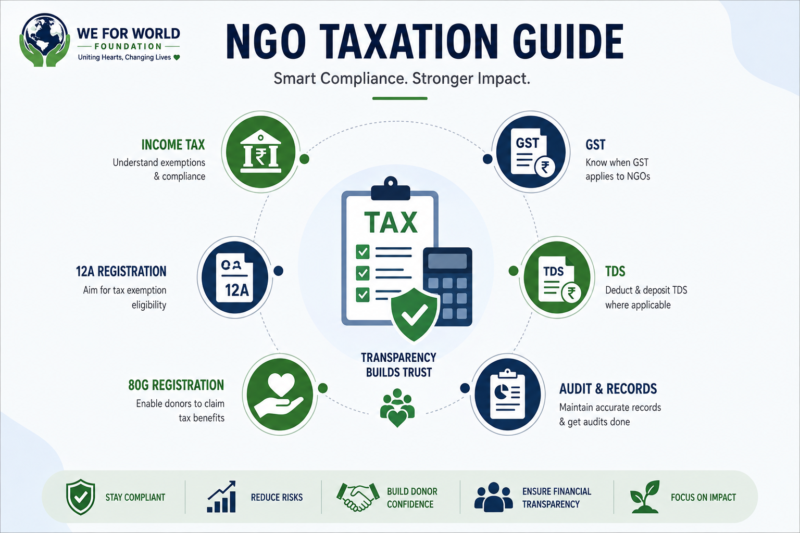
12A registration is an important tax-related registration available under the Income-tax framework for eligible charitable organizations.
Subject to compliance with legal conditions, it can help eligible NGOs claim tax-related benefits on their income.
Maintaining ongoing compliance is important for continuing eligibility.
80G registration benefits donors.
Subject to the applicable provisions of law, donations made to eligible organizations may qualify donors for tax deductions.
For NGOs, this registration can increase fundraising credibility and encourage philanthropic giving.
One of the most common misconceptions is that NGOs never need to consider Goods and Services Tax (GST).
In reality, GST implications depend on the specific activities undertaken by the organization.
Whether GST registration or compliance is required depends on factors such as:
Every NGO should obtain professional advice before determining its GST obligations.
Depending on the facts and applicable law, GST questions may arise in relation to activities such as:
Each activity should be evaluated individually.
Many NGOs are required to understand and comply with TDS provisions when making certain payments.
Examples may include payments relating to:
Applicable rates, thresholds, and filing requirements depend on current tax law.
Accounting is the backbone of financial compliance.
Maintain accurate records of:
Well-maintained books simplify audits and statutory reporting.
Every NGO should maintain:
Timely bookkeeping reduces errors and improves transparency.
Strong internal controls help prevent mistakes and misuse of funds.
Recommended practices include:
Financial controls strengthen governance.
Many NGOs are required to undergo audits depending on their legal status and applicable statutory provisions.
An audit generally helps:
Timely audits demonstrate responsible financial management.
A professionally managed NGO should maintain organized records such as:
Good documentation simplifies compliance and inspections.
Modern accounting software can significantly improve efficiency.
Useful features include:
Digital systems reduce manual errors and improve reporting.
Avoid these common errors:
Compliance failures can affect credibility as much as finances.
✅ Maintain updated books of accounts
✅ Record all donations and grants
✅ Preserve supporting documents
✅ Review GST implications
✅ Review TDS obligations
✅ Prepare financial statements
✅ Complete statutory audit (where applicable)
✅ File required tax and regulatory returns on time
✅ Maintain board approvals and governance records
✅ Consult a Chartered Accountant for annual compliance review
Not automatically. Tax treatment depends on applicable registrations, legal provisions, and ongoing compliance.
It depends on the nature of activities and other legal factors. Professional advice should be obtained for organization-specific situations.
Subject to the law, it may enable eligible charitable organizations to claim tax-related benefits.
It can provide tax benefits to eligible donors under applicable law, making fundraising more attractive.
Certain payments may attract TDS obligations depending on the applicable provisions of tax law.
Accurate records support transparency, audits, grant reporting, and statutory compliance.
Many NGOs are legally required to do so, while audits also enhance governance and donor confidence.
Yes. Modern software improves accuracy, reporting, documentation, and operational efficiency.
Assuming nonprofit status eliminates compliance responsibilities.
Yes. Professional advice helps ensure compliance with evolving tax and regulatory requirements.
Financial discipline is as important to an NGO’s success as its mission and programs. Transparent accounting, timely compliance, strong governance, and responsible tax management not only reduce legal risk but also strengthen trust among donors, beneficiaries, CSR partners, and government agencies.
By investing in sound financial systems and seeking professional guidance when needed, NGOs can focus confidently on creating sustainable social impact while meeting their legal and ethical responsibilities.
The We For World Foundation (WFWF) Knowledge Centre provides practical guidance for NGOs, trusts, societies, Section 8 companies, CSR professionals, and social entrepreneurs. Explore expert resources on governance, taxation awareness, compliance, fundraising, project management, digital transformation, monitoring & evaluation, leadership, and sustainable development to build a transparent, accountable, and future-ready nonprofit organization.