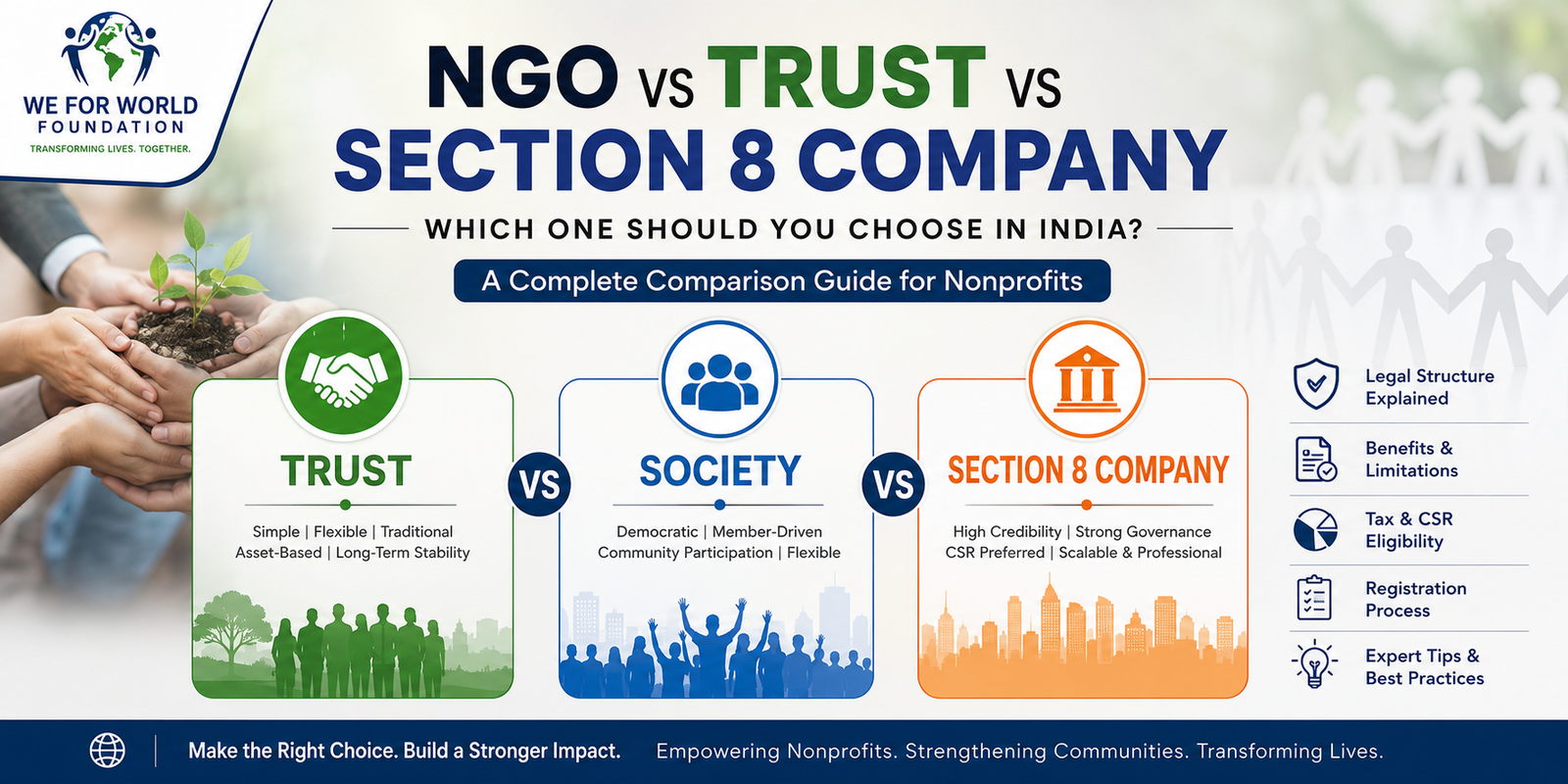
Starting a nonprofit organization is one of the most impactful ways to contribute to society. However, before beginning your social journey, one important question arises:
Should you register a Trust, Society, or Section 8 Company?
Many people use the word “NGO” as if it is a legal entity. In reality, NGO is not a legal structure. It is a broad term used to describe nonprofit organizations working for social welfare.
In India, most NGOs are legally registered as:
Each structure has its own advantages, legal requirements, governance model, compliance obligations, and suitability depending on your long-term vision.
This guide explains everything you need to know before choosing the right nonprofit structure.
NGO stands for Non-Governmental Organization.
It is not a legal form of registration but rather a general term for organizations working towards charitable, educational, environmental, healthcare, cultural, religious, or social causes.
An NGO in India usually registers under one of these laws:
A Trust is one of the oldest forms of nonprofit organizations in India.
It is established when a person (Settlor) transfers assets to Trustees who manage them for charitable purposes.
A Society is an association of individuals working together for a common charitable objective.
It is registered under the Societies Registration Act, 1860, along with applicable state laws.
A Section 8 Company is a nonprofit company incorporated under the Companies Act, 2013.
It is considered the most structured and professionally governed nonprofit entity in India.
Its profits cannot be distributed as dividends and must be used only for promoting charitable objectives.
| Feature | Trust | Society | Section 8 Company |
|---|---|---|---|
| Governing Law | State Trust Laws | Societies Registration Act | Companies Act, 2013 |
| Registration Authority | Local Registrar | Registrar of Societies | Registrar of Companies (MCA) |
| Minimum Members | 2–3 (state-specific) | 7 | 2 Directors & 2 Members (Private) |
| Legal Status | Moderate | Good | Excellent |
| Corporate Governance | Low | Medium | High |
| Compliance | Low | Medium | High |
| CSR Preference | Moderate | Good | Excellent |
| Credibility | Good | Good | Very High |
| Best For | Local charities | Community organizations | National & international nonprofits |
The right choice depends on your mission, governance needs, and future growth plans.
Registration alone does not automatically grant tax exemptions.
To access common tax benefits, organizations generally need to obtain applicable registrations under the Income-tax Act, such as:
Always consult a qualified Chartered Accountant or tax professional to determine the registrations relevant to your organization.
Companies covered under CSR obligations often look for implementing agencies that meet the requirements prescribed under the Companies Act and related CSR Rules.
Strong governance, transparent financial reporting, statutory compliance, and a proven track record significantly improve an organization’s ability to receive CSR support.
While legal structure is important, compliance and credibility are equally critical.
Although procedures vary by structure, the typical journey includes:
No. NGO is a general term, while a Trust is one specific legal structure used by many nonprofit organizations.
Many corporate donors value organizations with strong governance and compliance. A Section 8 Company is often preferred, although eligible Trusts and Societies can also implement CSR projects if they satisfy applicable legal requirements.
A Trust cannot automatically convert into a Section 8 Company. A new entity generally needs to be incorporated, and legal advice should be obtained before restructuring.
Trusts generally have fewer ongoing compliance requirements than Section 8 Companies, although obligations vary by state and applicable laws.
No. However, many donors prefer contributing to organizations that hold a valid 80G registration because it may provide tax benefits to eligible donors.
The minimum number of founders depends on the legal structure and applicable law.
Yes. Nonprofits may earn income through permissible activities, grants, donations, or services, provided the income is applied toward their charitable objectives and applicable legal conditions are met.
It depends on the nature of activities and applicable GST provisions. Registration may be required in certain circumstances.
Only organizations that comply with the applicable provisions of the Foreign Contribution (Regulation) Act (FCRA) may receive foreign contributions.
A Section 8 Company is widely regarded as having a strong governance framework due to its regulation under the Companies Act, 2013.
Choosing the right legal structure is one of the most important decisions when establishing a nonprofit organization. The appropriate option depends on your objectives, governance preferences, fundraising strategy, and long-term growth plans.
A carefully planned foundation today can help your organization build credibility, attract partners, and create lasting social impact.
The We For World Foundation Knowledge Centre is committed to empowering NGOs, Trusts, Foundations, Section 8 Companies, CSR professionals, volunteers, and social entrepreneurs through practical, reliable, and educational resources.
Explore our growing library of guides on NGO registration, CSR, fundraising, governance, compliance, taxation, FCRA, grant opportunities, and nonprofit management to strengthen your organization’s impact.