Starting an NGO is often driven by a simple but powerful purpose—to make a meaningful difference in people’s lives. Whether your organization works in education, healthcare, environmental conservation, women empowerment, child welfare, or rural development, financial sustainability is essential to continue creating impact.
Many newly registered NGOs focus on fundraising and project implementation but overlook one of the most important legal milestones: obtaining 12A and 80G registration under the Income Tax Act. Without these registrations, an NGO may face unnecessary tax liabilities, and potential donors may hesitate to contribute because they cannot claim tax benefits on their donations.
For founders, trustees, and nonprofit leaders, understanding these registrations is more than a compliance requirement. It is a strategic step that strengthens credibility, builds donor confidence, and improves long-term financial sustainability.
In this comprehensive guide, we’ll explain everything you need to know about 12A and 80G registration, including what they are, why they matter, who is eligible, the registration process, required documents, common mistakes to avoid, and how these certifications benefit both NGOs and their supporters.
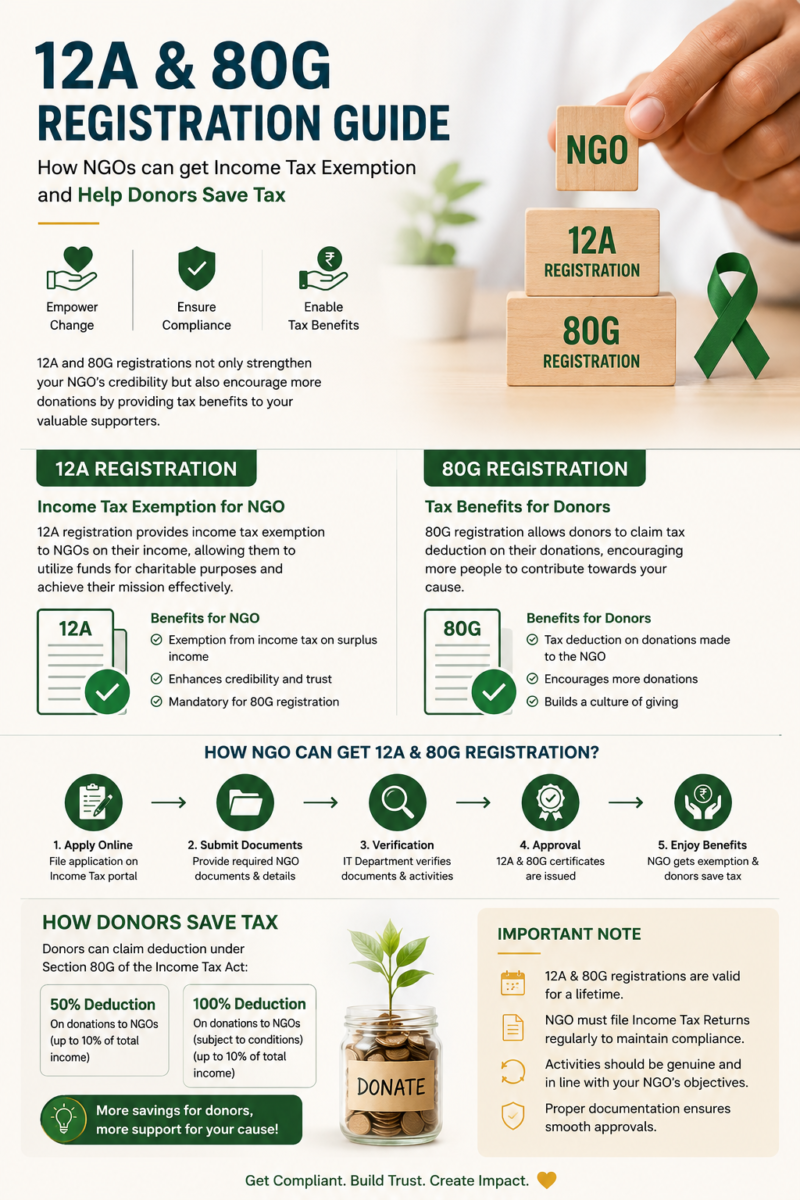
12A Registration (now administered under the updated provisions of Section 12AB of the Income Tax Act) allows eligible charitable and religious organizations to claim exemption from income tax on income applied toward their charitable objectives.
In simple terms, if an NGO receives grants, donations, membership fees, or other eligible income and uses those funds to carry out its charitable activities, 12A registration helps ensure that this income is not taxed, subject to compliance with the applicable provisions of the Income Tax Act.
Without this registration, an NGO may be treated like a regular taxable entity, reducing the resources available for community development and social welfare initiatives.
Obtaining 12A registration offers several long-term advantages for nonprofit organizations:
For many NGOs, 12A registration is one of the first major compliance milestones after establishing the organization. It not only protects financial resources but also signals professionalism and accountability to stakeholders.
While 12A registration benefits the NGO, 80G registration benefits the donor.
An NGO with valid 80G approval enables eligible donors to claim deductions on their taxable income for qualifying donations, subject to the conditions and limits prescribed under the Income Tax Act.
This tax benefit often encourages individuals, philanthropists, and businesses to contribute because their donations support a social cause while also offering tax relief.
For NGOs seeking long-term fundraising success, 80G registration is a powerful trust-building tool. Donors are generally more confident contributing to organizations that are legally compliant and transparent about how funds are managed and utilized.
Think of these registrations as complementary:
Together, they enhance the financial strength, credibility, and fundraising potential of a nonprofit organization.
One of the most common questions nonprofit founders ask is, “Is my organization eligible for 12A and 80G registration?” The good news is that a wide range of charitable organizations in India can apply, provided they operate with genuine charitable objectives and comply with the applicable provisions of the Income Tax Act.
Generally, organizations established for public welfare rather than private profit are eligible to seek these registrations. The Income Tax Department evaluates whether the organization is genuinely engaged in charitable activities and whether its governing documents support those objectives.
The following types of nonprofit entities are generally eligible to apply:
Regardless of the legal structure, the organization should be created with charitable purposes and maintain proper governance and financial records.
Many founders believe that only organizations distributing food or clothing qualify as charitable institutions. In reality, the law recognizes a much broader range of charitable activities.
An NGO may qualify if it works in areas such as:
Organizations providing education, scholarships, digital learning, vocational training, or literacy programs often qualify as charitable institutions.
Healthcare-focused NGOs working to improve community health are also generally eligible.
Examples include:
Organizations supporting economically weaker communities through food, shelter, clothing, or livelihood assistance are recognized as charitable institutions.
Examples include:
Organizations dedicated to improving the lives of women through education, employment, legal awareness, and healthcare may also qualify.
Examples include:
NGOs working for children’s education, nutrition, health, protection, or rehabilitation generally fall within recognized charitable purposes.
Examples include:
Environmental conservation has become an increasingly important area of charitable work.
Activities may include:
Organizations working to improve village infrastructure and livelihoods can also qualify.
Examples include:
Preparing complete and accurate documentation can significantly improve the efficiency of the registration process. Missing or inconsistent records are among the most common reasons applications are delayed.
While document requirements may vary depending on the organization, the following are commonly required:
The Income Tax Department generally requires proof of the registered office address.
Examples include:
For organizations already operating, the following may be required:
Newly established NGOs that have not yet commenced activities may not have historical financial records but should maintain proper documentation from the beginning.
Applicants should also demonstrate that the organization is genuinely pursuing charitable objectives.
Supporting documents may include:
These records help establish the authenticity of the NGO’s work and its commitment to public welfare.
Well-organized documentation does more than support a registration application. It reflects transparency, good governance, and accountability—qualities that are valued by government authorities, CSR partners, grant-making institutions, and individual donors alike.
Keeping records up to date also makes future renewals, audits, and compliance requirements much easier to manage.