Every NGO starts with a vision to solve a social problem and create meaningful change. However, turning that vision into reality requires resources, planning, and financial support. While donations and CSR partnerships are important funding sources, grants remain one of the most valuable opportunities for NGOs to develop sustainable projects.
Many NGOs have impactful ideas but struggle to receive funding because their proposals fail to clearly communicate the problem, solution, impact, and implementation strategy.
Grant proposal writing for NGOs is not simply about requesting financial support. It is about presenting a well-researched project plan that helps funders understand why your organization deserves support and how their investment will create measurable social impact.
A strong grant proposal combines storytelling, data, budgeting, project planning, and transparency. Whether your NGO works in education, healthcare, women empowerment, environmental protection, child welfare, or rural development, learning how to write effective grant proposals can significantly improve your chances of securing funding.
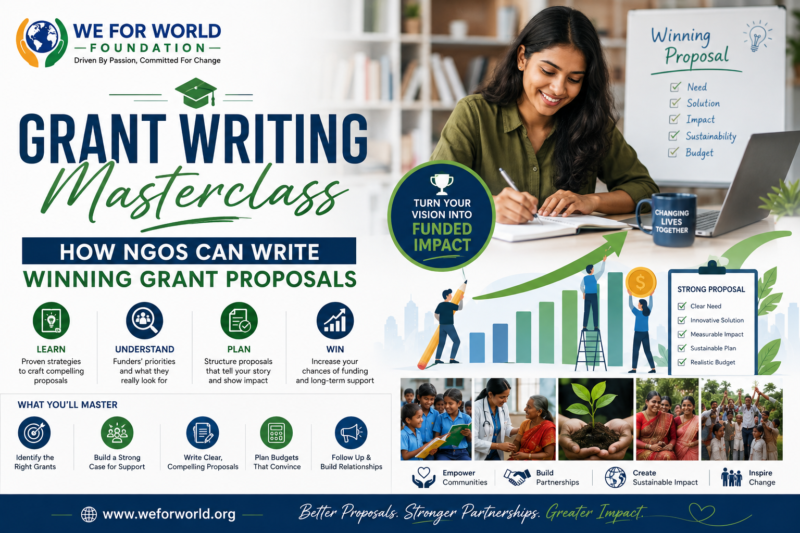
This Grant Writing Masterclass will guide NGO founders, trustees, and nonprofit professionals through the complete process of writing winning grant proposals, finding suitable funding opportunities, and building stronger relationships with donors.
NGOs can write successful grant proposals by understanding donor requirements, identifying the right funding opportunity, clearly explaining the social problem, presenting realistic solutions, creating measurable objectives, preparing a detailed budget, and showing how the project will create long-term impact.
Grant proposal writing is the process of preparing a formal document that explains an NGO’s project idea, funding requirements, objectives, implementation plan, and expected outcomes to a potential funder.
A grant proposal allows organizations to communicate:
Unlike general fundraising appeals, grant proposals require a structured and professional approach. Funders usually evaluate multiple applications, and NGOs that present clear, realistic, and measurable plans have a better chance of receiving support.
Grant funding can help NGOs expand their programs, reach more beneficiaries, and create long-term solutions.
Many NGOs have innovative ideas but lack sufficient resources to implement them. Grants provide financial assistance that helps organizations execute planned activities effectively.
Examples:
With grant support, NGOs can move beyond small initiatives and expand their work to larger communities.
For example:
A small education program supporting 50 children can potentially expand to hundreds of students with proper funding and planning.
Receiving grants from recognized institutions increases an NGO’s credibility.
Successful grant partnerships demonstrate:
This can also help attract future donors and CSR partnerships.
A well-written grant proposal can help NGOs develop sustainable programs instead of depending only on occasional donations.
Strategic grant funding allows organizations to:
Understanding different types of grants helps NGOs identify suitable funding opportunities.
Government departments provide grants for organizations working in priority development areas.
Common sectors include:
NGOs must meet eligibility requirements and maintain proper documentation.
Many companies provide grants through their CSR initiatives.
Corporate grants usually support projects aligned with:
A strong CSR proposal should clearly explain:
Private foundations and charitable institutions provide funding for specific causes.
These grants may focus on:
NGOs should carefully study each foundation’s funding priorities before applying.
International organizations and global foundations support NGOs working on social and environmental challenges.
International grants often require:
Writing a successful grant proposal requires proper research, planning, and communication. Funders receive hundreds of applications, and NGOs that present clear objectives, realistic budgets, and measurable impact have a better chance of approval.
A professional NGO grant proposal should not only explain the funding requirement but also demonstrate why the project matters and how it will create meaningful change.
Follow these steps to prepare a strong grant proposal.
The first step in successful grant writing is finding a funding opportunity that matches your NGO’s mission.
Many NGOs make the mistake of applying for every available grant without checking whether their project aligns with the funder’s objectives.
Before applying, research:
For example, an NGO working on education programs should focus on funders supporting education, child development, or skill-building initiatives.
A well-matched proposal has a much higher chance of success than a generic application.
Every donor has different expectations and evaluation criteria.
Before writing your proposal, carefully study:
Understanding donor expectations helps NGOs create proposals that directly answer the funder’s questions.
A common reason grant applications get rejected is failing to follow submission guidelines.
The executive summary is the first section many funders read.
It should provide a quick overview of:
A strong executive summary should immediately communicate why the project deserves support.
Example:
“XYZ Foundation aims to improve digital literacy among rural students by providing computer education, trained instructors, and learning resources to underserved communities.”
The summary should be clear, professional, and impact-focused.
A successful grant proposal starts with a clear understanding of the problem.
Funders want to know:
Avoid making general statements.
Instead of writing:
“Many children lack education.”
Write:
“Thousands of children in rural communities face barriers such as limited access to digital learning facilities, trained teachers, and educational resources.”
Using facts, research, and local data makes your proposal stronger.
Before funding a project, donors need confidence in the organization implementing it.
Your NGO profile should include:
Highlight achievements that demonstrate your ability to successfully complete the proposed project.
Important details may include:
A grant proposal must explain exactly what the project aims to achieve.
Goals describe the overall purpose, while objectives explain measurable results.
Example:
Improve healthcare access in rural communities.
Strong objectives should follow the SMART principle:
Funders want to understand how your NGO will execute the project.
The implementation plan should explain:
Example:
| Activity | Timeline | Expected Result |
|---|---|---|
| Community survey | Month 1 | Identify beneficiaries |
| Training sessions | Month 2-6 | Skill development |
| Impact evaluation | Month 12 | Measure outcomes |
A detailed plan shows that your NGO has prepared carefully.
A clear and realistic budget is one of the most important parts of an NGO grant proposal.
The budget should explain how funding will be used.
Common budget categories include:
Avoid unrealistic estimates or unnecessary expenses.
Funders prefer proposals where every expense directly supports project goals.
Successful NGOs do not only implement projects—they measure results.
A monitoring plan explains how your organization will track progress.
Include:
Examples:
Education project indicators:
Healthcare project indicators:
Measurable impact increases funder confidence.
Funders want to know what happens after the grant period ends.
A sustainability plan explains how the project can continue in the future.
Possible sustainability strategies:
A project with long-term potential is more attractive to donors.
A professional NGO grant proposal follows a structured format that helps funders understand the organization, project requirements, implementation strategy, and expected impact.
A well-organized proposal makes it easier for donors to evaluate the project’s purpose and decide whether it aligns with their funding objectives.
While different funders may have different requirements, most successful grant proposals include the following sections.
The cover page creates the first impression of your grant proposal.
It should include essential information such as:
A professional cover page reflects the seriousness and credibility of your NGO.
Example:
Project Title:
“Digital Education Initiative for Rural Students”
Submitted By:
“We For World Foundation”
The executive summary provides a brief overview of the complete proposal.
Although it appears at the beginning, many organizations write it after completing the full proposal because it summarizes all important points.
It should explain:
A strong executive summary should be clear enough that a donor understands the entire project within a few minutes.
The organization profile introduces your NGO to potential funders.
This section should highlight:
Include relevant credibility factors such as:
A strong organization profile builds trust with donors.
The problem statement explains the social issue your NGO wants to address.
A convincing problem statement should answer:
Use:
Avoid emotional statements without supporting information.
A combination of human stories and reliable data creates a stronger impact.
The project description explains what your NGO plans to implement.
It should include:
Example:
Project:
“Women Skill Development Program”
Activities:
A clear project description helps donors understand how their funding will be utilized.
Funders want to know who will benefit from the project.
Clearly mention:
Example:
“The project will support 500 rural women between the ages of 18–45 by providing vocational training and employment support.”
Specific beneficiary details make proposals more measurable.
A timeline shows how the NGO plans to complete project activities.
A simple timeline can include:
| Project Stage | Duration |
|---|---|
| Planning and research | Month 1 |
| Implementation | Month 2–10 |
| Monitoring | Month 6–12 |
| Final evaluation | Month 12 |
A realistic timeline demonstrates proper project management.
The budget section explains how grant funds will be used.
A detailed budget should include:
Every expense should connect directly with project activities.
Funders prefer transparent and justified budgets.
Monitoring and evaluation (M&E) help measure whether the project is achieving its goals.
This section should explain:
Examples of indicators:
Education Project:
Healthcare Project:
This section explains the change your project will create.
Strong proposals focus on measurable outcomes.
Example:
Instead of:
“We will improve education.”
Write:
“The project aims to improve learning outcomes for 1,000 students by providing educational resources, digital learning support, and teacher training.”
Clear impact statements help funders understand the value of their investment.
A grant-funded project should have a future beyond the funding period.
Explain how the initiative will continue through:
Sustainability shows that your NGO is focused on long-term change.
Many grant applications require supporting documents to verify NGO credibility.
Common documents include:
Preparing documents in advance makes the application process smoother.
Every funder has specific priorities.
Customize each proposal instead of sending the same document everywhere.
Donors are interested in outcomes.
Explain:
Avoid complicated words.
A good proposal should be:
Small mistakes can affect credibility.
Check:
Writing a grant proposal requires careful planning and attention to detail. Even NGOs with excellent projects may face rejection if their proposal does not clearly communicate the project’s value.
Understanding common mistakes can help organizations improve their applications and increase their chances of receiving funding.
One of the biggest mistakes NGOs make is applying for grants that do not match their work area.
For example:
An NGO working in healthcare applying for an environmental conservation grant may have very little chance of approval.
Before applying, NGOs should study:
A targeted application is always stronger than a general one.
Many NGOs create one proposal and send it to multiple funders without customization.
This approach often fails because every donor has different priorities.
A successful proposal should be customized according to:
Funders want to see that the NGO understands their vision.
A proposal without a strong problem statement fails to convince donors.
Simply stating:
“People need help”
is not enough.
A strong problem statement should explain:
Research-based proposals create more confidence among funders.
Funders need to understand exactly what the project will achieve.
Weak objective:
“We want to improve education.”
Strong objective:
“We aim to provide digital learning support to 500 rural students within 12 months through technology-based education programs.”
Clear and measurable objectives make proposals stronger.
An unclear or unrealistic budget can reduce the chances of approval.
Common budget mistakes include:
A good budget should be:
Funders want to know how success will be measured.
A proposal should include:
Without measurable outcomes, donors may find it difficult to understand the project’s effectiveness.
Many funding organizations verify an NGO’s legal and financial compliance before approving grants.
Important documents may include:
Maintaining updated compliance documents improves credibility.
A proposal represents your organization.
Spelling mistakes, incorrect information, poor formatting, or missing documents can negatively affect the donor’s impression.
Before submission:
Professional presentation increases trust.
Receiving grants is not only about writing a proposal. It is about building a strong organizational foundation.
Here are practical ways NGOs can improve their chances of securing funding.
Successful NGOs maintain proper records.
Important documents include:
Good documentation shows professionalism and transparency.
Numbers are important, but stories create emotional connection.
Share:
A combination of data and human stories makes proposals more powerful.
Grant funding is often relationship-based.
NGOs should:
Strong relationships can create future funding opportunities.
A sustainable NGO should not depend on only one grant.
A balanced funding model may include:
Diversified funding creates financial stability.
Grant writing is a skill that improves with experience.
NGOs should regularly:
Better proposals lead to better funding opportunities.
Grant proposal writing for NGOs is the process of preparing a formal document that explains an organization’s project goals, funding requirements, implementation plan, and expected impact to potential donors or funding institutions.
NGOs can write successful grant proposals by researching suitable funders, explaining the social problem clearly, presenting measurable objectives, creating realistic budgets, and demonstrating long-term impact.
A professional NGO grant proposal usually includes:
Common documents required include:
Requirements may vary depending on the funding organization.
New NGOs can get grants by building credibility, maintaining compliance, creating strong project proposals, developing partnerships, and applying for suitable funding opportunities.
Common reasons include poor alignment with donor goals, unclear objectives, unrealistic budgets, weak impact measurement, incomplete documents, and lack of project planning.
The length depends on donor requirements. A detailed proposal may range from a few pages to a complete project document covering objectives, activities, budget, and impact measurement.
A successful grant proposal is clear, well-researched, realistic, impact-focused, and aligned with the funder’s objectives.
Yes, small NGOs can apply for grants if they meet eligibility requirements and demonstrate their ability to successfully implement projects.
A grant proposal is usually submitted to institutions, foundations, or government bodies following specific requirements. A fundraising proposal may be used for individual donors, campaigns, or general financial support.
Grant funding can provide NGOs with the resources needed to expand programs, support communities, and create lasting social change. However, receiving grants requires more than having a meaningful mission—it requires effective planning, professional documentation, and strong communication.
A successful grant proposal writing for NGOs approach focuses on understanding donor expectations, presenting clear solutions, creating measurable goals, and demonstrating how funding will create meaningful impact.
NGOs that invest time in improving their grant writing skills can increase their chances of securing support from foundations, corporations, government programs, and other funding institutions.
At We For World Foundation, we believe that stronger NGOs create stronger communities. Through awareness, resources, and knowledge sharing, we aim to support nonprofit organizations in improving their compliance, fundraising strategies, and long-term sustainability.
By learning how to prepare professional grant proposals, NGOs can move closer to achieving their mission and creating a greater impact in society.