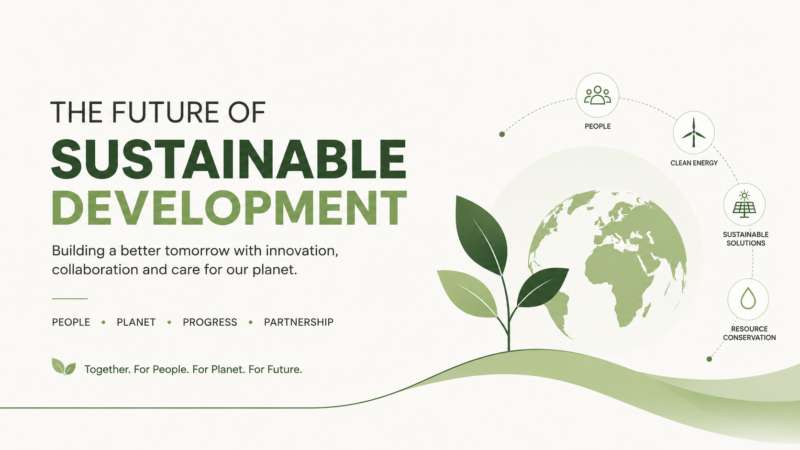
Sustainability is entering a completely new era.
For decades, sustainable development primarily focused on environmental conservation, poverty reduction, healthcare, education, and economic growth. Today, these priorities remain essential—but the tools available to achieve them have evolved dramatically.
Artificial Intelligence (AI), Digital Public Infrastructure (DPI), blockchain, satellite technology, open data, and collaborative digital ecosystems are enabling governments, nonprofits, businesses, and communities to solve complex challenges faster than ever before.
The future of sustainable development will not be driven by one organization alone. It will be built through intelligent collaboration powered by technology and guided by people.
Sustainable development means meeting today’s needs without compromising the ability of future generations to meet theirs.
It is built around three interconnected pillars:
These principles continue to guide the United Nations Sustainable Development Goals (SDGs), but implementation strategies are rapidly changing due to technological innovation.
Today’s sustainability efforts increasingly rely on real-time data, predictive analytics, digital governance, and cross-sector partnerships.
The world now generates more information in a single day than previous generations produced over decades.
This data can help solve problems only when transformed into actionable insights.
Modern technologies are enabling organizations to:
Technology has become the infrastructure that supports sustainable decision-making.
Artificial Intelligence is no longer limited to research laboratories.
It is becoming one of the most important tools for governments, nonprofits, researchers, educators, healthcare professionals, and environmental organizations.
AI helps organizations:
Machine learning models analyze weather patterns, satellite imagery, and historical climate data to forecast floods, droughts, heatwaves, and storms.
Communities can prepare before disasters occur.
AI-powered precision farming helps farmers:
This directly contributes to food security and sustainable farming.
Healthcare organizations now use AI to:
These innovations improve healthcare accessibility while reducing operational costs.
AI-powered learning platforms personalize education based on individual learning styles.
Students receive adaptive content, while teachers gain insights into learning progress.
This helps improve educational equity across diverse communities.
Digital Public Infrastructure (DPI) refers to shared digital systems that enable governments and citizens to access essential public services efficiently.
Examples include:
When implemented responsibly, DPI improves transparency, reduces administrative costs, and increases public trust.
It also accelerates inclusive development by ensuring services reach underserved populations.
The biggest global challenges cannot be solved by isolated organizations.
Collaboration has become the foundation of sustainable impact.
Modern ecosystems bring together:
These networks enable organizations to share knowledge, resources, expertise, and technology.
Collaboration reduces duplication while increasing measurable outcomes.
Successful development initiatives increasingly rely on evidence rather than assumptions.
Organizations now measure:
Reliable data enables continuous improvement and stronger accountability.
Environmental, Social, and Governance (ESG) principles are influencing investment decisions worldwide.
Businesses increasingly recognize that sustainability is not merely corporate responsibility—it is long-term business resilience.
Organizations embracing ESG often benefit from:
Innovation and sustainability are becoming inseparable.
Technology can accelerate development, but people remain at the center of sustainable progress.
Communities possess local knowledge that algorithms cannot replace.
Successful initiatives combine:
This balanced approach creates solutions that are both effective and sustainable.
Despite technological advances, important challenges remain.
These include:
Millions still lack reliable internet access and digital literacy.
Inclusive technology adoption remains essential.
Responsible data governance protects individuals while enabling innovation.
Ethical AI requires transparency and accountability.
Many regions are already experiencing severe climate impacts.
Investment in resilience is becoming increasingly urgent.
Many nonprofit organizations continue to face limited access to sustainable financing.
Innovative funding models, partnerships, and CSR collaborations will play a critical role.
The coming decade is likely to witness:
Organizations that embrace innovation while maintaining human-centered values will create the greatest long-term impact.
The future of sustainable development is not solely about technology.
It is about empowering people with better tools, stronger partnerships, and shared knowledge to solve global challenges responsibly.
Artificial Intelligence, Digital Public Infrastructure, collaborative ecosystems, and data-driven decision-making are transforming how societies address environmental, economic, and social issues.
Yet the most powerful driver of sustainable progress remains collective action.
Every government, nonprofit, business, researcher, volunteer, and citizen has a role to play in creating resilient communities and a healthier planet.
By combining innovation with inclusion, sustainability can evolve from aspiration into measurable, lasting impact.
The future of sustainable development involves combining technology, innovation, community participation, and responsible governance to address environmental, social, and economic challenges more effectively.
AI supports sustainable development by improving healthcare, agriculture, disaster prediction, education, climate monitoring, resource management, and data-driven decision-making.
Digital Public Infrastructure (DPI) consists of secure digital systems—such as digital identity, payment platforms, and public service networks—that improve access to government and community services.
Global challenges require expertise from governments, nonprofits, businesses, researchers, and communities. Collaboration accelerates innovation, reduces duplication, and increases long-term impact.
Organizations can contribute by adopting sustainable practices, investing in ESG initiatives, using technology responsibly, supporting community development, and partnering across sectors to create measurable social and environmental impact.