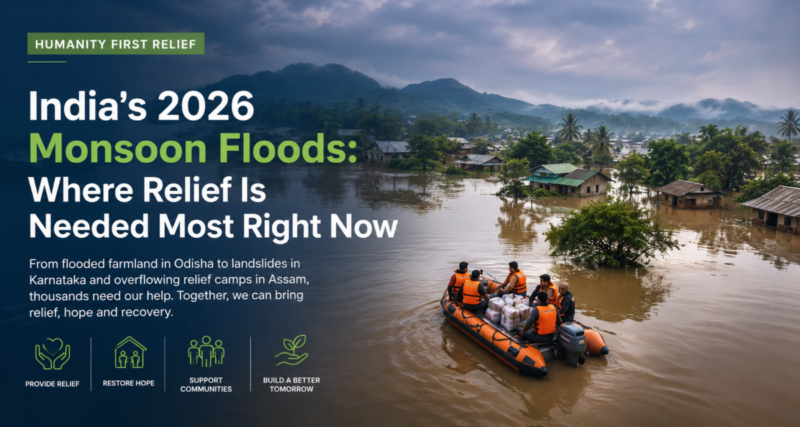
India’s 2026 southwest monsoon has been one of the more punishing in recent years. Since July, unusually heavy rainfall has triggered floods and landslides across at least five states — Kerala, Karnataka, Assam, Gujarat and Odisha — leaving a trail of damaged homes, submerged farmland and disrupted lives. While the headlines move on quickly, the recovery work for affected families is only just beginning.
At We For World Foundation, our Humanity First Relief initiative exists for exactly this moment. Here’s a state-by-state look at where things stand, and where support is needed most.
Kerala and Karnataka: Rescue Operations Still Underway
In Kerala, days of relentless rain triggered widespread flooding that has claimed at least a dozen lives and forced thousands of families out of their homes. Close to 7,700 people have been moved into roughly 275 relief camps set up across the state. Just across the border in Karnataka, the same spell of rain triggered a landslide that added to the toll. Rescue and evacuation efforts in both states are still active, with local authorities coordinating shelter, food and medical aid for displaced families.
Assam: Camps Still Full, Relief Still Falling Short
Assam has arguably seen the most sustained flood crisis of the season. At its late-July peak, the state was running over 360 relief camps and distribution centres sheltering more than 1.15 lakh people. Even as floodwaters have begun to recede in parts of the state, officials have openly acknowledged that relief has not yet reached tens of thousands of affected residents — a gap that is particularly stark in constituencies like Nazira and Sivasagar. The India Meteorological Department has continued to flag the region for further heavy rainfall, meaning the situation remains fluid rather than resolved.
Gujarat and Odisha: Farmland and Livelihoods Under Water
Further west, Gujarat has seen tens of thousands of residents evacuated as record-breaking rainfall overwhelmed roads, bridges and homes. In Odisha, the damage has hit differently — thousands of acres of farmland have been submerged, threatening the livelihoods of agricultural communities who depend on this season’s harvest. For many families in both states, the disruption won’t end when the water recedes; it will show up months later, in lost income and lost crops.
Why This Moment Matters for CSR and Donor Partners
Disaster relief funding tends to follow the news cycle — generous in the first week, and largely gone by the time the real recovery work (rebuilding homes, restoring livelihoods, getting children back into school) actually begins. That gap is where structured, sustained partnerships make the biggest difference.
For corporates evaluating where their CSR budgets can create the most measurable impact this quarter, monsoon relief and post-flood livelihood restoration offer a clear, outcome-linked opportunity — immediate relief now, and rehabilitation support over the months that follow.
How You Can Help Through WFWF
Through our Humanity First Relief initiative, We For World Foundation works with on-ground partners to channel support toward emergency essentials — food, clean water, shelter materials and medical aid — for families displaced by this year’s floods, with a longer-term focus on helping affected communities rebuild.
| Want to make a measurable difference this monsoon season? Get in touch with our partnerships team to discuss a relief contribution or a longer-term CSR collaboration: weforworld.org/contact |