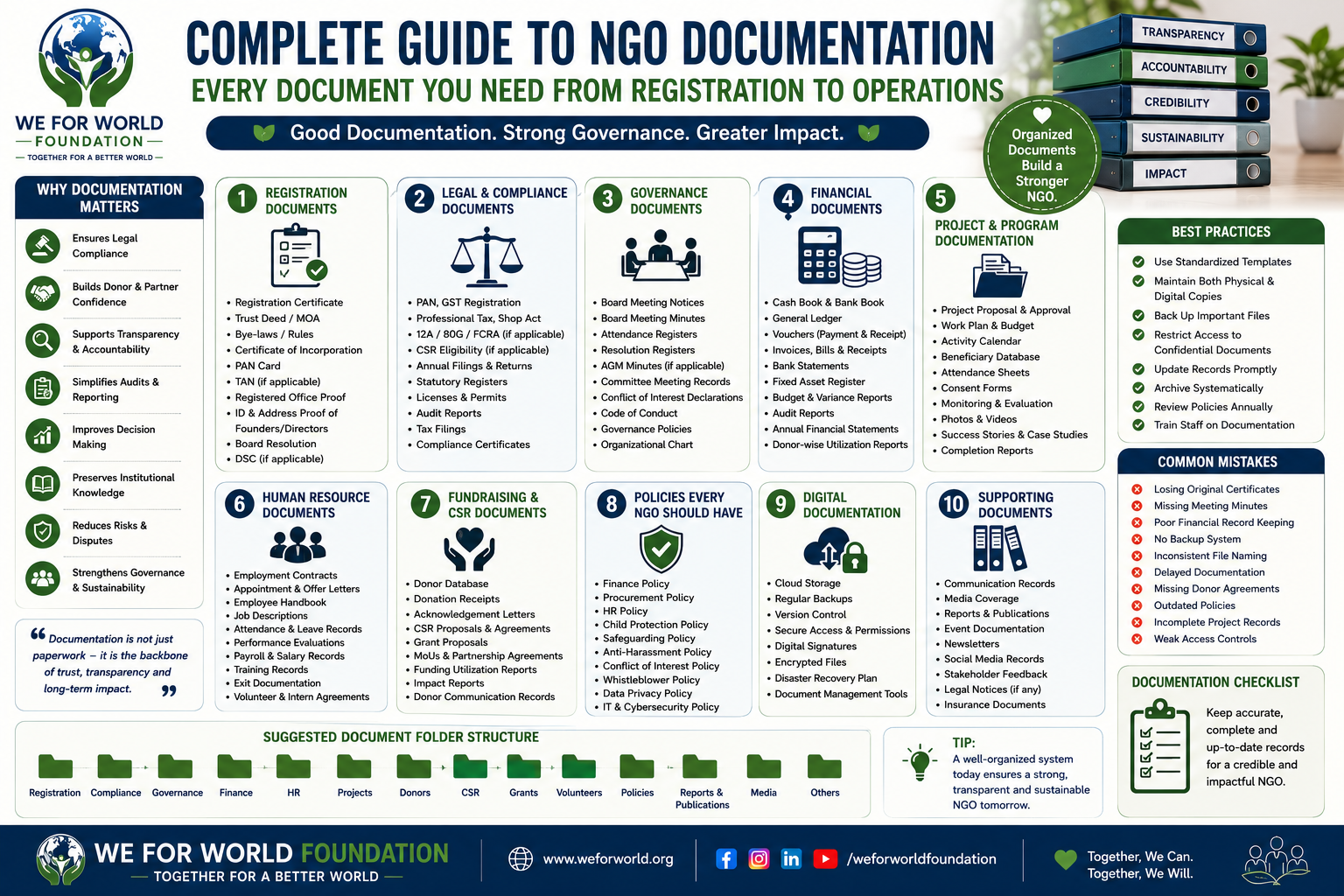
Proper documentation is the backbone of every successful NGO. Whether you’re registering a new organization, applying for grants, receiving CSR funding, managing employees, conducting projects, or undergoing an audit, maintaining accurate and organized records is essential.
Many NGOs focus on implementing impactful programs but overlook the importance of documentation. Missing or poorly maintained records can delay funding, create compliance issues, weaken donor confidence, and expose the organization to legal and operational risks.
This guide provides a comprehensive overview of the key documents every NGO should maintain throughout its lifecycle—from registration to governance, fundraising, financial management, human resources, and project execution.
Table of Contents
Why Documentation Matters
Good documentation is more than an administrative requirement—it demonstrates accountability, transparency, and professionalism.
Proper records help NGOs:
Well-maintained documentation reflects a well-managed organization.
Stage 1: Registration Documents
The first set of documents establishes the legal identity of your NGO.
Depending on your legal structure, maintain copies of:
Store both physical and digital copies securely.
Stage 2: Legal & Compliance Documents
Compliance documentation ensures your NGO meets statutory obligations.
Maintain records such as:
Create a compliance calendar to avoid missed deadlines.
Stage 3: Governance Documents
Good governance begins with proper documentation.
Essential governance records include:
These records demonstrate transparent decision-making.
Stage 4: Financial Documents
Financial documentation is critical for accountability and donor confidence.
Maintain:
| Financial Document | Purpose |
| Cash Book | Daily transactions |
| Bank Book | Bank records |
| General Ledger | Financial accounting |
| Payment Vouchers | Expense records |
| Receipt Vouchers | Income records |
| Invoices | Vendor documentation |
| Bills & Receipts | Supporting evidence |
| Bank Statements | Financial verification |
| Fixed Asset Register | Asset tracking |
| Budget Reports | Financial planning |
| Audit Reports | Independent verification |
| Annual Financial Statements | Organizational reporting |
Maintain supporting documentation for every financial transaction.
Stage 5: Project Documentation
Every project should be supported by complete records.
Project documents include:
Proper project records simplify reporting to donors and grantmakers.
Stage 6: Human Resource Documentation
As your NGO grows, HR documentation becomes increasingly important.
Maintain:
Clearly documented HR processes promote fairness and consistency.
Stage 7: Fundraising & CSR Documentation
Fundraising requires organized documentation to establish credibility.
Maintain:
Professional documentation strengthens relationships with supporters.
Stage 8: Policies Every NGO Should Have
Policies guide decision-making and reduce organizational risk.
Recommended policies include:
Policies should be reviewed periodically and communicated to staff.
Stage 9: Digital Documentation
Modern NGOs should maintain secure digital records.
Best practices include:
Digitization improves accessibility while reducing the risk of document loss.
Suggested Folder Structure
A simple and organized folder structure may look like this:
NGO Documents
│
├── Registration
├── Compliance
├── Governance
├── Finance
├── HR
├── Projects
├── Donors
├── CSR
├── Grants
├── Volunteers
├── Communications
├── Annual Reports
├── Media
└── Policies
A consistent filing system saves time and improves collaboration.
Best Practices for Document Management
Follow these practices to keep records organized and secure:
Good record management supports transparency and operational efficiency.
Common Documentation Mistakes
Avoid these common errors:
Small documentation gaps can become major compliance issues over time.
NGO Documentation Checklist
✅ Registration Certificate
✅ Governing documents (Trust Deed/MOA/Bye-laws)
✅ PAN and statutory registrations
✅ Board meeting records
✅ Financial books and vouchers
✅ Audit reports
✅ Annual reports
✅ HR records
✅ Volunteer records
✅ Project documentation
✅ Donor and CSR records
✅ Organizational policies
✅ Digital backups
✅ Secure cloud storage
Frequently Asked Questions
Documentation supports legal compliance, financial transparency, governance, operational efficiency, and donor confidence.
Yes. Maintaining secure physical and digital copies reduces the risk of document loss and improves accessibility.
Retention periods vary depending on applicable laws, donor requirements, and organizational policies. Establish a document retention policy that complies with relevant regulations.
Financial records, vouchers, bank statements, audit reports, governance records, statutory filings, and supporting documentation for transactions and projects.
Registration certificates, governing documents, financial statements, audit reports, annual reports, impact reports, and project proposals.
Yes. Policies promote consistency, accountability, risk management, and compliance.
Use a clear folder hierarchy, consistent naming conventions, regular backups, and secure cloud storage with role-based access.
Assign clear responsibility to designated staff or administrators, while ensuring leadership provides oversight and periodic reviews.
Update records promptly after significant events, transactions, meetings, or project activities. Regular reviews help ensure accuracy.
Treating documentation as an afterthought instead of integrating it into daily operations and governance.
Final Key Takeaways
Conclusion
Effective documentation is not simply about filing paperwork—it is about building a resilient, accountable, and professional organization. Every certificate, policy, financial record, meeting minute, and project report contributes to your NGO’s credibility and ability to serve communities effectively.
Organizations that prioritize documentation are better equipped to navigate audits, secure grants, manage risks, and maintain the trust of donors, partners, volunteers, and beneficiaries. By investing in robust documentation systems today, your NGO lays a strong foundation for sustainable growth and greater social impact tomorrow.
Continue Your Learning with WFWF
The We For World Foundation (WFWF) Knowledge Centre is dedicated to empowering NGOs, trusts, Section 8 companies, CSR professionals, donors, volunteers, and social entrepreneurs with practical, reliable, and easy-to-understand educational resources. Explore our comprehensive guides on NGO registration, governance, compliance, fundraising, branding, digital transformation, financial management, and nonprofit leadership to strengthen your organization and maximize its positive impact.