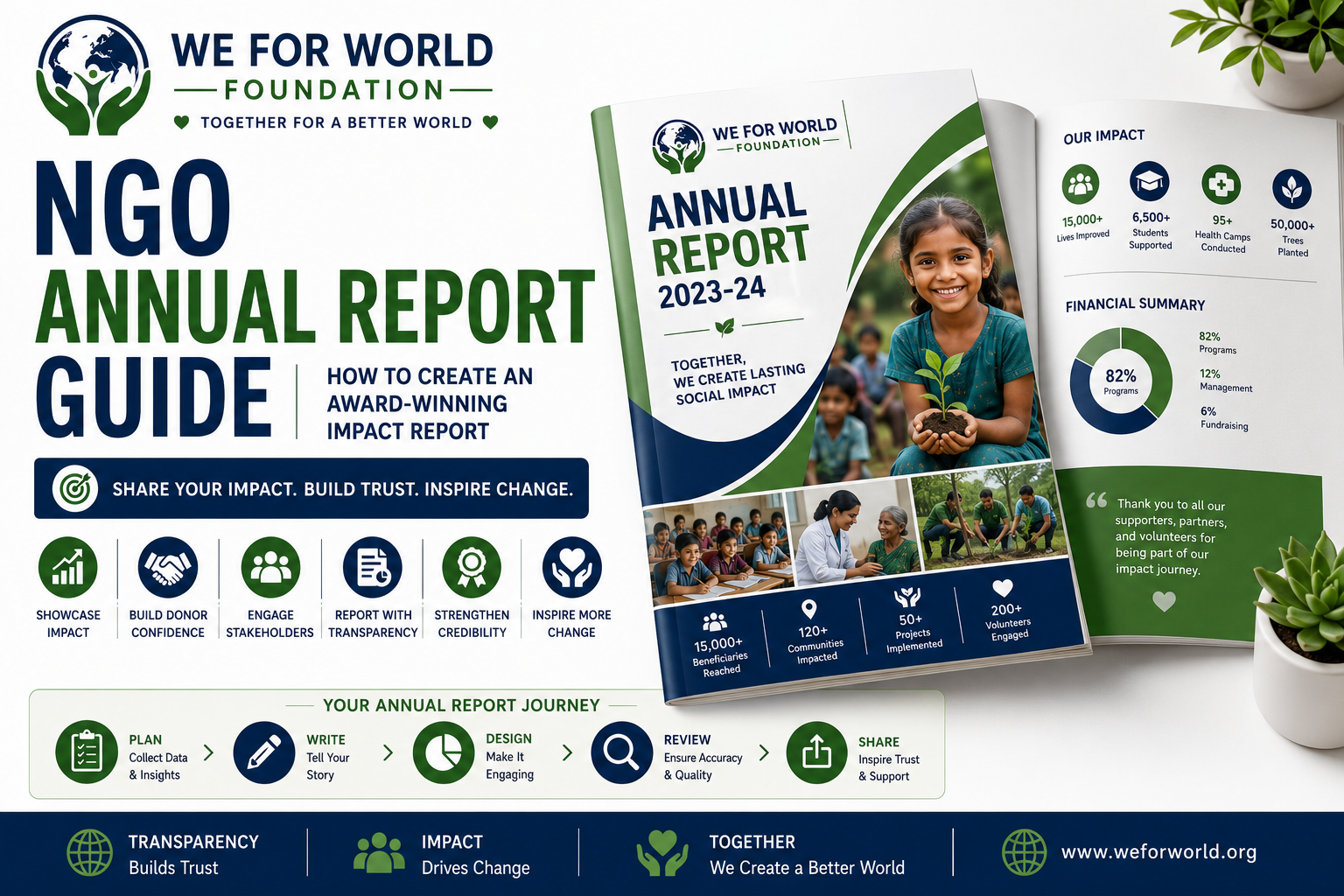
An annual report is much more than a statutory publication—it is the story of your NGO’s journey over the past year. It reflects your mission, demonstrates transparency, showcases measurable impact, and strengthens trust among donors, CSR partners, government agencies, volunteers, beneficiaries, and the wider community.
For many supporters, your annual report is the first impression they have of your organization. A professionally designed report can inspire confidence, attract new funding opportunities, and reinforce your NGO’s credibility. On the other hand, a poorly prepared report can undermine even the most impactful work.
This comprehensive guide explains how to create an engaging, informative, and professional NGO annual report that not only fulfills reporting requirements but also serves as a powerful communication and fundraising tool.
Table of Contents
What is an NGO Annual Report?
An NGO Annual Report is a comprehensive publication that summarizes an organization’s activities, achievements, financial performance, governance, partnerships, and social impact during a specific financial or calendar year.
It serves multiple purposes:
A great annual report combines facts, data, stories, and visuals into one compelling publication.
Why Every NGO Needs an Annual Report
An annual report helps your NGO:
Publishing a high-quality report annually signals professionalism and accountability.
Benefits of an Impact Report
A well-prepared annual report can:
Think of your annual report as both a record of achievements and a strategic marketing document.
Step 1: Plan Before You Write
Preparation makes report writing easier.
Collect information throughout the year instead of waiting until year-end.
Create folders for:
Organized documentation leads to a stronger report.
Step 2: Start with a Powerful Cover
Your cover should immediately communicate your organization’s purpose.
Include:
Keep the design clean, modern, and visually engaging.
Step 3: Include a Message from Leadership
A message from the Chairperson, Founder, President, or Executive Director adds a personal touch.
The message should:
Authentic leadership communication builds trust.
Step 4: Introduce Your Organization
Provide a concise overview of your NGO.
Include:
This section helps new readers understand your organization.
Step 5: Showcase Your Programs
Dedicate sections to major projects.
For each project include:
Use visuals and concise narratives to keep readers engaged.
Step 6: Highlight Your Impact
Move beyond describing activities—demonstrate results.
Present measurable outcomes such as:
| Indicator | Example |
| Beneficiaries reached | 15,000 |
| Villages covered | 120 |
| Volunteers engaged | 450 |
| Training sessions | 180 |
| Trees planted | 50,000 |
| Scholarships awarded | 620 |
| Medical camps conducted | 95 |
Support statistics with stories that illustrate real-life change.
Step 7: Tell Human Stories
Data informs, but stories inspire.
Feature:
Always obtain appropriate consent before publishing personal stories or images.
Step 8: Present Financial Information Clearly
Financial transparency is essential.
Include:
Present financial data using clear charts and simple explanations.
Step 9: Showcase Partnerships
Recognize organizations and individuals who supported your work.
Highlight:
Acknowledging partners strengthens long-term relationships.
Step 10: Recognize Your Team
Celebrate the people behind your impact.
Include:
Recognition builds morale and appreciation.
Step 11: Share Future Goals
End the report by looking ahead.
Discuss:
This section invites stakeholders to remain part of your journey.
Design Tips for an Award-Winning Report
A professional report should feature:
Visual design should enhance—not overwhelm—the content.
Print vs. Digital Annual Reports
| Printed Report | Digital Report |
| Suitable for formal meetings | Easy to share globally |
| Premium presentation | Lower distribution cost |
| Tangible leave-behind | Interactive features possible |
| Higher printing costs | Environmentally friendly |
Many NGOs publish a downloadable PDF while printing limited copies for key stakeholders.
Common Annual Report Mistakes
Avoid these pitfalls:
An effective report balances information with readability.
NGO Annual Report Checklist
✅ Cover page
✅ Leadership message
✅ Mission and vision
✅ Organizational overview
✅ Programs and projects
✅ Impact statistics
✅ Beneficiary stories
✅ Financial summary
✅ Governance information
✅ Partner acknowledgements
✅ Future plans
✅ Professional design
✅ Contact information
Frequently Asked Questions
It communicates an NGO’s activities, financial performance, governance, and social impact while promoting transparency and stakeholder confidence.
Most organizations publish one report each financial or calendar year.
Yes. Even a concise annual report helps build credibility, attract supporters, and document achievements.
Income, expenditure, funding sources, financial summaries, and audit information presented clearly and accurately.
The ideal length depends on organizational size, but clarity and relevance are more important than page count.
Yes. Personal stories help readers connect emotionally with the organization’s mission and outcomes.
Yes. High-quality, relevant photographs make reports more engaging and help illustrate project activities and impact.
Absolutely. Many donors and CSR partners review annual reports before making funding decisions.
Yes. A downloadable PDF on the organization’s website increases accessibility and reach.
Listing activities without demonstrating measurable outcomes or explaining how those activities improved lives.
Final Key Takeaways
Conclusion
An award-winning NGO annual report is not created by simply compiling statistics—it is created by telling the story of meaningful change. By combining transparent reporting, measurable outcomes, thoughtful design, and authentic human stories, your annual report becomes a powerful reflection of your mission and impact.
Whether your NGO is small or well-established, investing time in producing a professional annual report demonstrates accountability, celebrates achievements, and builds lasting relationships with donors, CSR partners, government agencies, volunteers, and the communities you serve.
Continue Your Learning with WFWF
The We For World Foundation (WFWF) Knowledge Centre is committed to helping NGOs, trusts, Section 8 companies, CSR professionals, donors, volunteers, and social entrepreneurs build stronger, more transparent organizations. Explore our expert guides on NGO registration, governance, compliance, fundraising, branding, digital transformation, project management, monitoring & evaluation, financial management, and nonprofit leadership to maximize your social impact and organizational excellence.