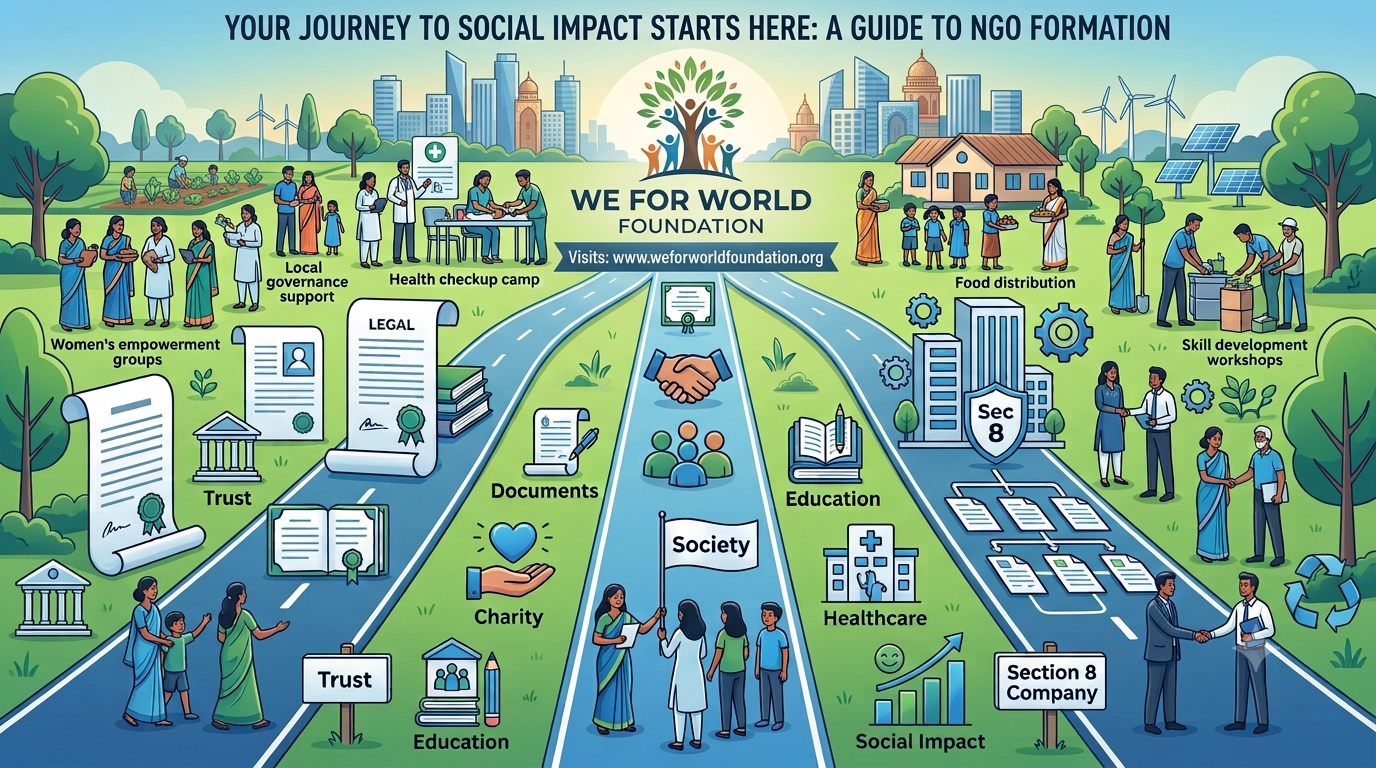
Starting an NGO is a dream for many people who want to create a positive impact in society. Whether your goal is to support education, improve healthcare, help underprivileged communities, protect the environment, or work for social development, an NGO gives your mission a proper identity.
But before starting your NGO, there is one important decision you need to make:
Which type of NGO registration should you choose?
In India, most NGOs are registered as one of these three structures:
Many first-time founders get confused because all three structures work for charitable purposes, but they are different in terms of registration process, management, compliance, and future growth.
Choosing the right structure at the beginning can save you time, reduce difficulties, and help your NGO grow smoothly.
In this guide, we will explain the difference between Trust, Society, and Section 8 Company in simple language so you can make the right decision for your NGO.
NGO registration is the legal process of creating a recognized organization that can work for social, charitable, educational, environmental, or community welfare purposes.
A registered NGO gets a legal identity, which helps it:
In India, an NGO is generally registered under one of these legal frameworks:
Each option has its own benefits and suitability.
Many people make one common mistake—they register their NGO without thinking about their future plans.
The right structure depends on questions like:
For example:
A small group helping children in a local community may find a Trust suitable.
A group of members working together on education or cultural activities may prefer a Society.
An organization planning large projects, corporate partnerships, and national-level operations may consider a Section 8 Company.
There is no single “best” NGO structure. The best choice depends on your vision.
Let’s understand each option in simple terms.
A Trust is one of the oldest and most commonly used structures for charitable activities in India.
A Trust is created when one or more people transfer assets or responsibilities to trustees who manage the organization for a charitable purpose.
A Trust usually works through a document called a Trust Deed, which explains:
A Trust is generally suitable for people who want to:
A group starts an organization to provide free education materials to children in rural areas.
A Trust structure may be suitable for such a purpose.
Trusts are often considered easier to manage compared to more formal structures.
Trusts are widely used for:
A properly created Trust can continue its work even when the original founders are no longer involved.
While Trusts are popular, they may not be ideal for every situation.
Consider:
If your goal is to build a large organization with many members, other structures may be worth considering.
A Society is another popular way to register an NGO in India.
A Society is usually formed by a group of individuals who come together for a common purpose.
Societies are commonly used for:
A Society is managed through members and a governing body.
A Society may be suitable if:
A group of teachers, social workers, and professionals creates an organization to promote education and skill development.
A Society structure may work well for this type of initiative.
Societies allow multiple members to participate in decision-making.
They work well when an NGO depends on teamwork and member involvement.
Societies are commonly used by many educational and social organizations.
A Society requires proper management among members.
Important factors include:
A Section 8 Company is a special type of company created for charitable and non-profit purposes.
It is registered under the Companies Act, 2013.
Unlike normal companies, a Section 8 Company does not distribute profits to shareholders. Any income generated is used to achieve the organization’s objectives.
A Section 8 Company is often preferred by organizations that want to:
An NGO plans to work across multiple states with corporate partnerships and large development projects.
A Section 8 Company may be a suitable choice.
Many donors and corporate organizations consider Section 8 Companies highly structured.
It can be suitable for organizations planning expansion and professional management.
Many organizations working with CSR programs choose this structure.
A Section 8 Company comes with more responsibilities.
You need to maintain:
It requires more discipline compared to simpler structures.
Choosing between a Trust, Society, and Section 8 Company is one of the most important decisions when starting an NGO.
All three structures can work for charitable purposes, but their management style, compliance requirements, and suitability are different.
Here is a simple comparison:
| Feature | Trust | Society | Section 8 Company |
|---|---|---|---|
| Main Purpose | Charitable activities | Community and member-based activities | Professional non-profit activities |
| Registered Under | Applicable Trust laws | Societies Registration Act, 1860 and state laws | Companies Act, 2013 |
| Managed By | Trustees | Governing members | Board of Directors |
| Best For | Small to medium charitable initiatives | Organizations with multiple members | Large NGOs and CSR-focused organizations |
| Structure | Simple | Member-oriented | Corporate-style governance |
| Compliance Level | Low to Moderate | Moderate | Higher |
| Expansion Potential | Good | Good | Excellent |
| Corporate Preference | Moderate | Moderate | High |
Important: The right choice depends on your goals, not just the registration process.
There is no universal answer because every NGO has a different vision.
Let’s make it simple.
A Trust may be the right choice if:
✅ You want to start a charitable initiative
✅ Your work is focused on a specific cause
✅ You want a simple management structure
✅ You are starting at a local or community level
Examples:
A Society may be suitable if:
✅ Many people want to work together
✅ Your organization depends on members
✅ You want collective decision-making
✅ Your activities involve community participation
Examples:
A Section 8 Company may be the right option if:
✅ You want to build a large NGO
✅ You plan to work with corporates
✅ You want CSR partnerships
✅ You need a professional governance structure
Examples:
Use this quick guide:
Are you starting a small charitable initiative?
➡ Yes → Consider a Trust
Will many members actively manage the organization?
➡ Yes → Consider a Society
Do you want corporate partnerships and large-scale growth?
➡ Yes → Consider a Section 8 Company
The documents required depend on the type of NGO you choose.
However, some common documents include:
The registration process becomes easier when divided into simple steps.
Before registration, clearly define:
A clear purpose helps you create better objectives for your NGO.
Choose between:
Think about your future plans before making this decision.
Changing the structure later can create unnecessary complications.
Select a name that is:
Avoid names that:
Collect all necessary documents and prepare your legal papers according to your chosen structure.
Proper documentation helps avoid delays.
Submit the required application and documents to the appropriate authority.
The process differs depending on whether you register a:
Once approved, your NGO receives official registration proof.
After this, your organization can begin operating as a legally recognized entity.
Registration is only the beginning.
A successful NGO requires proper management and compliance.
After registration, you should:
Keep NGO finances separate from personal finances.
This improves transparency and builds trust.
Your NGO needs a PAN card for financial and tax-related activities.
Keep records of:
Good records help during audits and funding applications.
Eligible NGOs may apply for:
These registrations can help NGOs and donors, subject to applicable rules.
Many new founders make mistakes that create problems later.
Avoid these:
Do not select a Trust, Society, or Section 8 Company without understanding your future plans.
Your objectives should clearly explain what your NGO wants to achieve.
Avoid copying objectives from other organizations.
Registration does not mean the work is finished.
Every NGO must follow applicable rules and maintain proper records.
Always maintain separate financial accounts.
This creates transparency and professionalism.
Before approaching donors, make sure your NGO has:
Starting an NGO is a meaningful journey. The first major decision is choosing the right legal structure.
A Trust, Society, and Section 8 Company can all be good options—but the right choice depends on your vision.
If you want a simple charitable initiative, a Trust may work well.
If you want a community-based organization, a Society may be suitable.
If you want professional growth, CSR partnerships, and larger operations, a Section 8 Company may be the better option.
The best NGO is not the one with the most complex structure. It is the one that has a clear mission, good governance, and a genuine commitment to creating social impact.
There is no single best option. The right choice depends on your NGO’s goals, size, and future plans.
You can work informally, but registration gives your organization a legal identity and makes it easier to operate professionally.
Many organizations seeking CSR partnerships prefer Section 8 Companies because of their structured governance, but eligibility depends on meeting applicable legal requirements.
The cost depends on the type of registration, state requirements, and professional assistance used.
The timeline depends on the NGO type, documents submitted, and approval process.
The requirements depend on the legal structure selected. Different structures have different requirements for founders and members.
No. It is not compulsory for registration, but eligible NGOs often apply because it may provide tax benefits to donors.
Eligible NGOs generally apply for 12AB to claim income tax benefits under applicable provisions.
Only NGOs meeting the requirements under FCRA can receive foreign contributions.
Trust, Society, and Section 8 Company are all recognized structures. Credibility depends on transparency, governance, and impact.