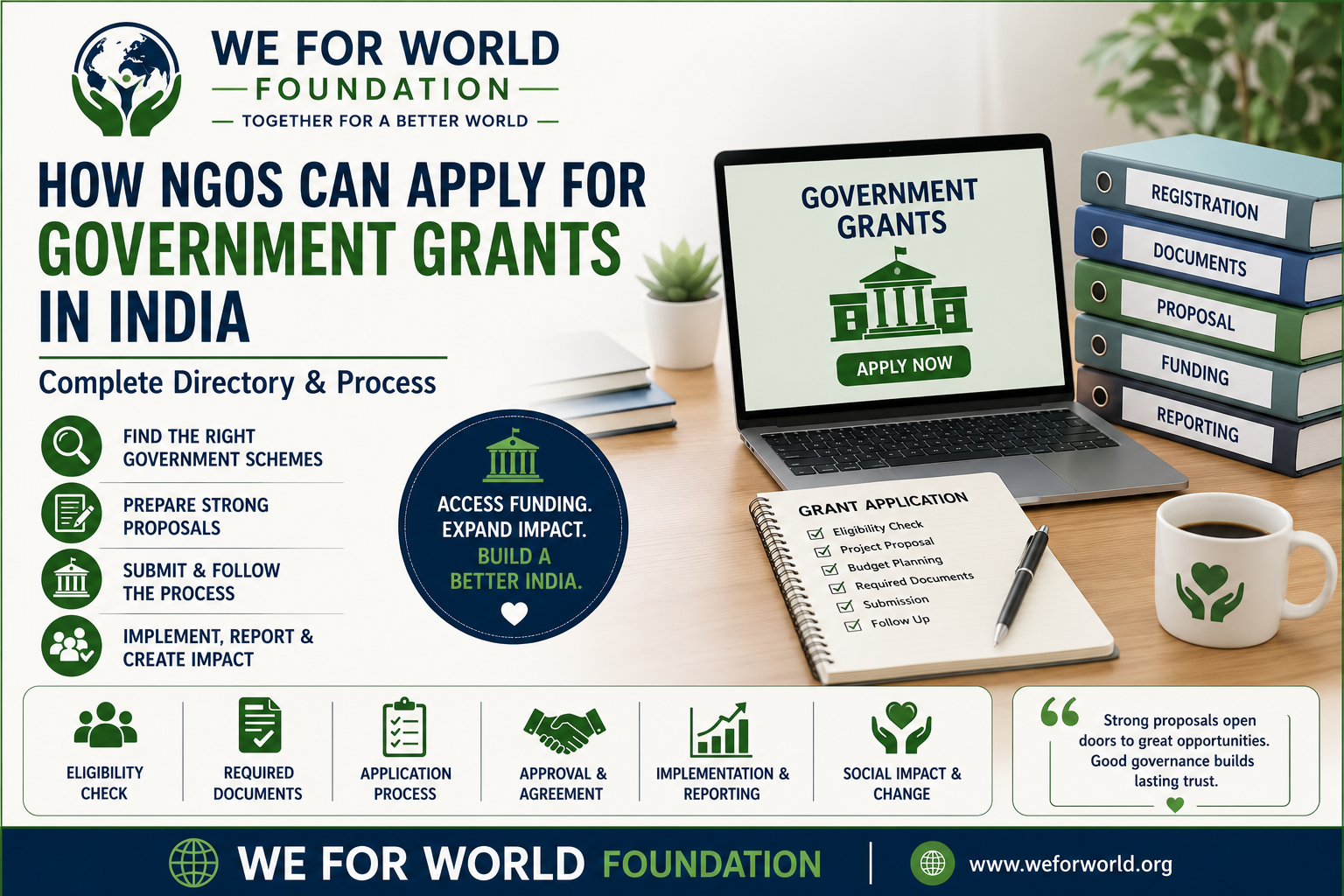
Government grants are among the most significant sources of funding available to NGOs in India. Every year, the Central Government, State Governments, ministries, departments, commissions, and public sector organizations allocate substantial budgets for projects focused on education, healthcare, women empowerment, rural development, environmental conservation, skill development, disability support, tribal welfare, youth development, and many other social causes.
However, many NGOs fail to secure these grants—not because they lack impactful work, but because they are unfamiliar with the application process, eligibility requirements, documentation, or funding opportunities.
This guide explains where NGOs can find government grants, who is eligible, what documents are required, and how to submit strong grant applications that improve the chances of approval.
Table of Contents
What Are Government Grants?
Government grants are financial assistance provided by Central or State Government departments to eligible nonprofit organizations for implementing projects that contribute to public welfare.
Unlike commercial loans, grants generally do not require repayment, provided the funds are used for approved purposes and reporting obligations are fulfilled.
These grants often support initiatives in:
Why Government Grants Are Important
Government funding enables NGOs to:
For many NGOs, grants provide the resources needed to scale successful initiatives.
Types of Government Grants
Government support may include:
| Grant Type | Purpose |
| Project Grants | Fund specific programs |
| Infrastructure Grants | Buildings, equipment, facilities |
| Capacity Building Grants | Training and organizational development |
| Research Grants | Studies and innovation |
| Awareness Campaign Grants | Public education initiatives |
| Skill Development Grants | Vocational training programs |
| Healthcare Grants | Medical outreach and health services |
| Education Grants | Schools, scholarships, learning programs |
Understanding the grant objective helps NGOs identify suitable funding opportunities.
Eligibility Criteria
Eligibility varies by scheme, but many grant programs consider factors such as:
Always review the specific guidelines of each scheme before applying.
Essential Documents Required
Prepare an updated document repository that typically includes:
Keeping these documents ready speeds up the application process.
Step-by-Step Application Process
Step 1: Identify the Right Scheme
Look for schemes aligned with your NGO’s mission and expertise.
Step 2: Read the Guidelines Carefully
Review:
Step 3: Prepare a Strong Project Proposal
Your proposal should clearly explain:
Step 4: Submit the Application
Follow the prescribed application process and provide complete, accurate documentation.
Step 5: Respond to Clarifications
Some departments may request additional information or supporting documents before making a decision.
Step 6: Project Approval & Agreement
If approved, carefully review funding conditions, reporting requirements, and utilization guidelines before accepting the grant.
Step 7: Project Implementation & Reporting
Maintain proper documentation, financial records, utilization reports, and progress updates throughout the project.
Major Government Ministries Supporting NGOs
Different ministries support different sectors. Depending on the scheme and eligibility, NGOs may find opportunities through ministries and departments working in areas such as:
| Ministry / Department | Typical Focus Areas |
| Ministry of Women and Child Development | Women, children, nutrition |
| Ministry of Social Justice and Empowerment | Disability, senior citizens, social welfare |
| Ministry of Tribal Affairs | Tribal development |
| Ministry of Minority Affairs | Minority welfare |
| Ministry of Rural Development | Rural livelihoods and infrastructure |
| Ministry of Skill Development and Entrepreneurship | Skills and employment |
| Ministry of Health and Family Welfare | Healthcare initiatives |
| Ministry of Education | Education and literacy |
| Ministry of Youth Affairs and Sports | Youth leadership and sports |
| Ministry of Environment, Forest and Climate Change | Environmental conservation |
| Department of Science & Technology | Research and innovation |
| State Government Departments | State-specific welfare programs |
Many states also operate their own grant schemes for local NGOs.
How to Write a Winning Grant Proposal
A strong proposal should:
Grant reviewers appreciate clarity, evidence, and practical implementation plans.
Common Reasons Grant Applications Are Rejected
Many proposals are rejected due to:
Attention to detail significantly improves your chances of success.
Best Practices for Successful Grant Applications
Follow these recommendations:
Consistency and preparation often distinguish successful applicants.
Government Grant Application Checklist
✅ Eligible legal registration
✅ Updated governing documents
✅ Annual reports
✅ Audited financial statements
✅ Project proposal
✅ Detailed project budget
✅ Board information
✅ Organizational profile
✅ Previous impact evidence
✅ Compliance records
✅ Required declarations
✅ Supporting documents
Frequently Asked Questions
Some schemes accept newly registered organizations, while others require a minimum period of operational experience. Always review the eligibility criteria of the specific scheme.
Many grant programs request audited financial records, particularly for organizations with previous operational history.
Yes, provided the NGO meets the eligibility requirements and complies with the conditions of each funding program.
Most grants do not require repayment if they are used according to the approved purpose and all reporting requirements are fulfilled.
A well-designed project proposal supported by realistic budgeting, measurable outcomes, and complete documentation.
Many NGOs receive funding from multiple sources, provided they comply with applicable laws and funding conditions.
Timelines vary depending on the scheme, department, completeness of the application, and administrative processes.
The NGO is generally expected to implement the approved project, maintain proper records, and submit utilization and progress reports as required.
Common reasons include incomplete documentation, weak proposals, non-compliance with eligibility criteria, unrealistic budgets, and missed deadlines.
By maintaining strong governance, transparent financial systems, quality documentation, and submitting well-prepared proposals that align with the objectives of the funding scheme.
Final Key Takeaways
Conclusion
Government grants provide valuable opportunities for NGOs to implement meaningful social initiatives at scale. However, securing funding requires more than a good idea—it demands careful planning, complete documentation, sound governance, financial accountability, and high-quality project proposals.
By understanding eligibility requirements, maintaining organizational readiness, and applying strategically, NGOs can build lasting partnerships with government agencies and contribute more effectively to national development goals.
Continue Your Learning with WFWF
The We For World Foundation (WFWF) Knowledge Centre is committed to empowering NGOs, trusts, Section 8 companies, CSR professionals, donors, volunteers, and social entrepreneurs with practical, reliable, and easy-to-understand educational resources. Explore our expert guides on NGO registration, governance, compliance, fundraising, CSR partnerships, digital transformation, financial management, and nonprofit leadership to strengthen your organization and maximize its social impact.