Every major social movement began with one person who believed change was possible.
Whether your passion is education, healthcare, environmental conservation, women’s empowerment, child welfare, animal protection, rural development, or human rights, starting an NGO can turn your vision into meaningful action.
However, passion alone does not build a successful organisation.
Many NGOs fail within their first few years because they lack planning, governance, funding strategies, documentation, and sustainable systems. On the other hand, successful NGOs combine compassion with professional management.
This guide provides a practical roadmap—from identifying a social problem to creating measurable impact—so you can build an NGO that serves communities effectively and grows sustainably.
A Non-Governmental Organisation (NGO) is a nonprofit entity established to address social, environmental, educational, cultural, humanitarian, or developmental issues for the public good.
Unlike businesses, NGOs are mission-driven rather than profit-driven. Their success is measured by the positive impact they create in society.
People establish NGOs to:
The most successful NGOs begin by solving one clearly defined problem.
Every successful NGO starts with a problem—not a project.
Ask yourself:
Examples include:
Clearly defining the problem ensures your organisation remains focused.
A strong NGO has two guiding statements.
The long-term change you want to see in society.
Example:
“A society where every child has access to quality education.”
How your organisation will work toward achieving that vision.
Example:
“To provide educational support, digital learning resources, and teacher training in underserved communities.”
These statements guide every decision your NGO makes.
Before launching your NGO:
Evidence-based planning increases the chances of creating meaningful and lasting impact.
The legal structure affects governance, compliance, and funding opportunities.
Common nonprofit structures include:
Consider:
Professional legal advice is recommended before registration.
A committed governing board provides direction, accountability, and credibility.
Look for individuals with expertise in:
A diverse board strengthens decision-making.
Every NGO should maintain professional documentation from day one.
Key documents include:
Good documentation improves transparency and operational efficiency.
After preparing your organisation:
Compliance protects the organisation and builds trust with stakeholders.
Financial sustainability should be planned from the beginning.
Potential funding sources include:
Build recurring donor programmes rather than relying only on one-time contributions.
Collaborate with businesses through CSR and community development initiatives.
Apply to government agencies, foundations, and philanthropic organisations.
Develop mission-related income-generating activities that support your programmes.
Encourage supporters to become long-term contributors.
Diversifying income reduces financial risk.
Even a small NGO needs clearly defined roles.
Typical functions include:
Strong leadership and teamwork are essential for sustainable growth.
Avoid trying to solve every problem immediately.
Instead:
A successful pilot creates credibility for future expansion.
Activity is not the same as impact.
Instead of reporting:
“We conducted 20 workshops.”
Report:
“More than 500 participants completed training, and 70% secured employment or started income-generating activities.”
Useful indicators include:
Measuring impact strengthens fundraising and accountability.
Trust is one of an NGO’s greatest assets.
Maintain trust by:
Transparency attracts supporters and partners.
Technology enables NGOs to increase efficiency and reach.
Useful tools include:
Digital transformation improves productivity and impact.
Collaboration accelerates growth.
Partner with:
Partnerships expand expertise, funding, and reach.
A successful NGO is built for sustainability.
Develop:
Long-term thinking ensures the organisation continues serving society beyond its founders.
Understand community needs before designing solutions.
Diversify funding to reduce financial uncertainty.
Professional records are essential for compliance and credibility.
Track outcomes, not just activities.
Growth requires clear goals and measurable milestones.
Transparent accounting is essential for donor confidence.
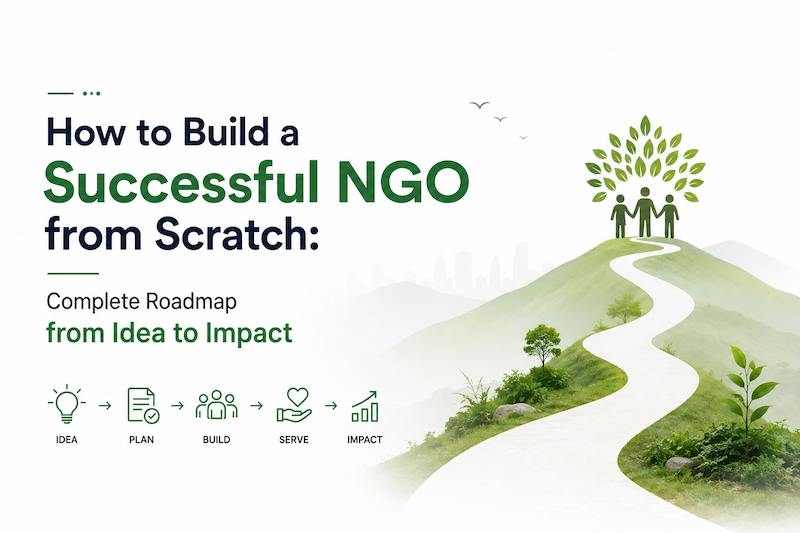
| Stage | Objective |
|---|---|
| Idea | Identify a genuine social problem |
| Research | Understand community needs |
| Planning | Define mission, vision, and strategy |
| Registration | Complete legal formalities |
| Governance | Build a capable governing board |
| Documentation | Develop organisational policies |
| Funding | Diversify income sources |
| Team Building | Recruit staff and volunteers |
| Pilot Project | Test and refine your model |
| Impact Measurement | Monitor and evaluate results |
| Partnerships | Expand collaborations |
| Sustainability | Build systems for long-term growth |
Begin by identifying a social issue, researching community needs, defining your mission, choosing the appropriate legal structure, completing registration, building a governing board, and launching a pilot project.
Not necessarily. Many NGOs begin with volunteers and small community initiatives, but a sustainable funding strategy should be developed early.
A combination of strong leadership, transparent governance, measurable impact, community trust, and sustainable funding.
An individual can initiate the process, but most registered NGOs require additional members or governing board participants depending on applicable laws.
Building a respected and impactful NGO is a long-term process that requires consistent effort, continuous learning, strong governance, and community engagement over several years.
This article is intended for educational purposes only. NGO registration requirements, governance structures, tax regulations, and compliance obligations vary by country and jurisdiction. Readers should consult qualified legal, financial, and regulatory professionals before establishing or operating an NGO.
Starting an NGO is not simply about creating an organisation—it is about creating sustainable change.
The most successful NGOs are built on a foundation of clear purpose, professional systems, ethical leadership, financial sustainability, and measurable impact. By following a structured roadmap, aspiring nonprofit leaders can transform an idea into an organisation that improves lives, empowers communities, and contributes to long-term social development.
At the WFWF Knowledge Centre, we believe that every meaningful movement begins with one idea backed by commitment, knowledge, and action. With careful planning and a people-first approach, your NGO can become a catalyst for lasting positive change.