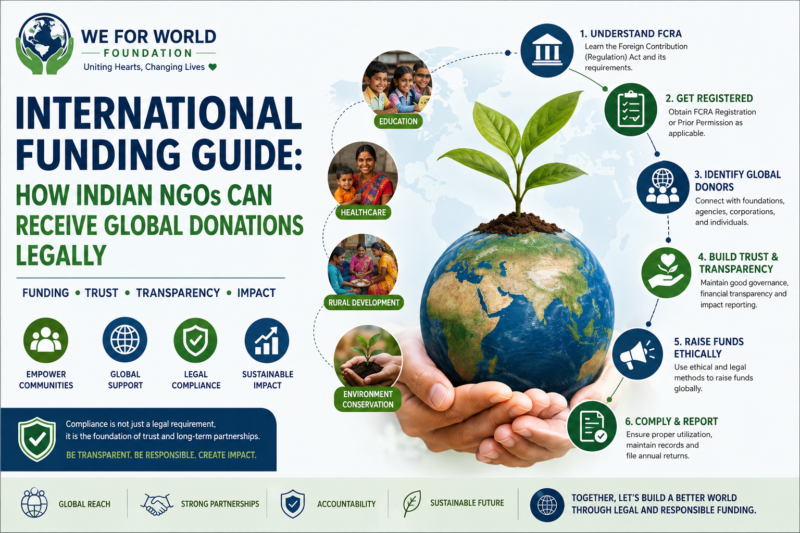
For many nonprofit organizations, international funding represents an opportunity to expand programs, strengthen communities, and create greater social impact. Around the world, millions of individuals, charitable foundations, corporations, and development agencies support credible NGOs working in education, healthcare, environmental conservation, women empowerment, disaster relief, and sustainable development.
However, in India, receiving foreign contributions is governed by specific legal regulations. NGOs cannot simply accept donations from overseas individuals or organizations without understanding and complying with the applicable laws.
The Foreign Contribution (Regulation) Act (FCRA) provides the legal framework for receiving foreign contributions in India. Compliance with these regulations is essential to maintain transparency, accountability, and public trust.
This guide explains how Indian NGOs can legally receive international donations, prepare for global fundraising, and build long-term relationships with international supporters while remaining compliant with Indian law.
Disclaimer: This article provides general educational information and is not legal or financial advice. NGOs should consult qualified legal or compliance professionals for organization-specific guidance.
International funding refers to financial contributions received by an Indian NGO from sources located outside India.
These may include:
International funding can support projects such as:
Under Indian law, a foreign contribution may include monetary donations, securities, or certain articles received from foreign sources, subject to the definitions and exemptions under the FCRA.
Examples may include:
Whether a contribution qualifies depends on the legal status of both the donor and the recipient. Always verify the applicable rules before accepting funds.
The Foreign Contribution (Regulation) Act (FCRA) regulates how eligible organizations in India may receive and utilize foreign contributions.
Its objectives include:
Receiving foreign contributions without complying with applicable legal requirements can lead to serious consequences.
Generally, eligible nonprofit entities such as:
may receive foreign contributions only if they meet the legal requirements prescribed under the FCRA, such as obtaining the appropriate registration or prior permission where required.
Eligibility depends on multiple statutory conditions, so organizations should verify their status before soliciting overseas donations.
Indian NGOs typically encounter two legal pathways:
This is generally intended for organizations that meet the eligibility requirements prescribed under the Act and expect to receive foreign contributions on an ongoing basis.
Organizations that do not yet qualify for regular registration may, in certain situations, seek prior permission to receive a specific foreign contribution from a specified donor for a specified purpose, subject to legal requirements.
The appropriate route depends on the organization’s circumstances and should be determined with professional guidance.
Before approaching international donors, ensure your organization has strong governance and operational systems.
Recommended preparations include:
International donors often assess organizational credibility before making funding decisions.
A professional digital presence increases donor confidence.
Your NGO website should include:
Consistency across your website and social media channels helps establish trust.
Many international organizations support development projects through grants.
Potential sources include:
Before applying, carefully review each grant’s eligibility criteria, geographic scope, thematic priorities, and compliance requirements.
International fundraising is about building relationships, not simply requesting funds.
Effective strategies include:
Long-term trust leads to sustainable funding.
Technology has made international engagement easier than ever.
NGOs can strengthen their global presence through:
Always ensure that donation mechanisms and fundraising activities comply with applicable Indian laws.
International supporters look beyond the cause—they evaluate the organization itself.
Key trust factors include:
Trust is built through consistent actions over time.
Good financial governance is essential.
Best practices include:
Transparent financial management strengthens long-term donor confidence.
International donors typically expect regular updates on funded projects.
Depending on the funding arrangement and applicable law, reporting may include:
In addition, NGOs must comply with applicable statutory reporting obligations under Indian law.
Avoid these common errors:
Strong systems are as important as strong programs.
✅ Appropriate legal registration
✅ Understanding of FCRA requirements
✅ Professional website
✅ Annual report
✅ Impact report
✅ Audited financial statements
✅ Governance policies
✅ Strong project documentation
✅ Donor communication plan
✅ Transparent accounting systems
No. NGOs must comply with the applicable legal requirements under the FCRA before receiving foreign contributions.
The Foreign Contribution (Regulation) Act regulates the receipt and utilization of foreign contributions by eligible organizations in India.
FCRA registration is generally intended for ongoing receipt of foreign contributions by eligible organizations, while prior permission may allow receipt of a specific contribution from a specified donor for a specified purpose, subject to the law.
Yes, many donors fund defined projects, provided the arrangement complies with applicable legal and grant requirements.
Common requests include organizational information, financial statements, annual reports, governance details, project proposals, and impact reports.
Transparency builds confidence with donors, regulators, beneficiaries, and partners.
Yes. A professional website helps demonstrate credibility and communicate your mission, impact, and governance.
By demonstrating measurable impact, maintaining transparency, communicating consistently, and building long-term relationships.
Yes. Foreign contribution laws are technical, and professional legal or compliance advice is strongly recommended.
Attempting international fundraising without first establishing robust governance and understanding the legal framework.
International donations can open new opportunities for Indian NGOs to scale their programs, reach underserved communities, and create lasting change. However, sustainable global fundraising begins with strong governance, legal compliance, financial transparency, and a commitment to accountability.
Organizations that invest in trust, professionalism, and measurable impact are better positioned to build enduring relationships with international donors and partners. By approaching global funding responsibly and ethically, NGOs can contribute to meaningful development while meeting the legal standards that safeguard the nonprofit sector.
The We For World Foundation (WFWF) Knowledge Centre provides practical guidance for NGOs, trusts, Section 8 companies, CSR professionals, fundraisers, and social entrepreneurs. Explore our expert resources on fundraising, governance, FCRA awareness, project management, compliance, monitoring & evaluation, digital transformation, and sustainable development to help your organization grow responsibly and create lasting social impact.