Starting an NGO is driven by a vision to create positive change, but turning that vision into reality requires more than passion—it requires sustainable financial support. Whether an organization works in education, healthcare, environmental protection, women empowerment, child welfare, or community development, fundraising plays a crucial role in expanding its reach and creating measurable impact.
Many NGOs have meaningful ideas and dedicated teams but struggle with one common challenge: how to raise funds consistently. Depending only on occasional donations can make it difficult to plan projects, support beneficiaries, and scale operations.
A strong fundraising strategy helps NGOs build financial stability, attract committed supporters, and develop long-term relationships with donors, companies, and institutions.
In India, NGOs have multiple fundraising opportunities available, including individual donations, CSR partnerships, government schemes, grants, online campaigns, crowdfunding, and community-based initiatives. However, successful fundraising requires proper planning, transparency, storytelling, and trust-building.
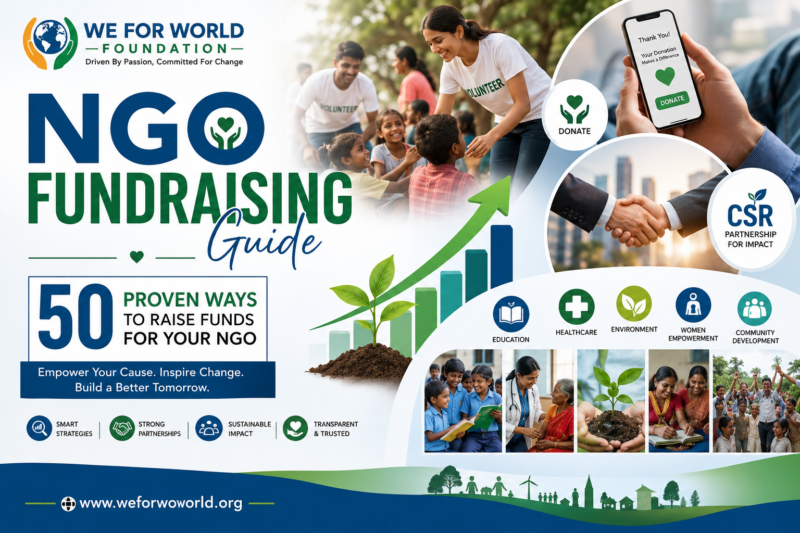
This complete NGO Fundraising Guide explains 50 proven ways NGOs can raise funds, improve donor engagement, and create sustainable funding models for long-term social impact.
Whether you are starting a new NGO or looking to expand an existing organization, these fundraising strategies can help you reach more supporters and strengthen your mission.
Fundraising is not only about collecting money. For a nonprofit organization, fundraising is the foundation that supports programs, operations, awareness campaigns, and future growth.
A well-planned fundraising strategy helps NGOs:
With adequate resources, NGOs can reach more communities, increase beneficiaries, and implement larger projects.
For example:
Many NGOs face challenges because they depend on limited funding sources. Multiple fundraising channels reduce dependency on one donor or one grant.
A financially stable NGO can:
Effective fundraising requires transparency. When NGOs communicate their impact clearly, donors feel more connected and confident about supporting their mission.
Sharing:
helps create stronger relationships with supporters.
Companies prefer working with NGOs that demonstrate:
A strong fundraising foundation improves an NGO’s chances of securing corporate CSR partnerships.
Individual donations remain one of the most common fundraising methods for NGOs.
People are more likely to contribute when they understand:
NGOs can attract individual donors through:
Building a regular donor community is more valuable than depending only on one-time contributions.
Recurring donations provide NGOs with predictable income.
Instead of asking supporters for a large one-time contribution, NGOs can encourage smaller monthly donations.
For example:
“₹500 every month can support a child’s education.”
Recurring donor programs help NGOs plan long-term projects and maintain consistent operations.
Corporate CSR funding is one of the biggest opportunities available for eligible NGOs in India.
Companies look for credible nonprofit partners working in areas such as:
NGOs should prepare professional CSR proposals highlighting:
Crowdfunding has become one of the fastest-growing fundraising methods for NGOs. It allows organizations to reach a large number of people through online platforms and social networks.
Instead of depending on a single donor, crowdfunding enables hundreds or thousands of individuals to contribute smaller amounts toward a common cause.
Successful crowdfunding campaigns usually include:
For example, an NGO working on child education can launch a campaign to provide school supplies, scholarships, or digital learning resources for underprivileged children.
A well-planned crowdfunding strategy can help NGOs reach supporters beyond their local communities.
Online donation platforms provide NGOs with a simple way to collect contributions digitally.
With increasing internet adoption, many donors prefer convenient online payment options instead of traditional donation methods.
NGOs should ensure their donation process is:
A professional online donation page should clearly explain:
A smooth donation experience can significantly improve fundraising results.
A dedicated donation page is essential for any NGO looking to build sustainable fundraising.
Many potential supporters visit an organization’s website before making a contribution. A well-designed donation page helps convert visitors into donors.
The page should include:
For NGOs with 12A and 80G registration, highlighting donor tax benefits can also encourage contributions.
Social media platforms have transformed how NGOs connect with supporters.
Platforms like Instagram, Facebook, LinkedIn, and YouTube allow organizations to share their work with a wider audience.
Effective social media fundraising includes:
People often donate when they emotionally connect with a cause. Authentic storytelling plays an important role in converting followers into supporters.
A successful NGO fundraising campaign is not only about asking for money—it is about communicating impact.
Donors want to understand:
Instead of saying:
“We need funds for education.”
A stronger message would be:
“Your contribution can help a child access learning resources and continue their education.”
Impact-driven storytelling builds emotional connections and increases donor trust.
Email marketing remains one of the most effective tools for nonprofit fundraising.
NGOs can use email campaigns to:
A good NGO email strategy should focus on building relationships rather than sending only donation requests.
Regular communication keeps supporters connected with the organization’s mission.
Fundraising events allow NGOs to engage directly with communities and supporters.
Events can create awareness while generating financial support.
Examples include:
Successful fundraising events combine social engagement with a clear purpose.
Physical challenges are popular fundraising methods because they encourage participation and awareness.
Examples:
Participants can collect sponsorships from friends, family members, and businesses.
These activities create both fundraising opportunities and public awareness.
Corporate sponsorships involve businesses supporting NGO initiatives through financial contributions, products, or services.
Unlike CSR partnerships, sponsorships may focus more on visibility and brand association.
NGOs can approach companies for sponsorship of:
A professional sponsorship proposal should explain:
Government grants can provide valuable financial support for NGOs working in priority development areas.
Various government departments offer funding opportunities for organizations working in:
NGOs should regularly monitor relevant government schemes and ensure their compliance documents are updated.
Important documents often include:
Many international foundations support NGOs working on social development projects.
International grants are often available for areas such as:
To apply successfully, NGOs need:
International funding opportunities require patience because the selection process can be competitive.
A well-written CSR proposal is one of the most important tools for securing corporate funding.
Companies receive many proposals, so NGOs must clearly explain:
A strong CSR proposal focuses on impact rather than only requesting financial support.
Small and medium businesses can become valuable supporters for NGOs.
Local businesses may contribute through:
Building relationships within the local business community can create long-term fundraising opportunities.
NGOs can create membership programs where supporters contribute regularly in exchange for updates, participation opportunities, or community involvement.
Membership models help create:
Examples:
Peer-to-peer fundraising allows supporters to raise funds on behalf of an NGO.
Instead of the NGO directly asking for donations, supporters create their own fundraising campaigns and encourage their networks to contribute.
Examples:
This method helps NGOs reach new audiences through existing relationships.
Traditional donation drives remain effective when properly organized.
NGOs can conduct:
Donation drives should include:
Transparency after the campaign builds donor confidence.
Many companies encourage employees to support social causes through workplace giving programs.
NGOs can collaborate with companies where employees:
Employee engagement programs can become a gateway to larger corporate partnerships.
WhatsApp has become one of the most powerful communication tools in India. NGOs can use WhatsApp fundraising campaigns to directly connect with supporters, share impact stories, and encourage donations.
Unlike traditional communication channels, WhatsApp allows NGOs to build personal relationships with donors.
Effective WhatsApp fundraising strategies include:
However, NGOs should avoid sending frequent donation requests without value. Building trust through meaningful communication is essential.
Video content helps NGOs communicate their mission more effectively.
A short video showing real impact can often create a stronger emotional connection than written content alone.
NGOs can use YouTube to share:
A consistent YouTube presence can attract donors, volunteers, and corporate partners.
Social media influencers and content creators can help NGOs reach new audiences.
A trusted influencer sharing an NGO’s mission can increase awareness and encourage donations.
NGOs can collaborate with influencers for:
The ideal influencer should have an audience that connects with the NGO’s cause.
For example:
Digital advertising can help NGOs reach people who are actively searching for social causes.
Eligible nonprofit organizations may explore programs such as Google Ad Grants, which help qualifying nonprofits increase online visibility.
NGOs can use search advertising to promote:
A well-optimized campaign can bring more visitors to an NGO website and increase supporter engagement.
SEO is a long-term fundraising strategy that many NGOs overlook.
When people search online for causes, donation opportunities, or social initiatives, a well-optimized NGO website can attract organic visitors.
NGOs should create content around topics such as:
A strong SEO strategy helps NGOs build authority and attract supporters without depending only on paid advertising.
A professional NGO blog can become a powerful fundraising tool.
Regular blog content helps:
Examples of blog topics:
Helpful content builds credibility and creates a stronger connection with supporters.
LinkedIn is especially valuable for NGOs looking for corporate partnerships.
Many CSR managers, business leaders, founders, and philanthropists use LinkedIn professionally.
NGOs can use LinkedIn to:
A professional LinkedIn presence can significantly improve corporate visibility.
Many companies encourage employees to participate in social initiatives.
NGOs can collaborate with businesses to create employee engagement programs such as:
These programs can become the first step toward larger CSR partnerships.
Building relationships is one of the most important parts of fundraising.
NGOs should actively participate in:
Strong relationships often lead to:
Educational institutions can become valuable partners for NGOs.
Schools and colleges often encourage students to participate in social activities.
NGOs can organize:
These partnerships also help create awareness among younger generations.
Educational alumni networks can become strong fundraising communities.
NGOs can approach alumni groups for:
Alumni fundraising works well because people often feel connected to causes involving education and youth development.
Local communities can become strong supporters of NGO initiatives.
Community fundraising methods include:
People are often more willing to support organizations creating visible impact in their own communities.
Charity auctions are creative fundraising methods where donated items or experiences are auctioned to raise funds.
Examples include:
Charity auctions work best when combined with awareness campaigns and community participation.
Selling branded merchandise can create an additional income stream for NGOs.
Examples:
Merchandise should connect with the NGO’s mission and help supporters feel part of the cause.
Businesses increasingly support social causes through cause-based marketing.
Examples:
These partnerships benefit both businesses and NGOs by combining social impact with customer engagement.
Matching gift programs encourage larger donations by involving companies.
In this model, a company matches donations made by employees to eligible nonprofit organizations.
Benefits include:
NGOs should educate corporate employees about such opportunities.
Some individuals contribute significant amounts toward social causes.
Building relationships with major donors requires:
Major donors usually support organizations they trust and believe can create measurable change.
Grant applications require more than describing a good cause.
Successful proposals should include:
Professional grant writing increases the chances of receiving institutional funding.
Some NGOs receive support from international individuals, foundations, and development organizations.
To attract international donors, NGOs should maintain:
International fundraising requires compliance with applicable regulations.
With increasing smartphone usage, mobile fundraising has become an effective strategy.
NGOs can use:
A simple mobile donation process can increase conversion rates significantly.
A donor database is one of the most valuable assets for any NGO.
Many organizations focus on finding new donors but forget the importance of maintaining relationships with existing supporters.
A proper donor management system helps NGOs track:
With organized donor data, NGOs can create personalized communication and improve donor retention.
A strong donor database helps transform one-time contributors into long-term supporters.
Annual fundraising campaigns provide NGOs with a structured approach to generating funds throughout the year.
Instead of launching random fundraising requests, organizations can plan campaigns around specific goals.
Examples:
A yearly fundraising calendar helps NGOs maintain consistent donor engagement and better financial planning.
Transparency plays a major role in successful NGO fundraising.
Donors want to understand how their contributions create change.
Impact reports help NGOs demonstrate:
A professional impact report builds credibility and encourages donors to continue supporting the organization.
Virtual events allow NGOs to reach supporters beyond geographical boundaries.
Examples include:
Virtual fundraising reduces event costs while allowing NGOs to connect with a larger audience.
QR code donations have made giving easier and faster.
People can donate instantly by scanning a QR code through digital payment apps.
NGOs can place QR codes on:
The easier the donation process, the higher the possibility of receiving contributions.
Emergency campaigns help NGOs respond quickly during urgent situations.
Examples:
Successful emergency fundraising requires:
People are more likely to support emergency campaigns when they trust the organization.
Volunteers can become powerful fundraising ambassadors for NGOs.
Instead of limiting volunteers to operational work, NGOs can train them to become supporters who spread awareness and encourage donations.
Volunteer ambassadors can:
A strong volunteer network can significantly expand fundraising reach.
Community leaders often have strong influence and public trust.
NGOs can collaborate with:
These partnerships help organizations reach more people and increase credibility within communities.
Finding new donors is important, but retaining existing donors is equally valuable.
A loyal donor community provides more sustainable support over time.
NGOs can improve donor retention by:
A donor who feels connected to the mission is more likely to contribute repeatedly.
The final and most important fundraising strategy is creating a long-term fundraising plan.
A sustainable NGO does not depend on a single funding source.
A balanced fundraising model may include:
A fundraising plan should define:
Strategic planning helps NGOs move from short-term fundraising to long-term financial sustainability.
Even organizations with strong social missions can struggle with fundraising if they make certain mistakes.
Relying on a single donor, grant, or company creates financial risk.
NGOs should diversify their funding channels.
Donors want to know the difference their support creates.
Sharing measurable results builds trust.
Modern donors increasingly prefer online giving options.
NGOs should invest in:
Transparency is essential for donor confidence.
NGOs should maintain:
Fundraising is about relationships, not only transactions.
Organizations should focus on creating meaningful connections with supporters.
Building a successful NGO requires more than passion—it requires knowledge, compliance, resources, and strategic planning.
We For World Foundation works towards empowering nonprofit organizations by creating awareness about NGO development, compliance, fundraising strategies, CSR opportunities, and sustainable growth practices.
Through educational resources and social impact initiatives, We For World Foundation aims to support organizations working toward meaningful community transformation.
New NGOs can raise funds through individual donations, crowdfunding, CSR partnerships, grants, fundraising events, online campaigns, and community support.
The best fundraising strategy depends on the NGO’s mission, audience, and resources. A combination of multiple funding sources usually creates better sustainability.
NGOs can secure CSR funding by maintaining proper compliance, obtaining required registrations, preparing professional proposals, and approaching suitable corporate partners.
Yes. 80G registration allows eligible donors to claim tax benefits on donations, which can encourage more people to support the NGO.
NGOs can attract recurring donors through transparent communication, impact reporting, storytelling, and easy online donation options.
Yes, but NGOs receiving foreign contributions must follow applicable regulations, including requirements related to foreign contribution compliance.
NGOs can improve fundraising by building trust, maintaining transparency, using digital platforms, creating strong proposals, and developing long-term donor relationships.
Fundraising is one of the biggest challenges faced by NGOs, but with the right strategy, organizations can build strong financial foundations and expand their social impact.
From individual donations and CSR partnerships to crowdfunding, grants, digital campaigns, and community engagement, there are multiple ways NGOs can create sustainable funding models.
The most successful NGOs understand that fundraising is not simply about collecting money—it is about building trust, communicating impact, and creating meaningful relationships with people who believe in the mission.
By implementing the strategies shared in this NGO Fundraising Guide: 50 Proven Ways to Raise Funds for Your NGO, organizations can strengthen their fundraising approach and create a greater impact in the communities they serve.
We For World Foundation continues to share practical resources and guidance to help NGOs grow, improve compliance, and create lasting social change.