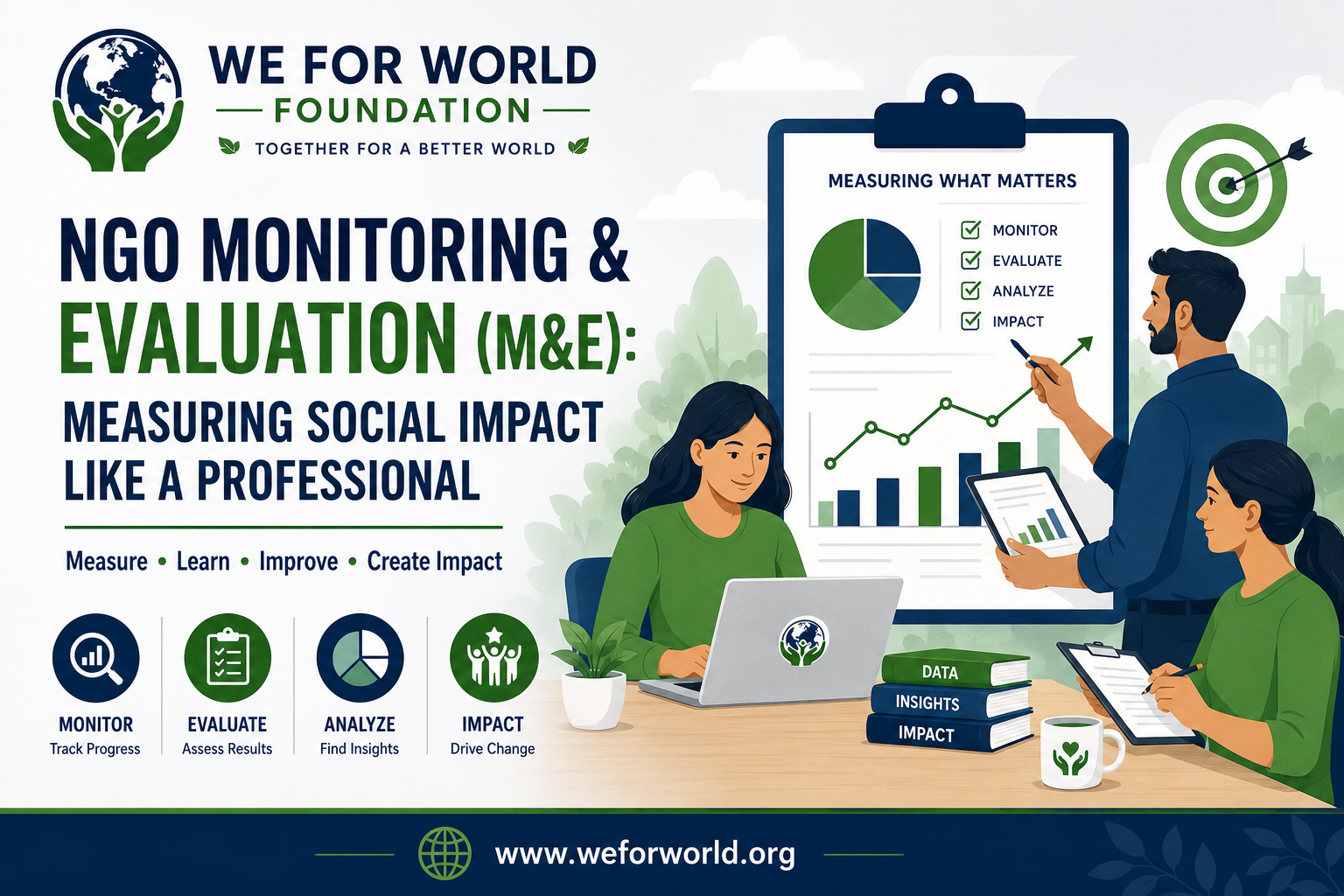
Every NGO exists to create positive social change. But how do you know whether your projects are actually improving lives? How can you prove your impact to donors, CSR partners, government agencies, grantmakers, and the communities you serve?
The answer lies in Monitoring and Evaluation (M&E).
Many NGOs invest significant time and resources into implementing projects but struggle to measure their effectiveness. Without a structured Monitoring & Evaluation system, organizations may find it difficult to demonstrate accountability, improve programs, secure funding, or make informed decisions.
Monitoring and Evaluation is not simply about preparing reports—it is about understanding what works, identifying what needs improvement, and ensuring that every project delivers meaningful and measurable impact.
This guide explains how NGOs can build a professional M&E system, measure social impact, and use evidence to strengthen their mission.
Table of Contents
What is Monitoring & Evaluation?
Monitoring & Evaluation (M&E) is a systematic process used to track project activities, measure progress, evaluate results, and assess long-term impact.
It helps NGOs answer important questions such as:
M&E transforms assumptions into evidence-based decision-making.
Why Monitoring & Evaluation Matters
A strong M&E system enables NGOs to:
Organizations that measure impact are better positioned to attract funding and partnerships.
Monitoring vs Evaluation
Although often used together, Monitoring and Evaluation serve different purposes.
| Monitoring | Evaluation |
| Ongoing process | Conducted at specific stages |
| Tracks implementation | Assesses effectiveness |
| Focuses on activities | Focuses on results |
| Identifies operational issues | Measures outcomes and impact |
| Supports day-to-day management | Supports strategic decision-making |
Both processes complement each other and should be integrated throughout the project lifecycle.
Understanding the NGO Results Chain
Professional NGOs often measure results using a logical sequence:
| Level | Description |
| Inputs | Resources invested |
| Activities | Actions undertaken |
| Outputs | Immediate deliverables |
| Outcomes | Short- to medium-term changes |
| Impact | Long-term social change |
Example
Input: Funding, trainers, educational materials
↓
Activity: Conduct digital literacy workshops
↓
Output: 500 students trained
↓
Outcome: Students improve digital skills
↓
Impact: Increased educational and employment opportunities
This framework helps organizations understand how activities contribute to long-term change.
Step 1: Develop an M&E Framework
Every project should include an M&E plan from the beginning.
A comprehensive framework should define:
Embedding M&E into project planning ensures that impact measurement is systematic rather than an afterthought.
Step 2: Select Meaningful Indicators
Indicators help determine whether progress is being made.
Good indicators are:
Examples of Indicators
| Objective | Indicator |
| Improve education | School attendance rate |
| Increase income | Average household income |
| Improve health | Vaccination coverage |
| Empower women | Women participating in leadership roles |
| Protect environment | Trees surviving after one year |
Choose indicators that reflect meaningful change rather than simply counting activities.
Step 3: Define Key Performance Indicators (KPIs)
KPIs help track organizational and project performance.
Examples include:
Limit KPIs to those that directly support decision-making.
Step 4: Collect High-Quality Data
Reliable data forms the foundation of effective evaluation.
Common data collection methods include:
Train field teams to collect data consistently and ethically.
Step 5: Establish Baseline and Endline Assessments
A baseline measures conditions before the project begins.
An endline measures conditions after implementation.
Comparing the two helps determine whether meaningful change has occurred.
Example:
| Indicator | Baseline | Endline |
| School attendance | 62% | 88% |
| Digital literacy | 25% | 74% |
| Women’s participation | 18% | 49% |
Baseline and endline assessments strengthen evidence of project effectiveness.
Step 6: Analyze and Interpret Data
Collecting data is only the beginning.
Analysis should identify:
Use both quantitative data (numbers) and qualitative insights (stories, interviews, testimonials) for a balanced understanding.
Step 7: Prepare Professional Impact Reports
Impact reports communicate achievements to stakeholders.
Include:
Clear, evidence-based reporting builds trust and supports future fundraising.
Step 8: Learn and Improve
Monitoring & Evaluation is not about proving success—it is about improving future performance.
Ask questions such as:
Continuous learning strengthens organizational effectiveness.
Technology for Monitoring & Evaluation
Digital tools can improve efficiency and accuracy.
Many NGOs use technology for:
Technology should support—not replace—good evaluation practices and human judgment.
NGO M&E Dashboard Example
Track a balanced set of indicators, such as:
| Metric | Example |
| Beneficiaries reached | 5,200 |
| Activities completed | 96% |
| Budget utilization | 92% |
| Volunteer retention | 87% |
| Beneficiary satisfaction | 94% |
| Project completion rate | 100% |
| Outcome achievement | 89% |
Dashboards provide leadership with timely information for decision-making.
Common Monitoring & Evaluation Mistakes
Avoid these common challenges:
A simple, well-designed M&E system is often more effective than an overly complex one.
NGO Monitoring & Evaluation Checklist
✅ Project objectives defined
✅ Baseline assessment completed
✅ Indicators selected
✅ KPIs established
✅ Data collection tools prepared
✅ Monitoring schedule created
✅ Regular field monitoring conducted
✅ Mid-term review completed
✅ Endline evaluation completed
✅ Impact report published
✅ Lessons learned documented
Frequently Asked Questions
It is the structured process of tracking project implementation, assessing results, and measuring long-term social impact.
It improves accountability, supports evidence-based decision-making, strengthens donor confidence, and helps NGOs improve project effectiveness.
Monitoring tracks project implementation on an ongoing basis, while evaluation assesses the effectiveness and impact of a project at defined stages.
Indicators are measurable variables used to assess progress toward project objectives.
A baseline survey measures conditions before project implementation and serves as a reference point for future comparisons.
It is the process of assessing the long-term changes created by an NGO’s interventions in people’s lives and communities.
Monitoring should occur regularly throughout implementation, with frequency based on project size, complexity, and reporting requirements.
Surveys, interviews, focus groups, observations, administrative records, case studies, and community consultations.
Yes. Digital tools can improve data collection, storage, analysis, reporting, and visualization while increasing efficiency.
Focusing only on reporting activities instead of measuring meaningful outcomes and long-term impact.
Final Key Takeaways
Conclusion
Monitoring & Evaluation is more than a reporting requirement—it is a strategic management tool that enables NGOs to understand, improve, and demonstrate their impact. Organizations that measure outcomes, learn from evidence, and continuously refine their programs are better equipped to deliver sustainable social change.
By investing in a practical, well-designed M&E system, NGOs can strengthen transparency, build stakeholder confidence, improve funding opportunities, and ensure that every project contributes meaningfully to the lives of the people they serve.
Continue Your Learning with WFWF
The We For World Foundation (WFWF) Knowledge Centre is dedicated to empowering NGOs, trusts, Section 8 companies, CSR professionals, donors, volunteers, and social entrepreneurs through practical, expert-led educational resources. Explore our comprehensive guides on NGO governance, project management, fundraising, compliance, digital transformation, monitoring & evaluation, financial management, leadership, and organizational development to build stronger organizations and create lasting social impact.