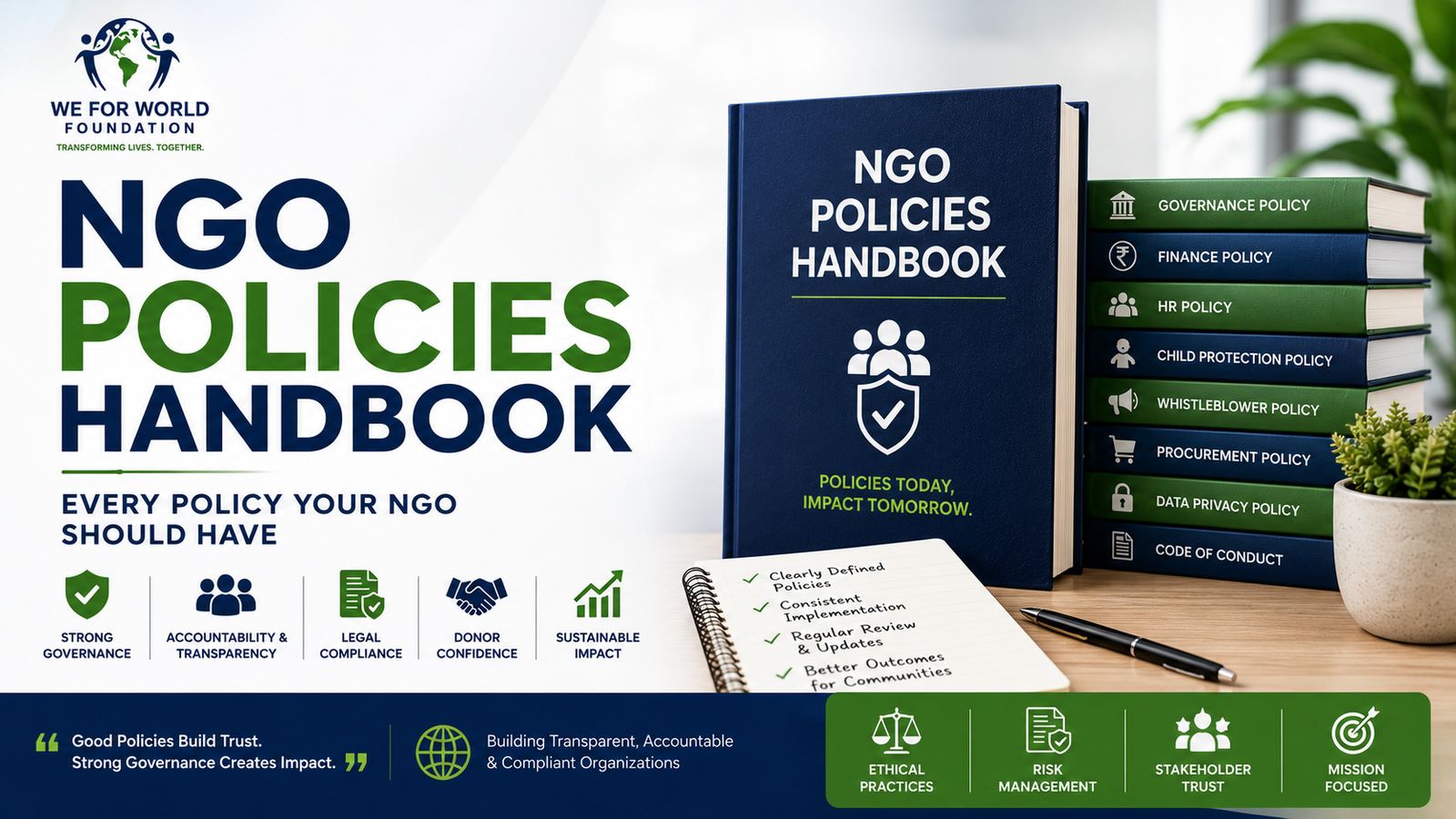
Home Latest Updates NGO Policies Handbook: Every Policy Your NGO Should Have (Complete Guide 2026)

NGO Policies Handbook: Every Policy Your NGO Should Have (Complete Guide 2026)

NGO Policies Handbook: Every Policy Your NGO Should Have (Complete Guide 2026)

Running an NGO successfully requires more than passion and good intentions. Strong governance, transparency, accountability, and well-documented internal policies are essential for building trust with donors, CSR partners, regulators, volunteers, employees, and beneficiaries.

Whether your organization is a Public Charitable Trust, Society, or Section 8 Company, a comprehensive policy framework helps ensure consistent decision-making, legal compliance, ethical conduct, and effective risk management.

This handbook provides an overview of the key policies every NGO should consider adopting, explains why each policy matters, and outlines the core elements it should include.


Table of Contents

  • Why NGOs Need Written Policies
  • Benefits of Strong Governance
  • Essential NGO Policies
  • HR & Employee Policies
  • Financial Policies
  • Governance Policies
  • Child Protection & Safeguarding
  • IT & Data Protection
  • Procurement & Vendor Management
  • Risk Management
  • Common Mistakes
  • FAQs
  • Key Takeaways

Why Every NGO Needs Written Policies

Policies provide a consistent framework for decision-making and help ensure that everyone within the organization understands their responsibilities. They also demonstrate professionalism and strengthen confidence among donors, government agencies, auditors, and beneficiaries.

Well-documented policies help NGOs:

  • Improve accountability
  • Reduce operational risks
  • Ensure legal compliance
  • Promote ethical behavior
  • Protect staff and beneficiaries
  • Strengthen governance
  • Enhance donor confidence
  • Standardize internal processes

Benefits of a Strong Policy Framework

A robust policy framework can help an NGO:

  • Maintain transparency
  • Improve financial discipline
  • Reduce fraud risks
  • Protect organizational reputation
  • Meet donor expectations
  • Prepare for audits
  • Support long-term sustainability

Essential Policies Every NGO Should Have

1. Governance Policy

Defines the structure and functioning of the governing board.

Key Elements:

  • Roles and responsibilities
  • Board meetings
  • Decision-making process
  • Quorum requirements
  • Conflict resolution
  • Board committees
  • Ethical responsibilities

2. Human Resources (HR) Policy

Provides clear guidelines for managing employees fairly and consistently.

Should Include:

  • Recruitment
  • Appointment
  • Probation
  • Leave policy
  • Attendance
  • Working hours
  • Performance appraisal
  • Promotion
  • Resignation
  • Termination
  • Employee benefits

3. Code of Conduct & Ethics Policy

Sets expectations for professional and ethical behavior.

Covers:

  • Professional conduct
  • Integrity
  • Respect in the workplace
  • Anti-corruption
  • Anti-bribery
  • Confidentiality
  • Gifts and hospitality
  • Social media conduct

4. Financial Management Policy

One of the most critical policies for any NGO.

Should Cover:

  • Budget preparation
  • Expense approvals
  • Payment authorization
  • Accounting procedures
  • Cash handling
  • Petty cash
  • Bank reconciliation
  • Asset management
  • Financial reporting
  • Audit preparation

5. Procurement Policy

Ensures fair, transparent, and value-for-money purchasing.

Include:

  • Vendor selection
  • Competitive quotations
  • Approval hierarchy
  • Purchase orders
  • Contract management
  • Conflict of interest checks

6. Conflict of Interest Policy

Helps board members, employees, and volunteers disclose situations where personal interests could influence organizational decisions.

Key components include:

  • Disclosure requirements
  • Annual declarations
  • Recusal procedures
  • Documentation of decisions

7. Whistleblower Policy

Encourages reporting of suspected fraud, corruption, harassment, misuse of funds, or unethical conduct without fear of retaliation.


8. Anti-Fraud and Anti-Corruption Policy

Defines prohibited practices and outlines prevention, detection, investigation, and disciplinary measures.


9. Child Protection & Safeguarding Policy

Essential for NGOs working with children or vulnerable individuals.

Should include:

  • Safe recruitment
  • Background verification
  • Reporting mechanisms
  • Mandatory response procedures
  • Digital safeguarding
  • Photography and media consent
  • Prevention of abuse and exploitation

10. Prevention of Sexual Harassment (POSH) Policy

Organizations covered by applicable law should establish mechanisms to prevent and address workplace sexual harassment, including Internal Committee requirements where applicable.


11. Volunteer Management Policy

Defines:

  • Recruitment
  • Orientation
  • Responsibilities
  • Safety
  • Code of conduct
  • Reimbursements
  • Recognition
  • Exit process

12. Data Privacy & Information Security Policy

Protects organizational and personal information.

Include:

  • Data collection
  • Data storage
  • Password security
  • Email usage
  • Cloud storage
  • Access controls
  • Data retention
  • Incident reporting

13. Social Media & Communication Policy

Provides guidelines for official communication, branding, media interactions, and responsible use of social platforms.


14. Donation Acceptance Policy

Specifies:

  • Acceptable donations
  • Restricted funds
  • Anonymous donations
  • In-kind donations
  • Ethical screening of donors
  • Receipt issuance

15. Grant Management Policy

Outlines procedures for managing grants from application to closure, including budgeting, reporting, compliance, and documentation.


16. Travel & Expense Reimbursement Policy

Defines:

  • Travel approvals
  • Accommodation standards
  • Daily allowances
  • Local transport
  • Expense claims
  • Supporting documentation

17. Risk Management Policy

Helps identify, assess, monitor, and mitigate operational, financial, legal, and reputational risks.


18. Record Retention & Document Management Policy

Specifies how long financial records, contracts, HR files, meeting minutes, and statutory documents should be retained and securely disposed of.


19. Environmental & Sustainability Policy

Encourages environmentally responsible practices such as reducing paper use, waste management, energy conservation, and sustainable procurement.


20. Disaster Recovery & Business Continuity Policy

Ensures continuity of operations during emergencies by addressing backup procedures, communication plans, recovery priorities, and critical responsibilities.


Recommended Policy Adoption Process

  1. Identify organizational needs.
  2. Draft policies aligned with applicable laws and organizational objectives.
  3. Review with legal and governance professionals where appropriate.
  4. Obtain board approval.
  5. Communicate policies to staff and volunteers.
  6. Conduct regular training.
  7. Review and update policies periodically.

Common Mistakes NGOs Make

  • Operating without written policies.
  • Copying templates without customization.
  • Failing to train staff.
  • Not reviewing policies regularly.
  • Weak financial controls.
  • Inadequate documentation.
  • Poor conflict-of-interest management.
  • Ignoring cybersecurity risks.

Best Practices

  • Maintain a centralized policy manual.
  • Review policies annually or after major legal changes.
  • Keep version control and approval records.
  • Ensure policies are accessible to employees and volunteers.
  • Conduct periodic internal audits to verify implementation.

Frequently Asked Questions

1. Are written policies legally mandatory for every NGO?
Some policies are required under specific laws or donor agreements, while others are considered governance best practices.

2. How often should policies be reviewed?
At least annually or whenever there are significant legal, regulatory, or operational changes.

3. Who approves NGO policies?
Typically, the governing board or authorized governing body approves organizational policies.

4. Can small NGOs use the same policies as large NGOs?
Policies should be tailored to the size, activities, and risk profile of each organization.

5. Should volunteers follow organizational policies?
Yes, volunteers should comply with policies relevant to their role.

6. Why is a conflict of interest policy important?
It helps maintain transparency and protects the integrity of organizational decisions.

7. Is a procurement policy necessary for donor-funded projects?
Many donors expect transparent procurement processes, making a procurement policy highly valuable.

8. What is the purpose of a whistleblower policy?
It provides a safe mechanism for reporting suspected wrongdoing.

9. Should NGOs maintain a policy manual?
Yes. A centralized handbook improves accessibility, consistency, and governance.

10. Can policies improve donor confidence?
Absolutely. Strong governance frameworks often enhance credibility with donors, CSR partners, and other stakeholders.


Final Key Takeaways

  • Written policies are the foundation of good nonprofit governance.
  • Every NGO should adopt policies that reflect its legal structure, activities, and operational risks.
  • Financial, HR, safeguarding, procurement, and governance policies are among the highest priorities.
  • Policies should be approved, communicated, implemented, and reviewed regularly.
  • A comprehensive policy handbook strengthens transparency, accountability, and long-term sustainability.

Continue Learning with We For World Foundation

The We For World Foundation (WFWF) Knowledge Centre is dedicated to helping NGOs, Trusts, Societies, and Section 8 Companies build stronger organizations through practical guidance on governance, compliance, CSR, fundraising, financial management, and nonprofit leadership.

Explore our growing library of educational resources to develop effective policies, improve organizational systems, and create lasting social impact.

Recent Posts

Similar Like This