Technology has become one of the most powerful enablers of social impact. Today’s NGOs are expected to manage projects, communicate with donors, coordinate volunteers, measure impact, ensure compliance, raise funds, maintain transparency, and collaborate with stakeholders—all while operating with limited resources.
Fortunately, modern software and Artificial Intelligence (AI) have transformed how nonprofit organizations work. The right technology stack can automate repetitive tasks, improve productivity, strengthen donor relationships, enhance transparency, and allow NGO teams to focus on what matters most: creating positive change.
Whether you are a newly registered NGO or a large nonprofit organization, building the right digital ecosystem is essential for long-term growth.
This guide explores the essential software, AI tools, and automation platforms every NGO should consider in 2026.
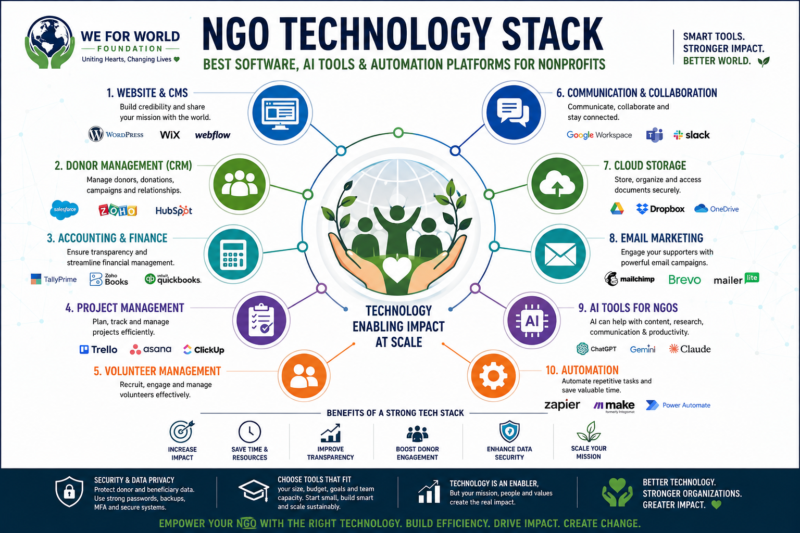
An NGO technology stack is the collection of digital tools, software, and platforms an organization uses to manage its daily operations.
A complete technology ecosystem may include:
The goal is simple:
Reduce manual work while increasing impact.
Technology helps nonprofits:
Organizations that embrace digital transformation can scale their impact more effectively.
Your website is your NGO’s digital headquarters.
It should include:
A professional website builds credibility and improves donor confidence.
Managing donor relationships manually becomes difficult as your NGO grows.
A CRM helps you:
Financial transparency is essential.
Accounting software helps with:
NGOs often manage multiple projects simultaneously.
Project management tools help organize:
As volunteer networks grow, coordination becomes more complex.
Volunteer platforms help with:
Look for systems that integrate with your CRM for a better volunteer experience.
Strong communication improves teamwork.
Useful platforms include:
Cloud-based collaboration reduces delays and improves productivity.
Important NGO documents should be securely stored and accessible.
Popular cloud storage solutions include:
Organize folders for governance, finance, projects, HR, legal documents, and communications.
Email remains one of the highest-performing fundraising and engagement channels.
Use email marketing to share:
Popular platforms include:
Managing multiple social platforms manually is time-consuming.
Scheduling tools help plan content in advance.
Popular options include:
Consistent communication strengthens public engagement.
Artificial Intelligence is changing how nonprofits operate.
AI can support:
AI should support human decision-making—not replace it.
Automation reduces repetitive administrative work.
Tasks that can be automated include:
Popular automation tools include:
Data helps NGOs make informed decisions.
Track metrics such as:
Dashboard tools include:
Protecting donor and beneficiary data is essential.
Best practices include:
A secure NGO earns greater stakeholder trust.
Choose tools based on:
Avoid purchasing software simply because it is popular.
Choose solutions that solve real operational challenges.
Recommended essentials:
This combination covers most operational needs while remaining affordable.
As organizations expand, consider adding:
Growth requires scalable systems.
Avoid these common pitfalls:
Technology should simplify work—not create more complexity.
✅ Professional website
✅ Donor CRM
✅ Accounting software
✅ Project management platform
✅ Volunteer management system
✅ Cloud document storage
✅ Email marketing tool
✅ AI productivity assistant
✅ Automation platform
✅ Cybersecurity measures
Technology improves efficiency, transparency, communication, fundraising, volunteer coordination, and project management.
Yes. AI can assist with writing, research, communication, productivity, planning, and knowledge management while supporting—not replacing—human judgment.
A professional website, CRM, accounting software, project management tool, and cloud collaboration platform form the core technology stack.
Yes. Many providers offer free plans or discounted nonprofit pricing.
Yes. Automation saves time, reduces errors, and improves consistency.
Extremely important. NGOs often manage sensitive donor, volunteer, employee, and beneficiary information.
Where possible, yes. Integrated systems reduce duplicate work and improve data accuracy.
At least once a year to ensure tools continue to meet organizational needs.
No. AI is best used as an assistant that enhances productivity and decision-making while human expertise remains essential.
Implementing multiple disconnected tools without a clear digital strategy.
Technology is no longer a luxury for nonprofit organizations—it is a strategic necessity. The right combination of software, AI tools, and automation platforms can help NGOs improve efficiency, strengthen governance, deepen donor relationships, coordinate volunteers, and measure impact more effectively.
Rather than adopting every new tool, successful nonprofits focus on building an integrated technology ecosystem that supports their mission, scales with their growth, and empowers their teams to spend less time on administration and more time creating meaningful social change.
The We For World Foundation (WFWF) Knowledge Centre empowers NGOs, trusts, Section 8 companies, CSR professionals, and social entrepreneurs with practical resources on digital transformation, governance, fundraising, compliance, project management, volunteer engagement, monitoring & evaluation, leadership, and sustainable development. Explore our expert guides to build a smarter, more efficient, and future-ready nonprofit organization.