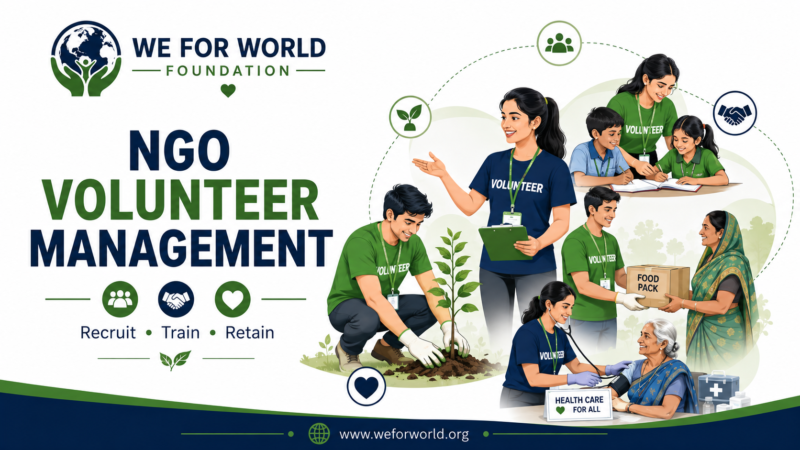
Behind every successful nonprofit organization is a passionate community of volunteers. While funding, leadership, and partnerships are essential, volunteers are often the driving force that transforms ideas into action and missions into measurable impact.
From organizing community events and planting trees to teaching children, conducting awareness campaigns, supporting disaster relief, and managing fundraising activities, volunteers contribute their time, skills, and compassion to create positive social change.
However, attracting volunteers is only the beginning. The true challenge lies in recruiting the right people, providing meaningful training, creating rewarding experiences, and retaining volunteers for the long term.
This comprehensive guide explains how NGOs can build a professional volunteer management system that attracts dedicated volunteers, strengthens organizational capacity, and creates lasting community impact.
Volunteer management is the process of recruiting, screening, training, coordinating, supporting, recognizing, and retaining individuals who contribute their time and skills to an NGO without financial compensation.
Effective volunteer management ensures that volunteers:
A structured volunteer program benefits both the organization and the volunteers themselves.
Volunteers provide more than manpower—they bring passion, creativity, local knowledge, professional expertise, and community trust.
A strong volunteer network helps NGOs:
Many of today’s nonprofit leaders began their journey as volunteers.
Before recruiting volunteers, define your volunteer program.
Ask yourself:
A clear strategy prevents confusion and improves volunteer satisfaction.
Every volunteer should have a clear role.
Examples include:
Well-defined responsibilities improve productivity and accountability.
Successful recruitment focuses on attracting people who align with your mission and values.
Recruit through:
Clearly communicate:
Transparency attracts committed volunteers.
Not every applicant is the right fit.
A simple screening process may include:
The objective is to match volunteers with suitable opportunities.
First impressions matter.
A professional onboarding process helps volunteers feel welcomed and prepared.
Orientation should include:
Provide a volunteer handbook or digital welcome kit whenever possible.
Training increases confidence, quality, and consistency.
Topics may include:
Continuous learning keeps volunteers motivated and effective.
People remain committed when they feel their work has purpose.
Provide opportunities to:
Meaningful experiences create long-term ambassadors for your mission.
Effective communication keeps volunteers informed and engaged.
Use:
Regular communication reduces misunderstandings and strengthens teamwork.
Experienced volunteers can become team leaders, mentors, trainers, or coordinators.
Leadership opportunities may include:
Developing leaders creates a sustainable volunteer ecosystem.
Recognition is one of the strongest drivers of volunteer retention.
Show appreciation through:
Recognition should be timely, genuine, and inclusive.
Retaining experienced volunteers is more valuable than constantly recruiting new ones.
Improve retention by:
People stay where they feel respected and valued.
Track volunteer performance and program effectiveness.
Useful metrics include:
| KPI | Why It Matters |
|---|---|
| Number of active volunteers | Measures program growth |
| Volunteer retention rate | Indicates satisfaction |
| Volunteer hours contributed | Demonstrates commitment |
| Projects supported | Measures organizational capacity |
| Training completion rate | Reflects preparedness |
| Event participation | Indicates engagement |
| Beneficiaries served | Shows community impact |
Review these indicators regularly to improve your volunteer program.
Digital tools simplify volunteer management.
Consider using technology for:
Technology saves time while improving the volunteer experience.
A welcoming environment encourages long-term participation.
Promote:
An inclusive culture strengthens both volunteer satisfaction and organizational reputation.
Avoid these common mistakes:
Strong volunteer programs are built on mutual respect.
✅ Define volunteer roles
✅ Recruit strategically
✅ Screen applicants
✅ Conduct orientation
✅ Provide training
✅ Maintain regular communication
✅ Recognize contributions
✅ Collect feedback
✅ Track volunteer performance
✅ Continuously improve the program
Volunteers expand an NGO’s reach, strengthen community engagement, and contribute valuable time, expertise, and local knowledge.
Through websites, social media, universities, CSR partnerships, volunteer portals, and community outreach.
Mission, vision, policies, safety guidelines, organizational structure, communication channels, and role expectations.
Training improves confidence, quality of service, consistency, and volunteer satisfaction.
By providing meaningful work, recognizing contributions, offering learning opportunities, maintaining communication, and creating a supportive culture.
Yes. Certificates acknowledge contributions and can motivate continued engagement.
Through metrics such as active volunteers, retention rates, volunteer hours, projects supported, and beneficiary outcomes.
Absolutely. Digital tools simplify recruitment, scheduling, communication, training, reporting, and recognition.
Failing to support, appreciate, and engage volunteers after recruitment.
By providing mentoring, leadership opportunities, project responsibilities, and continuous learning pathways.
Volunteers are far more than supporters—they are partners in creating lasting social change. When NGOs invest in structured recruitment, thoughtful training, meaningful engagement, and genuine appreciation, they build a motivated volunteer community that amplifies their mission and extends their impact.
An effective volunteer management program transforms enthusiasm into action, strengthens relationships with communities, and develops future nonprofit leaders. By treating volunteers with respect, providing opportunities for growth, and recognizing every contribution, organizations can cultivate a culture of service that drives sustainable development for years to come.
The We For World Foundation (WFWF) Knowledge Centre provides practical resources for NGOs, trusts, Section 8 companies, CSR professionals, volunteers, and social entrepreneurs. Explore expert guides on volunteer management, fundraising, governance, project management, compliance, digital transformation, monitoring & evaluation, leadership, and sustainable development to build stronger organizations and create lasting social impact.