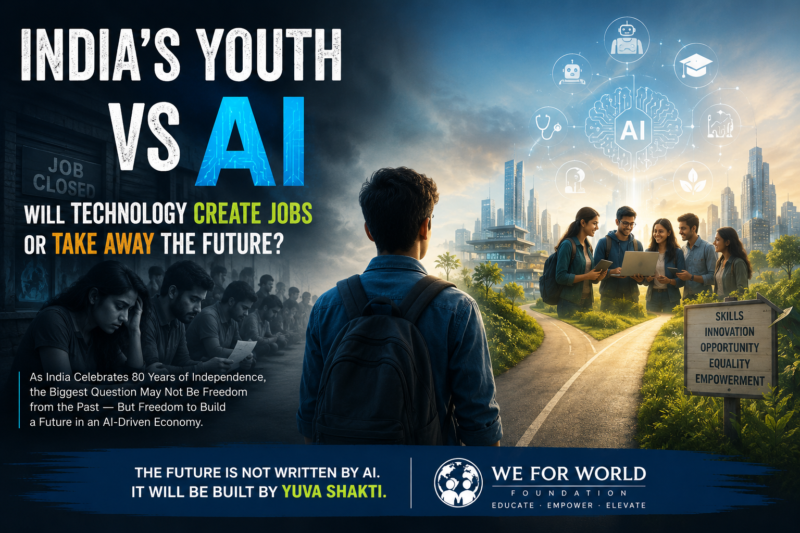
India is approaching a defining moment.
For decades, the country has spoken about its demographic dividend — the enormous potential created by having one of the world’s youngest populations. More than 65% of India’s population is under the age of 35, placing young Indians at the centre of the country’s economic and technological transformation.
But demographic strength alone does not create prosperity.
Young people need education. They need skills. They need opportunities. They need dignified employment. And, above all, they need a realistic pathway from the classroom to the workplace.
Now, Artificial Intelligence is changing that pathway.
AI is entering offices, factories, banks, hospitals, classrooms, media companies, software firms, creative industries and even small businesses. It is writing code, analysing data, generating images, translating languages, answering customer queries and automating repetitive tasks.
For India’s youth, therefore, the question is no longer:
“Will AI affect jobs?”
It already is.
The bigger question is:
Will India prepare its young people to work with AI — or leave millions of them competing against it?
India’s employment challenge existed long before generative AI.
According to India’s Periodic Labour Force Survey (PLFS) 2025, the unemployment rate for young people aged 15–29 was 14.3% in the October–December 2025 quarter.
The challenge becomes even more important when we look at education.
A degree is no longer a guarantee of employment.
The PLFS 2025 data shows that unemployment among people with secondary education and above was 6.5% nationally, with the urban rate at 7.2%.
This creates a difficult contradiction.
India is educating more young people.
Technology is creating new industries.
Digital adoption is accelerating.
Yet many young Indians continue to struggle to find employment that matches their education and aspirations.
And now AI is arriving at exactly this point of transition.
The debate around AI and employment in India is often reduced to a frightening headline:
“AI will replace humans.”
But the reality is more complicated.
Artificial Intelligence does not necessarily replace an entire profession overnight. More often, it replaces or transforms specific tasks within a profession.
A graphic designer may use AI to generate initial concepts.
A programmer may use AI to write and debug code.
A lawyer may use AI to search and organise documents.
A teacher may use AI to create learning material.
A journalist may use AI to analyse large datasets.
A customer-service employee may use AI to handle routine queries.
A small entrepreneur may use AI for marketing, accounting, translation and customer communication.
The person who understands how to use these tools can potentially become more productive.
The person who does not may find that the same job now requires fewer workers.
This is why the future of work in India should not be framed simply as:
Humans vs machines.
It should be framed as:
Humans who know how to work with machines vs humans who have been denied the opportunity to learn.
Perhaps the biggest concern for India’s youth is not the immediate disappearance of every existing job.
It is the possibility that entry-level jobs become harder to find.
For generations, young graduates entered companies through junior positions. They learned on the job, gained experience and gradually moved upward.
AI is beginning to challenge this traditional career ladder.
If software can perform some junior coding tasks, if AI can prepare basic reports, if automated systems can answer routine customer questions and if generative tools can produce first drafts of marketing and creative work, companies may need fewer people for certain entry-level tasks.
The World Economic Forum has highlighted this issue globally, noting that more than one in three young workers are in occupations with medium-to-high exposure to AI-driven task change.
That matters enormously for countries like India.
Because the first job is not just a salary.
The first job is often the first step toward economic independence.
It is where a graduate learns workplace discipline, builds confidence, develops professional networks and discovers what they are capable of achieving.
If that first step disappears, the consequences can extend far beyond unemployment.
It would be a mistake to look only at the jobs AI could disrupt.
AI is also creating entirely new categories of work.
India’s AI ecosystem is generating demand for roles involving:
The World Economic Forum identifies AI and Machine Learning Specialists, Big Data Specialists and Security Management Specialists among India’s fastest-growing job roles toward 2030. It also reports that Indian employers are increasingly looking at skills-based hiring and broader talent pools.
India’s own employment indicators also show that AI is creating demand rather than simply destroying it. Hiring for AI/ML roles increased 32% year-on-year in April 2026, according to the government’s Economic Division report.
The lesson is important:
The future may not have fewer jobs. It may have different jobs.
And that distinction could determine whether India’s demographic dividend becomes an economic miracle or a missed opportunity.
There is another danger that deserves much greater attention.
AI could create a new form of inequality.
Imagine two young Indians.
One grows up in a major city, has a laptop, high-speed internet, access to English-language resources, paid AI tools, coding courses and mentors.
The other lives in a smaller town or rural community, has limited internet access, uses a smartphone as their primary digital device and cannot afford expensive courses or subscriptions.
Both are equally intelligent.
Both are equally ambitious.
Both want the same future.
But one has access to the technology needed to compete.
The other does not.
That is not merely a technology problem.
It is an inequality problem.
AI should not become a dividing line between those who can afford to learn it and those who cannot.
If access to AI education becomes concentrated among privileged students, the technology that promises to democratise opportunity could instead deepen existing economic and educational inequalities.
The education system must evolve.
For decades, students have been encouraged to memorise information, pass examinations and collect degrees.
But AI can already retrieve, summarise and generate information at extraordinary speed.
That means the value of purely memorising information is changing.
The future requires young people to develop abilities that machines cannot easily replace:
Critical thinking.
Creativity.
Problem-solving.
Communication.
Leadership.
Emotional intelligence.
Collaboration.
Adaptability.
Ethical judgement.
And, increasingly:
The ability to use AI intelligently.
AI literacy should therefore become as fundamental as digital literacy.
A student does not necessarily need to become an AI engineer.
A future lawyer should understand AI.
A future doctor should understand AI.
A future filmmaker should understand AI.
A future teacher should understand AI.
A future entrepreneur should understand AI.
A future farmer should understand AI.
A future government employee should understand AI.
The goal should not be to turn every young Indian into a programmer.
The goal should be to make every young Indian capable of participating in an AI-enabled economy.
There is another opportunity hidden inside this transformation.
India has millions of young people who are already using AI.
But using AI and building with AI are two very different capabilities.
A recent upGrad survey reported that 94% of participating Indian learners were using AI tools, but only around 20% had developed AI-powered automations, agents or applications.
That gap is significant.
India should not aim merely to become one of the world’s largest consumers of AI.
It should aim to become one of the world’s largest creators of AI-powered products, services and solutions.
That means giving young Indians access to:
The transformation must reach beyond Bengaluru, Hyderabad, Mumbai, Delhi and other major technology hubs.
The next great AI entrepreneur could come from a small town in Bihar.
The next AI researcher could come from Uttar Pradesh.
The next technology-enabled social entrepreneur could come from rural Maharashtra.
The next global creative technology company could be founded by a young Indian who currently has no access to the ecosystem.
Opportunity must travel beyond the metropolitan elite.
One of the most exciting aspects of AI is that its impact will not be limited to software companies.
AI is increasingly becoming a general-purpose technology.
It can be applied to agriculture, healthcare, manufacturing, education, finance, logistics, entertainment, media, tourism and public services.
For India, that creates an enormous opportunity.
Imagine a farmer using AI-assisted systems to understand weather patterns, crop diseases and market information.
Imagine a student in a rural school accessing an AI tutor in their own language.
Imagine a small manufacturer using AI to improve production efficiency.
Imagine a young entrepreneur using AI to build a business without needing a large administrative team.
Imagine a healthcare worker using AI-assisted tools to identify risks earlier.
Imagine young creators using AI to produce films, animation, music and digital content for a global audience.
This is where the conversation about AI jobs in India becomes much larger than technology.
It becomes a conversation about economic inclusion.
India’s Gen Z is entering the workforce with a fundamentally different relationship with technology.
They grew up with smartphones, social media, online learning, digital payments and instant access to information.
Now they are entering an economy where AI can become their daily co-worker.
For Gen Z jobs in India, adaptability may become one of the most valuable career assets.
The ability to learn something new every few years could become more important than simply holding one qualification for an entire career.
The traditional idea of:
Study → Graduate → Get a Job → Stay in the Same Profession
may increasingly become:
Learn → Work → Adapt → Reskill → Build → Reinvent.
This does not mean degrees will become irrelevant.
It means degrees and skills must work together.
India’s youth should not be told simply to “learn AI.”
That advice is too vague.
Young people need a clearer roadmap.
Understand what AI can do, what it cannot do, and how to use AI responsibly.
Cloud computing, data analysis, cybersecurity, digital collaboration and modern productivity tools will become increasingly important.
The ability to communicate clearly — verbally and in writing — will remain deeply human and commercially valuable.
AI can generate answers.
Humans must learn to determine whether those answers are correct.
Original ideas, storytelling, design, innovation and cultural understanding remain powerful human capabilities.
AI becomes more powerful when combined with knowledge of a particular industry.
A person who understands healthcare plus AI may be more valuable than someone who understands AI alone.
The same applies to agriculture, finance, law, education, manufacturing, entertainment and other sectors.
India cannot create enough traditional salaried jobs for every young person indefinitely.
Young people must also be encouraged to create businesses, products and employment opportunities.
Leadership, empathy, teamwork, negotiation and decision-making will become even more important in a world where machines handle more routine tasks.
The responsibility cannot fall entirely on young people.
It would be unfair to tell millions of students to “upskill” while leaving them to figure everything out themselves.
India needs a coordinated approach involving government, schools, universities, companies, NGOs and civil society.
AI literacy should reach government schools, colleges, ITIs, vocational institutions and community learning centres — not just expensive private institutions.
Training programmes should be designed around real industry demand.
The government’s recent emphasis on employer-led and demand-driven skilling across sectors such as IT, healthcare, logistics, electronics and green jobs reflects this need.
A young person should be able to experiment with an AI business without needing enormous capital.
Access to mentorship, computing resources, incubation and early-stage funding can make a major difference.
When technology changes an occupation, workers need pathways to retraining rather than simply being left behind.
India’s hiring ecosystem should increasingly recognise what a young person can actually do.
A certificate can show that someone completed a course.
A portfolio can show what they can build.
This is where organisations like We For World Foundation have an important role to play.
The AI transition should not be treated only as an economic or technological issue.
It is also a social-development issue.
If a young person from a disadvantaged background cannot access quality education, digital infrastructure or modern skills, their disadvantage can compound over time.
Civil society organisations can help bridge this gap by creating community-level access to:
The objective should be simple:
No young person should be excluded from the future simply because they were born without access to the tools required to build it.
As India marks 80 years of Independence, the national conversation should go beyond celebrating how far the country has travelled.
We should also ask where we are going.
India’s vision of Viksit Bharat 2047 depends heavily on its ability to convert its demographic strength into productive, inclusive economic participation.
AI can accelerate that journey.
But technology alone cannot.
A country does not become developed simply because it has powerful computers, advanced models or large technology companies.
A developed nation is one where its people have the opportunity to participate in progress.
That means a young woman in a village should have access to the same knowledge that a student in a metropolitan university can access.
A graduate from a small town should have a pathway into the digital economy.
A young person from a low-income family should be able to learn AI without being priced out.
A student should be encouraged not only to search for a job, but also to imagine creating one.
That is how Yuva Shakti becomes economic power.
The honest answer is:
Some jobs will disappear.
Some roles will shrink.
Some entry-level opportunities will change.
Some skills will become obsolete.
Some companies will need fewer people to perform tasks that once required large teams.
Pretending otherwise would be irresponsible.
But another reality is equally important:
New jobs will emerge.
New industries will be created.
Entire professions will evolve.
Millions of workers will use AI to become more productive.
Young entrepreneurs will build companies that do not yet exist.
And people who learn continuously may find opportunities that previous generations could never have imagined.
The question, therefore, is not whether AI will change employment.
It will.
The question is whether India will manage that change fairly.
This may ultimately be the defining social question of India’s AI era.
If AI becomes accessible only to the privileged, it could widen inequality.
If AI becomes accessible to everyone, it could become one of the greatest tools for expanding opportunity.
That choice will depend on what India does today.
Schools must adapt.
Universities must adapt.
Employers must adapt.
Governments must adapt.
NGOs must adapt.
And young people must be given the confidence and resources to adapt.
Because the greatest risk is not that machines become smarter than humans.
The greatest risk is that millions of capable young humans are never given the opportunity to become future-ready.
Artificial Intelligence is not destiny.
It is a tool.
Like every transformative technology before it, its impact will depend on how society chooses to use it.
India has the population.
India has the entrepreneurial energy.
India has an enormous technology ecosystem.
India has ambitious young people.
What India now needs is inclusive access to skills and opportunity.
The goal should not be an India where young people compete against AI.
It should be an India where young people use AI to compete with the world.
That is the opportunity before us.
And perhaps, as India looks toward its next chapter of independence, the most meaningful definition of freedom is not simply freedom from colonial rule.
It is freedom from unemployment, freedom from lack of opportunity, freedom from unequal access to education — and freedom to build a future defined by knowledge, innovation and human potential.
It will be decided by what we choose to teach our children today.
At We For World Foundation, we believe that education, opportunity and empowerment must reach every section of society.
The AI revolution should not leave behind the young people who need opportunity the most.
We must work toward a future where every young Indian — regardless of background, geography or economic status — has the opportunity to learn, adapt, create and contribute.
Because technology should not decide who gets a future.
People should.
And every young person deserves the chance to build one.
Artificial Intelligence is changing how people learn, work and build businesses. For India’s young population, the transition brings both opportunities and uncertainty. Here are answers to some of the most important questions about AI jobs in India, youth employment and the future of work.
AI is likely to automate certain tasks and transform many existing jobs, but that does not necessarily mean that entire professions will disappear. At the same time, AI is creating demand for new roles and industries. The impact will depend on the occupation, industry, level of automation and the ability of workers to develop new skills.
Yes. India’s growing AI ecosystem is creating opportunities in areas such as artificial intelligence, machine learning, data science, cybersecurity, cloud computing, automation, AI implementation and AI-enabled business services. AI is also expected to create new opportunities beyond the traditional technology sector.
Emerging career opportunities include AI and machine learning, data science, data engineering, AI product development, cybersecurity, automation, AI research and AI implementation. However, many future jobs will combine AI skills with expertise in another field such as healthcare, finance, agriculture, education, law, manufacturing or media.
AI will change the skills employers look for and may make some traditional entry-level roles more automated. At the same time, young people who understand AI and develop strong digital, analytical, creative and communication skills may be better positioned to benefit from new opportunities.
Future-ready skills will include AI literacy, digital skills, critical thinking, creativity, communication, problem-solving, adaptability, entrepreneurship and domain expertise. Human qualities such as judgement, empathy, leadership and collaboration will also remain highly valuable.
AI could increase unemployment in certain occupations if workers are unable to transition as technology changes. However, technological transformation can also create new industries, occupations and productivity-driven employment. The key challenge for India will be ensuring that workers and young people have access to education, reskilling and new opportunities.
Students can start by developing basic AI literacy and learning how modern AI tools work. Building practical projects, improving communication and problem-solving skills, gaining industry experience and continuously learning new technologies can help students prepare for an evolving job market.
Not necessarily. Coding and technical skills are important for many AI careers, but the AI economy will also need professionals in business, design, healthcare, education, finance, marketing, law, media and other fields. The most valuable combination may be AI literacy plus expertise in a specific domain.
Some entry-level tasks may become automated, which could change how companies hire and train fresh graduates. However, new roles will also emerge. This makes internships, practical projects, apprenticeships, industry exposure and continuous skill development increasingly important for young people entering the workforce.
The future of work in India is likely to involve humans working alongside AI and automation. Jobs requiring creativity, critical thinking, communication, technical knowledge, human judgement and problem-solving may remain particularly important, while many existing roles will evolve around AI-enabled productivity.
AI has the potential to create new industries, improve productivity and open opportunities for entrepreneurship and digital employment. However, technology alone cannot solve youth unemployment. India will also need accessible education, practical skill development, affordable digital infrastructure and pathways connecting young people with real employment opportunities.
AI can potentially expand access to education, career guidance, digital services, entrepreneurship tools and global markets. But this opportunity will only become inclusive if young people in rural and underserved communities have affordable access to devices, internet connectivity, training and mentors.
India’s ambition to become a developed nation by 2047 will depend significantly on how effectively it converts its young population into a skilled, productive and innovative workforce. AI can accelerate this transformation, but only if its benefits reach beyond major cities and privileged communities.
The future of AI jobs in India is not simply about whether machines will replace people.
It is about whether people will be given the opportunity to learn, adapt and work alongside machines.
For India’s youth, access to education and future-ready skills could become one of the most important determinants of economic opportunity.
AI should not become a dividing line between those who can afford to learn it and those who cannot.
The future should be built by everyone — and every young Indian deserves the opportunity to be part of it.
This editorial draws on data, research and policy perspectives from leading government and international institutions working on employment, education, skills and the future of work.
For readers who want to explore the subject further, we recommend the following authoritative sources:
Ministry of Statistics and Programme Implementation (MoSPI) — Periodic Labour Force Survey (PLFS)
India’s official employment and unemployment statistics, including data on youth employment and unemployment.
Explore PLFS 2025
Department of Economic Affairs, Ministry of Finance — Monthly Economic Report
Government analysis covering India’s labour market, hiring trends, AI/ML employment and emerging economic developments.
Read the Monthly Economic Report
Ministry of Education, Government of India
Information on India’s education policies and initiatives involving Artificial Intelligence, digital learning and technology-enabled education.
AI and Education Initiatives
Ministry of Skill Development and Entrepreneurship (MSDE)
Government initiatives focused on skilling, employability, vocational education and preparing India’s workforce for emerging industries.
NITI Aayog — Roadmap for Job Creation in the AI Economy
A policy roadmap examining how Artificial Intelligence could transform India’s technology workforce, create new roles and address emerging AI-related skill gaps.
Read the NITI Aayog AI Jobs Roadmap
World Economic Forum — Future of Jobs Report 2025
Global research examining technological change, emerging occupations, declining roles and the skills expected to shape employment through 2030.
Explore the Future of Jobs Report 2025
World Economic Forum — India: Future of Jobs
Insights specifically examining how AI, digital access, robotics, advanced technologies and skills-based hiring are expected to shape India’s employment landscape.
Read the India Employment Insights
International Labour Organization (ILO) — India Employment Report 2024
Research examining youth employment, education, skills and India’s changing labour market.
Read the India Employment Report 2024
UNESCO — AI Competency Framework for Students
A global framework designed to help education systems prepare students to understand, use and create with AI responsibly, with emphasis on human-centred thinking, ethics, AI applications and system design.
Explore UNESCO’s AI Competency Framework for Students
UNESCO — Artificial Intelligence in Education
Research and guidance on using AI in education while protecting inclusion, equity, human agency and access to knowledge.
Explore UNESCO’s AI and Education Resources
The future of AI jobs in India cannot be understood through headlines alone.
Employment data, education outcomes, technological adoption, skill development and access to opportunity are all interconnected. By referring to official government statistics and research from recognised international institutions, this editorial aims to encourage a more informed and balanced conversation about AI, employment, education and India’s youth.
The objective is not to predict whether AI will “win” or humans will “lose.”
The objective is to ensure that India’s young people are prepared to participate in the future they will inherit.
Sources accessed and reviewed for this editorial in August 2026.