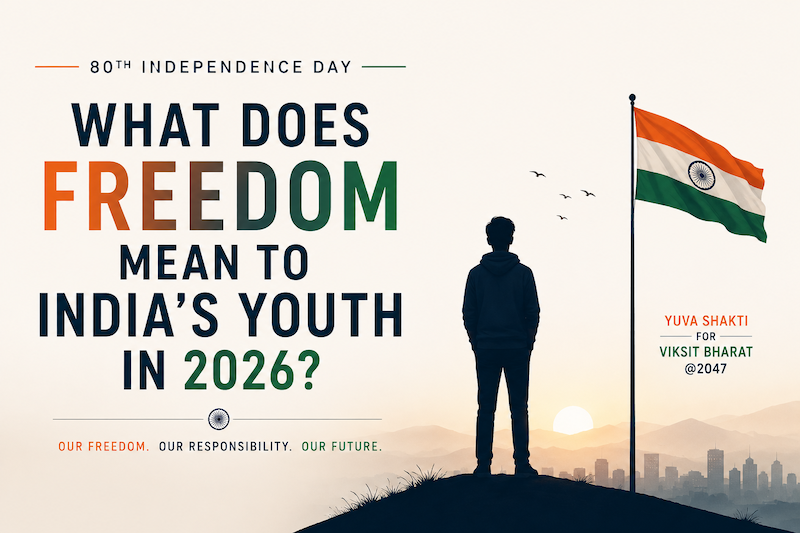
Every year, on 15 August, India looks back.
We remember the freedom fighters who sacrificed everything for independence. We remember the struggle against colonial rule. We remember the midnight of 1947, when a nation stepped into freedom and began writing its own story.
We raise the Tricolour.
We sing Vande Mataram.
We say Jai Hind.
And rightly, we celebrate.
But in 2026, as India marks its 80th Independence Day, perhaps there is another question we should ask:
What does freedom actually mean to a young Indian today?
Is freedom simply the absence of foreign rule?
Or does freedom also mean having the opportunity to study, work, earn, dream, create, speak, participate and build a dignified life?
Because a young person cannot feel completely free if poverty determines their future.
A student cannot feel completely free if quality education is beyond their reach.
A graduate cannot feel completely free if there is no pathway from education to employment.
A child cannot feel completely free if malnutrition limits their ability to learn and grow.
And a young person cannot fully participate in India’s future if the digital world remains inaccessible to them.
Political freedom gave India the right to determine its own destiny.
The next generation must have the opportunity to determine its own destiny.
India’s freedom struggle was never only about removing a foreign power.
It was about dignity.
It was about self-determination.
It was about the belief that Indians should have the right to shape their own lives and their own nation.
That idea remains relevant.
The challenges are simply different.
In 1947, the struggle was against colonial rule.
In 2026, the struggles are also against poverty, inequality, unemployment, ignorance, exclusion and lack of opportunity.
The enemy is no longer standing outside India’s borders.
Some of the biggest barriers are within our society.
And defeating them will require a different kind of freedom movement — one driven not by armies, but by education, innovation, compassion, entrepreneurship, social responsibility and Yuva Shakti.
Ask a 20-year-old student in Mumbai what freedom means.
Then ask a young woman in a village in Bihar.
Ask a graduate searching for their first job.
Ask a young entrepreneur trying to build a business without family wealth.
Ask a child who has never had access to a computer.
Ask a young person living with disability.
Ask a young person who has been excluded because of social or economic circumstances.
Their answers may be very different.
But underneath those differences, there is likely to be one common desire:
The freedom to build a better life.
For today’s youth, freedom can mean:
This is what the next chapter of India’s development must be about.
For a young graduate, a degree can represent years of hard work.
It can also represent a promise.
The promise of a better future.
But when education does not translate into opportunity, frustration grows.
Youth unemployment is therefore not merely an economic statistic.
Behind every number is a young person waiting for an opportunity.
Someone who wants to contribute.
Someone who wants to support their family.
Someone who wants to become independent.
Someone who wants to prove themselves.
And someone who may eventually begin to question whether the education they received was enough to change their circumstances.
India’s demographic dividend will only become an advantage if young people can participate meaningfully in the economy.
A young population without opportunity can become a source of frustration.
A young population with education, skills and opportunity can become one of the country’s greatest strengths.
That is why youth employment in India must be treated as more than an economic priority.
It is a nation-building priority.
Imagine being born with talent but without opportunity.
Imagine being intelligent but unable to afford a good school.
Imagine having entrepreneurial ideas but no access to capital.
Imagine being capable of learning but having to choose between education and helping your family survive.
This is where poverty becomes more than a lack of money.
It becomes a limitation on choice.
True development must therefore mean expanding the choices available to ordinary people.
A young Indian should not have to inherit their future simply because of the circumstances into which they were born.
India’s progress must be measured not only by skyscrapers, highways, startups and economic growth.
It must also be measured by a simpler question:
How many young people can now dream bigger than their parents could?
That is progress.
That is empowerment.
And that is freedom.
If there is one force capable of changing the meaning of freedom for India’s youth, it is education.
Education can turn poverty into opportunity.
It can turn vulnerability into confidence.
It can turn an ordinary idea into a profession.
It can help a young person understand their rights, responsibilities and potential.
But education must be more than the ability to pass examinations.
The India of 2047 will need young people who can think, question, innovate, collaborate and solve problems.
It will need scientists and teachers.
Doctors and engineers.
Farmers and entrepreneurs.
Artists and filmmakers.
Researchers and designers.
Skilled workers and technology professionals.
Social entrepreneurs and community leaders.
Education must therefore prepare young people not merely for the jobs that exist today, but for the opportunities that will exist tomorrow.
There was a time when access to information depended heavily on where you lived.
Today, a smartphone can put an enormous amount of knowledge into someone’s hands.
But access to a device does not automatically mean access to opportunity.
A young person needs:
Connectivity.
Digital literacy.
Quality information.
The ability to use technology productively.
And the confidence to participate in the digital economy.
This is especially important as Artificial Intelligence transforms education, employment and entrepreneurship.
The question is no longer simply whether a young Indian has internet access.
The question is:
Can they use the digital world to improve their life?
If the answer is no, the digital divide becomes another form of inequality.
Technology should therefore become a bridge to opportunity — not another wall separating those who have access from those who do not.
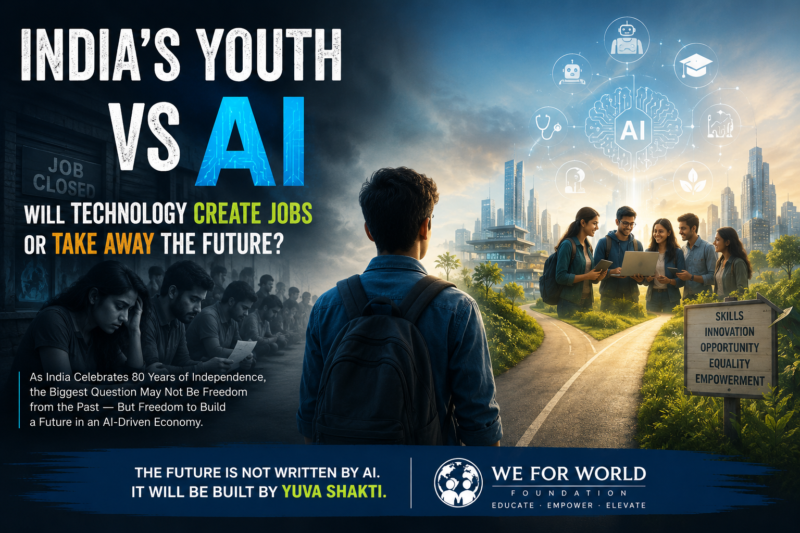
The previous generation worried about finding a job.
Today’s young generation may also have to worry about whether the job itself will change.
Artificial Intelligence is transforming industries across the world.
For India’s youth, this can create extraordinary opportunities.
But it can also create uncertainty.
What happens to traditional entry-level jobs?
What happens to workers whose skills become outdated?
What happens to young people who cannot afford expensive technology and training?
These are not merely technology questions.
They are questions about economic freedom and social equality.
The answer cannot be to stop technology.
India must move forward.
But progress must be inclusive.
A young person from a rural community should have an opportunity to learn AI just as a student in a metropolitan university can.
A student should not need to be wealthy to become future-ready.
The freedom to participate in India’s digital future should not belong only to those who can afford it.
India’s Constitution promises equality.
But equality on paper and equality of opportunity are not always the same thing.
Young people can face barriers because of poverty, gender, disability, geography, social background or lack of access to networks and resources.
A truly developed India must continue working toward a society where talent can rise.
Where a young woman can pursue her ambitions without unnecessary barriers.
Where a child from a rural school can dream of becoming a scientist.
Where a person with a disability can participate fully in economic and social life.
Where someone’s financial background does not determine the ceiling of their ambition.
Freedom means being able to say:
“My circumstances may shape where I begin, but they do not have to determine where I finish.”
It is difficult to talk about freedom while ignoring hunger.
A hungry child cannot concentrate in school.
A malnourished child may struggle to reach their full developmental potential.
A family facing food insecurity cannot easily prioritise education or long-term planning.
This is why nutrition is not separate from education.
It is not separate from employment.
And it is not separate from India’s future.
A healthy young population is an essential foundation for a strong nation.
The freedom to dream must begin with the freedom to grow, learn and live with dignity.
For decades, success has often been defined by getting a good job.
But India’s future will also depend on young people who create jobs.
Entrepreneurs.
Innovators.
Farmers who build modern agricultural businesses.
Creators who build global audiences.
Small manufacturers who scale.
Technology founders who solve Indian problems.
Social entrepreneurs who build sustainable solutions for communities.
A young person should not be told that the only definition of success is getting hired by someone else.
Sometimes freedom means having the ability to build something of your own.
India’s startup and entrepreneurship ecosystem has already demonstrated what young Indians can accomplish when ideas meet opportunity.
The next stage is ensuring that entrepreneurship is not accessible only to young people with wealthy families, elite networks or metropolitan connections.
Entrepreneurial freedom must become more inclusive.
What does freedom mean if the air we breathe is unhealthy?
What does development mean if rivers are polluted?
What does progress mean if extreme weather increasingly threatens livelihoods?
Young Indians will inherit the environmental consequences of today’s decisions.
Climate change, pollution, water stress, waste management and biodiversity are not distant issues.
They are questions about the quality of life of the next generation.
Environmental sustainability must therefore become part of the definition of development.
The young India of 2047 deserves not only a richer country.
It deserves a healthier one.
Perhaps this is the most powerful definition of freedom.
The freedom to dream.
A child should be able to dream of becoming a doctor without asking whether their family can afford medical education.
A young person should be able to dream of starting a company without believing entrepreneurship is only for the wealthy.
An aspiring filmmaker should be able to tell stories regardless of where they come from.
A rural student should be able to imagine a career in science and technology.
A young woman should be able to choose her own path.
A child from an underprivileged family should be able to believe:
“I can become more than the circumstances I was born into.”
That belief is powerful.
Because every great transformation begins with someone believing that a different future is possible.
We often hear:
“The youth are the future of India.”
That is true.
But it is incomplete.
Young Indians are not merely future citizens.
They are already students, workers, entrepreneurs, researchers, creators, voters, volunteers, athletes, artists, engineers, farmers and community leaders.
They are already building India.
The Government’s youth programmes increasingly emphasise youth participation in the Viksit Bharat journey. In 2026, the Viksit Bharat Youth Parliament brought together young representatives from hundreds of universities and institutions to contribute ideas to the national conversation.
MY Bharat has also been encouraging youth participation and registration across the country, including efforts aimed at reaching rural youth, women and young people from different sections of society.
This is important because Yuva Shakti is not simply a slogan.
It is a national resource.
The question is whether we will give that resource the education, health, skills, opportunities and freedom it needs to flourish.
India fought for Swaraj — self-rule.
The next generation must work toward something broader:
A society where freedom produces opportunity.
Where opportunity produces dignity.
Where dignity produces participation.
And where participation produces development.
The freedom movement gave India political independence.
The development movement must give every citizen the ability to participate meaningfully in India’s progress.
That means:
Swaraj must lead to opportunity.
Opportunity must lead to dignity.
Dignity must lead to empowerment.
And empowerment must reach everyone.
By the time India reaches 100 years of independence in 2047, today’s young people will be the leaders of the country.
They will be running businesses.
Teaching children.
Building technology.
Managing cities.
Farming land.
Creating films.
Designing infrastructure.
Leading institutions.
Serving communities.
Making decisions that will affect hundreds of millions of people.
So the question we should ask today is:
What kind of India do we want them to inherit?
An India where economic growth is concentrated among a few?
Or an India where opportunity reaches every district?
An India where technology creates new inequalities?
Or an India where technology expands access?
An India where education is a privilege?
Or an India where quality education is an expectation?
An India where young people simply search for opportunities?
Or an India where young people create them?
That is the real conversation behind India 2047.
This year carries another powerful historical connection.
India is commemorating 150 years of Vande Mataram, which was first published in 1875 and became deeply associated with India’s freedom movement. The Government’s year-long commemoration runs through 2026, with programmes designed to connect its historical legacy with contemporary national participation.
For generations, Vande Mataram represented love for the motherland.
But patriotism should not end with singing a song.
It should become action.
To love India is to care about the child who cannot afford education.
To love India is to care about the young graduate searching for work.
To love India is to care about the farmer.
To love India is to protect the environment.
To support innovation.
To respect diversity.
To help someone who has been left behind.
To build institutions that create opportunity.
To serve society even when nobody is watching.
Patriotism is not only about remembering those who built India.
It is also about deciding what we will build for those who come after us.
Every generation inherits a different challenge.
Our freedom fighters fought colonialism.
The generation after independence fought poverty, illiteracy and the challenge of building a new republic.
Today’s generation faces a different battlefield.
It is the battle against:
Poverty.
Unemployment.
Inequality.
Ignorance.
Digital exclusion.
Malnutrition.
Environmental degradation.
Lack of opportunity.
And perhaps one of the greatest challenges of all:
Indifference.
Because a nation cannot become truly developed if one part of society moves forward while another is left behind.
Freedom is not only something governments provide.
It is also something citizens protect and strengthen through participation.
Young Indians can:
Develop skills that will remain relevant in a changing economy.
Build businesses, technologies, art, ideas and solutions.
Give time and knowledge to communities that need support.
Look at India’s problems not simply as obstacles, but as opportunities to create solutions.
Engage with civic life, local communities and national development.
Care for the environment and public spaces.
Help ensure that people from different backgrounds have access to opportunity.
Take responsibility rather than waiting for someone else to solve every problem.
The India of 2047 will not be built by one institution.
It will be built by millions of ordinary people doing extraordinary things consistently.
This question matters to organisations working in education and social development.
At We For World Foundation, we believe that empowerment begins when opportunity becomes accessible.
A young person does not need sympathy.
They need a chance.
A child does not need to be told that poverty defines their future.
They need education.
A graduate does not need another motivational speech.
They need skills and an opportunity to use them.
A young entrepreneur does not need to be told to “dream big.”
They need access to knowledge, mentorship and an ecosystem that allows them to build.
This is where civil society, NGOs, educational institutions, businesses and communities have an important role.
Our responsibility is not simply to celebrate India’s youth.
It is to invest in them.
Perhaps the greatest lesson of India’s freedom struggle is that freedom is never passive.
It requires courage.
It requires responsibility.
It requires participation.
And it requires generations to protect what previous generations fought to achieve.
In 1947, India became free to determine its own destiny.
In 2026, our responsibility is to ensure that every young Indian has a genuine opportunity to participate in that destiny.
Because what use is freedom if opportunity remains inaccessible?
What use is education if it cannot open doors?
What use is technology if it leaves millions behind?
What use is economic growth if dignity and opportunity are not widely shared?
Development must therefore be measured not simply by how high India can rise.
It must also be measured by how many people rise with it.
Tomorrow, millions of Indians will say:
Happy Independence Day.
We should.
We should celebrate.
We should remember.
We should honour the sacrifices that made our freedom possible.
But perhaps this Independence Day, we should also ask ourselves:
What are we doing with that freedom?
Are we using it to learn?
To create?
To help?
To innovate?
To build?
To include?
To serve?
To give someone else the opportunity that we were fortunate enough to receive?
Because the freedom fighters of 1947 did not sacrifice so that one generation could simply celebrate independence every year.
They fought so that future generations could live with dignity and possibility.
We are that future generation.
And now it is our turn.
It is not against a foreign power.
It is not fought with weapons.
It is fought in classrooms.
In villages.
In laboratories.
In startups.
In farms.
In hospitals.
In communities.
In schools.
On digital platforms.
In every family trying to give its children a better life.
It is the struggle against poverty, inequality, ignorance, exclusion and the absence of opportunity.
And the most powerful weapon in this struggle is not anger.
It is education.
It is skill.
It is innovation.
It is compassion.
It is opportunity.
And it is the determination of India’s Yuva Shakti.
India’s freedom story did not end in 1947.
It continues.
Every generation gets the opportunity to add another chapter.
For today’s youth, that chapter should be about building an India where:
No child is denied education because of poverty.
No young person is denied opportunity because of where they were born.
No graduate is made to feel worthless because they cannot find work.
No community is left behind by technology.
No person is excluded because of their identity or circumstances.
No child goes hungry while society looks away.
No future is sacrificed because we failed to protect the environment.
And where every young Indian can look at the country and say:
“I have a place in India’s future.”
That is the promise of Viksit Bharat 2047.
And that is the true meaning of Yuva Shakti.
It means more than a flag.
More than a holiday.
More than a speech.
More than a patriotic song.
Freedom means having the opportunity to become who you are capable of becoming.
It means education that opens doors.
It means work that provides dignity.
It means technology that expands opportunity.
It means food, health and a safe environment.
It means equality.
It means inclusion.
It means the freedom to dream — and a fair chance to turn that dream into reality.
India won political freedom in 1947.
Now, our generation must work toward freedom from the barriers that prevent millions from reaching their potential.
Because the next chapter of India’s freedom story will not be written by governments alone.
It will be written by teachers, parents, entrepreneurs, farmers, workers, scientists, artists, volunteers and millions of young Indians who decide that their country’s future is worth building.
And perhaps that is the greatest responsibility of freedom:
Not simply to enjoy what previous generations fought for — but to build something worthy of what they sacrificed for.
You were born in a free India.
But you have inherited a country that is still being built.
You have inherited its achievements.
You have inherited its challenges.
And you have inherited its possibilities.
Do not measure your freedom only by what you are allowed to do.
Measure it by what you are empowered to become.
Learn.
Build.
Question.
Create.
Serve.
Include.
Lead.
And when your generation reaches 2047, may you be able to look back and say:
We did not simply inherit India’s freedom.
We expanded its meaning.
We made opportunity more equal.
We made education more accessible.
We helped those who were left behind.
We built a stronger, kinder and more inclusive India.
Because India’s next freedom struggle is not against a foreign power.
It is against poverty.
It is against inequality.
It is against ignorance.
It is against exclusion.
It is against the absence of opportunity.
And winning that struggle will be the greatest tribute we can give to those who gave us freedom.
Jai Hind.