A successful fundraising campaign is more than simply asking people for donations. It is about building trust, communicating a meaningful cause, reaching the right audience, and showing donors how their support can create real change.
Whether you are an NGO, nonprofit organization, community group, school, or individual working for a social cause, a well-planned fundraising campaign can help you raise money while also building long-term relationships with supporters.
But how do you organize a successful fundraising campaign?
From defining your fundraising goal to promoting your campaign and thanking your donors, every stage matters. In this guide, we will explain the essential steps you can follow to plan, launch, and manage an effective fundraising campaign.
A fundraising campaign is an organized effort to collect financial contributions from individuals, businesses, foundations, or other supporters for a specific purpose.
Fundraising campaigns can support many causes, including:
A campaign can be conducted online, offline, or through a combination of both.
The most effective campaigns usually have a clear purpose, a realistic goal, a compelling story, and a well-defined audience.
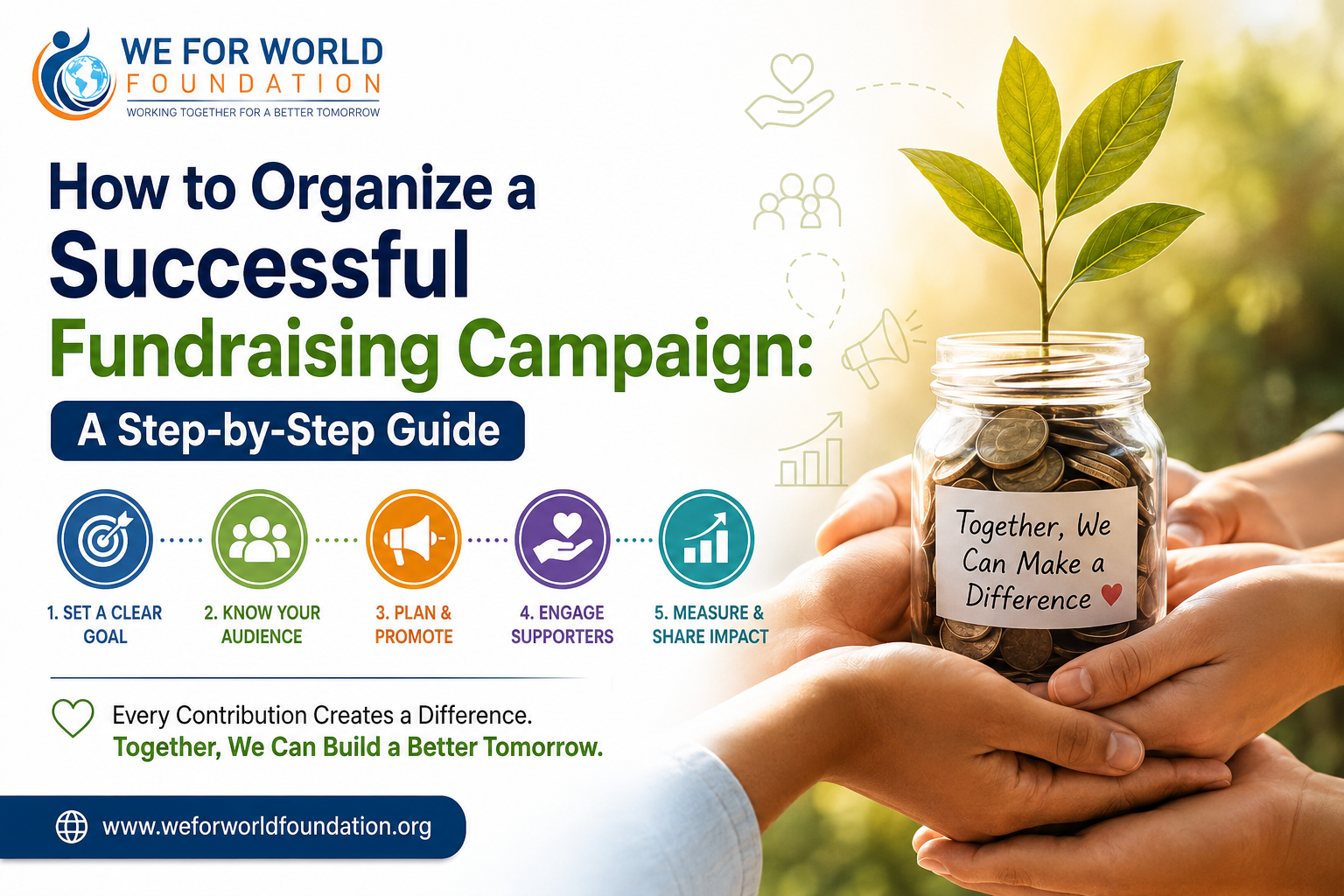
The first step in organizing a successful fundraising campaign is deciding exactly what you want to achieve.
Avoid setting a vague goal such as “We want to help people.” Instead, make your objective specific and measurable.
For example:
“Our goal is to raise ₹5,00,000 to provide educational materials and school support to 200 children from underserved communities.”
This immediately tells potential donors:
Your fundraising goal should ideally be:
Specific: Clearly explain what you want to accomplish.
Measurable: Use a specific fundraising amount or impact target.
Achievable: Set a realistic goal based on your audience and resources.
Relevant: Connect the goal directly to your organization’s mission.
Time-bound: Establish a deadline for the campaign.
A clear goal gives your team direction and gives donors a concrete reason to participate.
Not everyone will respond to the same fundraising message.
Before launching your campaign, identify your target audience.
Your potential supporters could include:
Understanding your audience will help you decide what message to use, which platforms to choose, and how to communicate with potential donors.
People connect with stories more easily than statistics.
Instead of simply saying:
“Please donate to our education program.”
Explain the problem, introduce the people affected by it, describe your organization’s work, and show what the donor’s contribution can accomplish.
For example:
“For many children, the biggest barrier to education is not a lack of ambition but a lack of basic resources. A school bag, books, learning materials, and consistent educational support can make an important difference in a child’s journey.”
Your story should answer four important questions:
Keep the story honest, respectful, and focused on dignity. Avoid exaggerating people’s situations simply to encourage donations.
Donors want to know where their money is going.
Make your campaign transparent by explaining how contributions will be used.
For example:
The exact examples should always reflect your organization’s actual costs and programs.
When donors understand the connection between their contribution and the intended impact, they can make more informed decisions.
A fundraising campaign should have a beginning and an end.
Create a simple campaign calendar covering:
A timeline helps prevent your campaign from losing momentum.
Your campaign does not need to appear everywhere. Choose channels that your supporters actually use.
Some common fundraising channels include:
Your NGO website should clearly explain the campaign and provide an easy way for people to learn more or donate.
Platforms such as Instagram, Facebook, LinkedIn, and other relevant social networks can help you reach existing supporters and new audiences.
Email is especially useful for reaching previous donors and people who have already expressed interest in your organization.
Personal messages can be effective when used respectfully and without excessive repetition.
Community meetings, charity events, awareness programs, school activities, and local fundraising events can complement an online campaign.
A complicated donation process can discourage potential supporters.
Your donation page should be:
Avoid asking donors for unnecessary information.
The easier it is for a supporter to understand the campaign and complete a donation, the better the overall donor experience.
Trust is one of the most important elements of successful fundraising.
Before donating, people may want to know:
For NGOs, clearly presenting relevant registration details, financial information, program information, and impact reports can help strengthen donor confidence.
Never make claims about tax benefits, certifications, registrations, or donation utilization unless they are accurate and applicable to your organization.
Launching your campaign is only the beginning.
Create different types of content throughout the campaign.
Explain the problem your organization is addressing.
Share real stories and experiences, while protecting people’s privacy and dignity.
Show how close you are to reaching your fundraising goal.
For example:
“We have reached 60% of our goal. Thank you to everyone who has supported our campaign. With your help, we can reach the remaining 40%.”
Show what the campaign is helping accomplish.
As the deadline approaches, remind supporters that the campaign is ending.
Consistency is important, but avoid overwhelming your audience with repetitive requests.
Your existing supporters can become powerful campaign ambassadors.
Instead of asking only for donations, encourage people to:
Sometimes a person may not be able to donate financially but can help you reach someone who can.
A campaign grows not only through donations but also through people who believe in the cause and share it with others.
Do not communicate with donors only when you need money.
Regular updates can help build long-term relationships.
You can share:
For example:
“Thanks to the support received through our campaign, we were able to provide educational resources to children participating in our program.”
Updates help donors understand that their support is part of a larger effort.
Always thank your supporters.
A simple thank-you message can go a long way toward building a lasting relationship.
Depending on your organization’s processes, you can thank donors through:
Avoid publicly identifying donors unless you have their permission to do so.
Once the campaign ends, evaluate what worked and what did not.
Important metrics can include:
Do not focus only on the amount raised.
A campaign that attracts new supporters, increases awareness, and builds relationships can create value beyond the immediate fundraising total.
After the campaign, tell your supporters what happened.
If your campaign raised ₹5,00,000, explain how that support was used according to the campaign’s stated purpose.
For example:
“Together, our supporters helped us reach our fundraising goal and expand educational support for children in our community.”
Where appropriate, share measurable outcomes such as:
This closes the communication loop and demonstrates accountability.
Even a well-intentioned campaign can struggle if certain mistakes are made.
A fundraising target should be ambitious but achievable.
Donors should quickly understand what their contributions are intended to support.
Keep the donor journey as simple as possible.
Share information about your organization, work, and intended use of funds.
Build relationships throughout the year.
Supporters appreciate knowing how campaigns progress.
Accuracy and dignity should always come before emotional appeal.
Many supporters will discover and interact with campaigns through mobile devices, so your campaign pages should work well on smaller screens.
Here are some practical tips that can improve your campaign:
Start early: Give yourself enough time to prepare your message, donation system, and promotional materials.
Use a clear call to action: Tell people exactly what you want them to do—donate, share, volunteer, or learn more.
Use authentic stories: Real experiences can help people understand the importance of your cause.
Show progress: A visible campaign milestone can motivate supporters.
Make sharing easy: Provide clear links and social media content supporters can share.
Stay transparent: Explain your campaign purpose and communicate responsibly about the use of funds.
Build relationships: Treat fundraising as relationship-building rather than a one-time transaction.
A successful fundraising campaign generally combines a clear goal, compelling communication, an appropriate target audience, an easy donation process, consistent promotion, transparency, and meaningful donor engagement.
There is no universal ideal length. The duration depends on your goal, audience, urgency, campaign type, and available resources. A clearly defined start and end date can help maintain momentum.
NGOs can improve fundraising by building donor trust, communicating their impact, making donations convenient, engaging existing supporters, using appropriate digital channels, and maintaining relationships beyond individual campaigns.
Yes. A specific target can make the campaign easier to understand and measure. It also gives supporters a clear sense of what the campaign is trying to accomplish.
Yes. Social media can help organizations reach existing supporters, introduce their causes to new audiences, share campaign updates, and encourage supporters to share fundraising messages.
Organizations can thank donors through personalized messages, emails, letters, donation confirmations, and impact updates. Public recognition should generally be done only with the donor’s permission.
Organizing a successful fundraising campaign requires more than asking people to contribute money. It requires planning, trust, communication, transparency, and genuine engagement with supporters.
Start with a clear goal. Explain the problem you are addressing. Show people how their support can make a difference. Make donating simple, communicate regularly, and follow up by sharing the campaign’s results.
Most importantly, remember that every fundraising campaign is an opportunity to build a community around a cause.
When people understand the mission, trust the organization, and can see the impact of their support, they are more likely to become long-term supporters rather than one-time donors.